Registration for the 24th Annual Festival of Nature is now open! Click Here to learn more and register.

Nature Notes: A Buzzing Sanctuary

During the warmer months at The Ridges, a symphony of insects can be heard from the front garden to the Range Light corridor and throughout the rustic trails. This series of music, formed by layers of species harmonizing in unison, is the song of summer here. One of the key musicians in this seasonal band is a group of some of our most cherished pollinators: bees.  

The fact that these fuzzy friends call The Ridges home is not by chance. As part of our mission of preservation, our team of staff, members, and volunteers has dedicated themselves to maintaining the native landscapes at the Sanctuary. At the Nature Center, this means planting beneficial plants that pollinators can use for everything from nectar to laying their eggs. In the heart of The Ridges, this means battling invasive species and researching the rare plants that inhabit our ridges and swales. 

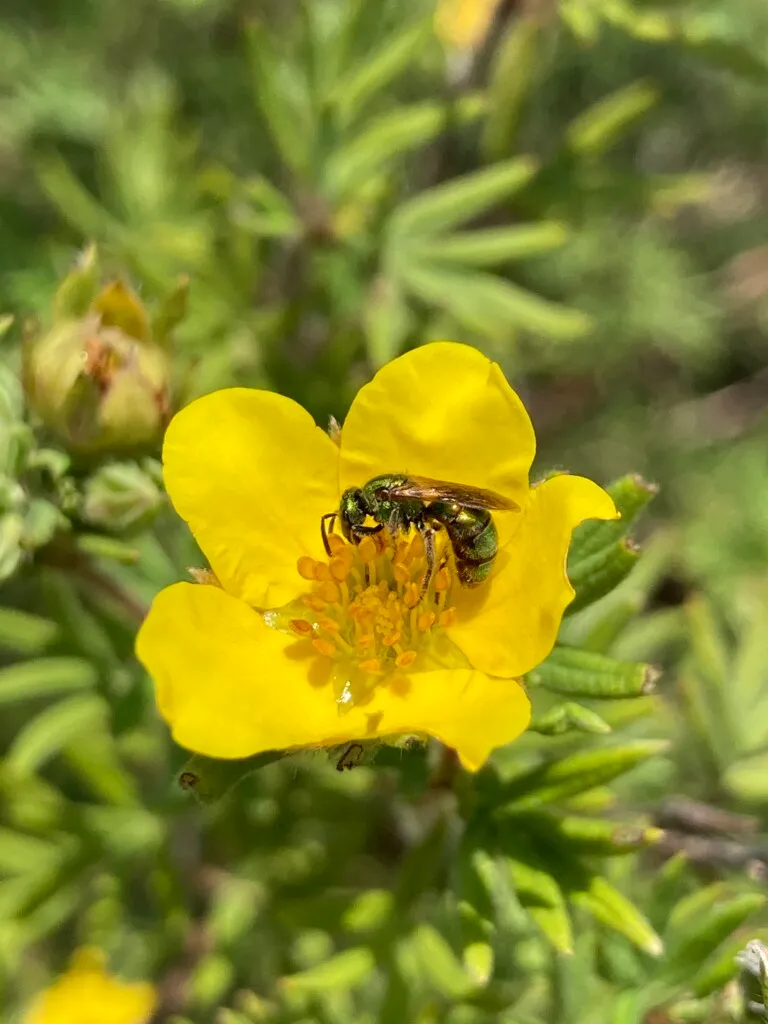
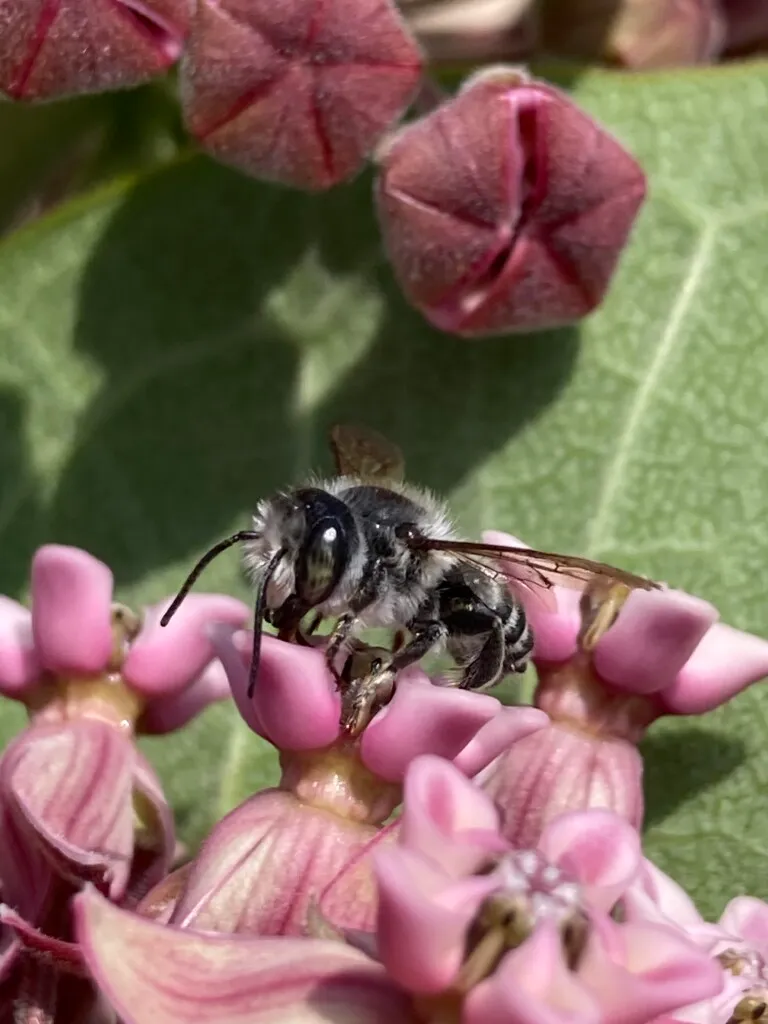
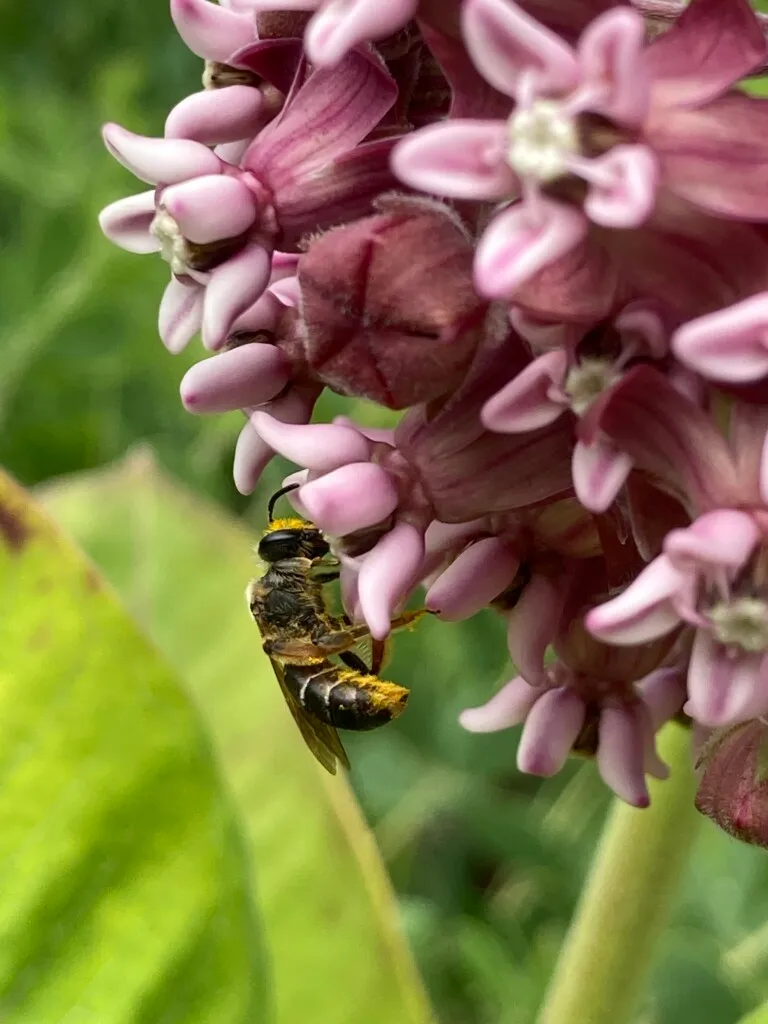
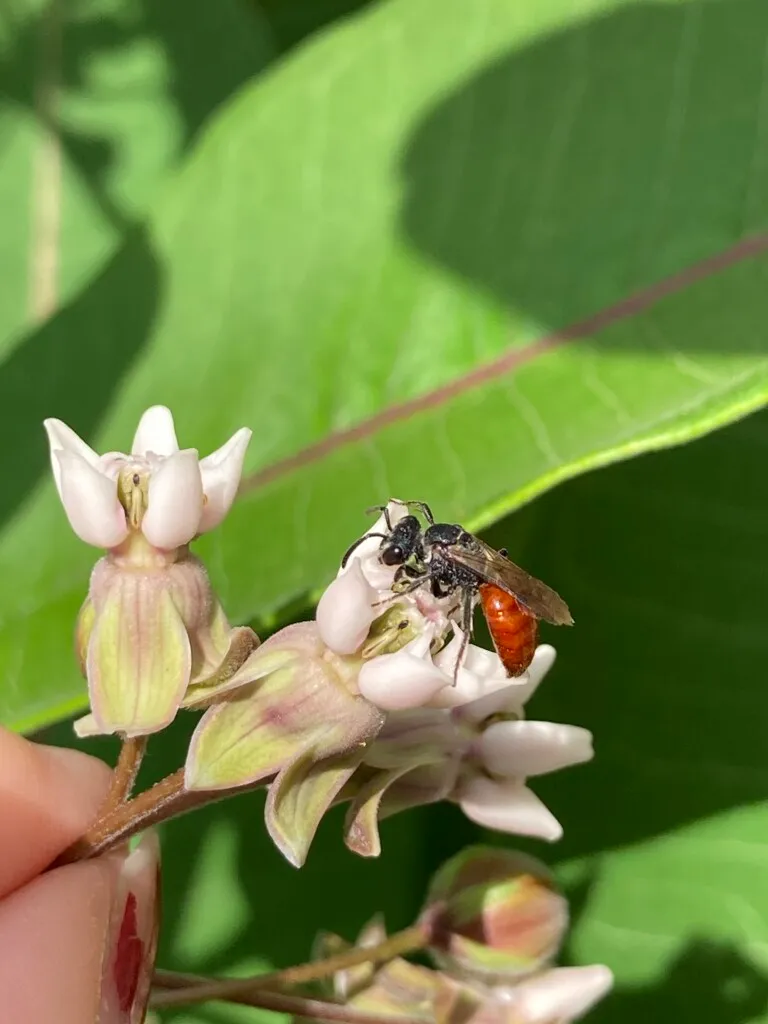
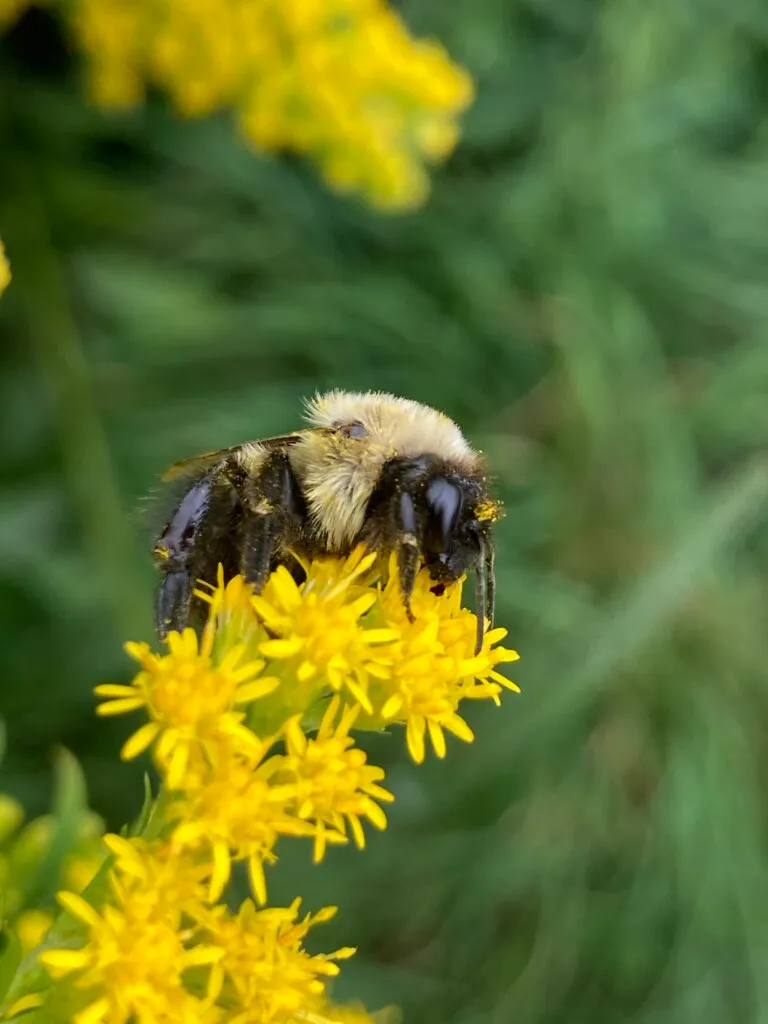
The result of these efforts is quite the buzzing Sanctuary. As a Summer Naturalist, I documented 25 bee species on Ridges property from May through August alone. That’s a lot of bees! Even more, these species are members of five of the seven bee families: Andrenidae (ground-nesting bees), Apidae (bumble bees and honey bees), Colletidae (plasterer bees), Halictidae (sweat bees), and Megachilidae (leaf-cutter bees). To my surprise, many species I documented don’t fit the bill for what we traditionally think of as a bee: large, yellow, and fuzzy like flying teddy bears (think bumble bees). Most were about the size of my thumbnail, sporting metallic greens, browns, or reds. Some were black and shiny like a small wasp – or they had thick scopa (pollen-collecting hairs) on the underside of their abdomens.  

L to R, Top to Bottom: 1. Flat-Tailed Leafcutter Bee (Megachile mendica) 2. Golden Sweat Bee (Augochlorella aurata) 3. Texas Leafcutter Bee (Megachile texana) 4. Wilke’s Mining Bee (Andrena wilkella) 5. Davis’s Cuckoo Sweat Bee (Sphecodes davisii) 6. Brown Belted Bumble Bee (Bombus griseocollis). Photos by Libby Humphries.

While conducting this summer project, it occurred to me that the world of bees is extremely diverse – so why is the focus of “save the bees” campaigns often solely on honey bees? Well, we’re more intimately involved with them compared to wild bee species. Humans have been domesticating the western honey bee (Apis mellifera) since at least 2600 BC–that’s 4,623 years of beekeeping! It’s no wonder that when we think of a bee species worth “saving,” the honey bee comes to mind first. After all, we’ve used them for major agricultural pollination since the early 20th century. In reality, honey bees aren’t the only bees we need to be worried about. 

Honey bees are a non-native introduced bee species; they were brought over to the Colony of Virginia from Europe in the early 1600s. Because Apis mellifera is a domesticated bee species, hives are under the constant care of beekeepers. Thus, they needn’t worry about finding food and shelter. In comparison, there are 3,600 native species in North America that have been here for thousands, if not millions of years. They have to fend for themselves, relying exclusively on their environment for foraging resources, nesting habitat, and overwintering. This fact has contributed to their devastation; habitat destruction is killing our bees. According to the Xerces Society, a non-profit focused on invertebrate conservation, 28% of North American bumble bee species are considered threatened by the IUCN. Even more alarming, 40% of invertebrate pollinators are at risk for extinction in just the next few decades. A loss of pollinators to this degree could spell disaster for species beyond those with six legs.

It’s important to note that wild animals are as dependent on native bees for their food as we are on honey bees. Their pollination efforts create nuts, seeds, fruits, and foliage for the individuals in their environments. Even bees themselves are a tasty snack for those who dare. Simply put, they are a key source of energy in our ecosystems. Without them, both predator and prey would see detrimental effects.   

While the looming threat of extinction is intimidating, all hope is not lost for these bustling creatures. As environmental stewards, we can restore and conserve native habitats so our bees can thrive. Native bee species have co-evolved with the plants in their environment, meaning that their pollination methods are the most efficient on native flowers. They’re also messy! Compared to honey bees who store compact pollen on their hind legs, wild bees usually carry pollen as dry grains all over their bodies. When they go from flower to flower in search of nectar, some of these pollen grains fall off and pollinate the plant. By landscaping with plants that grow in your specific ecoregion, you’re feeding the bees and your environment. How great is that?  

The pollinator work we do at The Ridges wouldn’t be possible without the efforts of citizen scientists in our community. If you’re interested in learning more about citizen science at the Sanctuary, please join us for our first annual Citizen Science Symposium on October 21 from 9:00 am to 12:00 pm. Reports and anecdotes from The Ridges Sanctuary, Crossroads at Big Creek, and Door County Land Trust will serve as celebration of a successful field season. 


Additional Resources: 

Wisconsin’s Bees/Bee Identification 

https://wiatri.net/inventory/BBB

Native Plant Lists 

https://xerces.org/publications/plant-lists/native-plants-for-pollinators-and-beneficial-insects-midwest

https://xerces.org/publications/plant-lists/native-plants-for-pollinators-and-beneficial-insects-great-lakes

Sources:  

https://www.xerces.org/blog/want-to-save-bees-focus-on-habitat-not-honey-bees

Crane, Eva (1999). The World History of Beekeeping and Honey Hunting.

Nature Notes: Monarch Madness

A symbol of summer, monarch butterflies are widely recognized for their bright orange, black, and white spotted wings. Their scientific name, Danaus plexippus, translates to “sleepy transformation” in Greek, referring to their incredible ability to metamorphosize. From their larval stage, they form a chrysalis, spending two weeks metamorphizing into an adult butterfly. The tiny, delicate monarch butterfly not only transforms itself but takes on an amazing feat each year. Monarchs migrate between 1,200 and 2,800 miles to the mountains of central Mexico, where they overwinter. There, they gather in the millions to rest, with tens of thousands of monarchs resting on a single tree. In the spring, they make the journey back north, making it to the southern United States to lay eggs. These eggs are the first generation of the next year’s monarch population, slowly making their way northward.

For many people, including myself, monarchs hold more meaning than the symbol of species conservation. I can recall finding monarch butterflies in my grandmother’s field as a little girl. We would collect the small caterpillars, put them in an enclosure made with wood and mesh, and pick milkweed leaves for them until they were big enough to form a chrysalis. Caring for monarchs taught me about the need for native wildflowers (like milkweed) for butterflies and other pollinators. It also taught me patience – a required skill for monarch rearing and a skill not often developed in 3-year-old children. Now when I see monarch butterflies, I think of my grandmother. Many others had similar experiences as children, whether it be with a parent, grandparent, or teacher in an elementary classroom. We’re also lucky to be able to rear monarchs here at the Ridges, sharing the lifecycle of the butterflies with children and families who visit the Nature Center!

While monarch rearing is a contribution to the conservation of the species, staff at the Ridges also contribute to the yearly data on monarch butterfly populations during their migration south, through the southern United States, and down to central Mexico. Every year, the Ridges receives tags from the non-profit organization Monarch Watch, which we apply to the migrating monarch butterflies before they are released at the end of August. Scientists in the southern United States and in Mexico collect monarchs with these tags and record them. This way, we can identify monarchs that have migrated from Door County all the way down to their winter habitat! This data also contributes to data sets that tell us about monarch migration patterns and population sizes from year to year.

From what I’ve been able to observe during my time spent outside, monarchs are back this summer in what appear to be much greater numbers! Last year, we struggled to find monarch caterpillars on the milkweed within the Ridges. I also noticed significantly fewer monarch butterflies the previous year (2021). However, this year, I regularly see multiple monarchs fluttering around the front gardens of the Nature Center on my way in to work. Research has shown that single weather events can have a huge impact on monarch populations from year to year, particularly, deviations from the mean temperature and precipitation (Monarch Watch Blog, 2023). For example, drought results in a shortage of milkweed, on which monarchs rely throughout their lifecycle. A late spring snowstorm could also impact monarchs migrating to northeastern states.

Based on 2023 data from monarchwatch.org, the migrating populations are expected to remain similar to populations in the last decade. However, the season isn’t over. There are still plenty of factors at play. In a recent newsletter from the organization, Jim Lovett stated, “The size of that generation [migrating south] will largely depend on the temperatures, nectar availability and quality and abundance of the milkweeds in the breeding areas north of 40N” (Monarch Watch July 2023 Newsletter). It’s important to collect data on monarch populations each year to learn more about population trends. Monarch butterflies have been in decline for many years, with statistics varying from 22% decline to 90% decline (IUCN, Monarch Watch). The large variation in percentages is likely due to the lack of data on monarch butterflies. In 2022, monarchs were added to the IUCN’s Red List as an Endangered species. Collecting data will help us determine how to best conserve the species and other important pollinators.

There are so many ways to protect monarch butterflies and other native pollinators! Come learn about what you can do at our annual Monarch Madness event on August 26th. Ridges staff will be in the Nature Center to answer questions and teach visitors about monarch caterpillars and butterflies. We’re starting the day with a monarch-themed Story Hour at 10:00am outside the Nature Center for young children and their families. After Story Hour, we’ll be hosting a monarch tagging event from 11:00am-1:00pm. During the event, visitors can sponsor a monarch butterfly for $5. This includes tagging and releasing the butterfly. We do have a limited number of monarch butterflies available to tag, so plan to get to the Center promptly at 11:00am if you’d like to sponsor a monarch. In addition, we will be offering tags for $5 each to take home and tag monarch butterflies in your community!


Learn more about Monarchs:

https://monarchwatch.org/conserve

https://monarchwatch.org/blog

https://www.worldwildlife.org/species/monarch-butterfly

https://www.fws.gov/initiative/pollinators/monarchs

https://www.iucn.org/press-release/202207/migratory-monarch-butterfly-now-endangered-iucn-red-list

https://www.fs.usda.gov/wildflowers/pollinators/Monarch_Butterfly/conservation/index.shtml#:~:text=Working%20with%20Local%20Communities&text=Deforestation%20threatens%20the%20wintering%20habitat,ways%20to%20supplement%20their%20incomes.

https://xerces.org/monarchs

Nature Notes: Hine’s Emerald – The Hidden Gem of the Sanctuary

Did you know that one of the most precious species of The Ridges Sanctuary is the Hine’s emerald dragonfly (Somatochlora hineana)? This winged wonder is listed as Federally endangered and its largest populations are found in Door County, particularly in The Ridges Sanctuary and surrounding wetlands. In fact, the Hine’s emerald dragonfly is among the most endangered dragonflies in the United States due to many factors, including groundwater contamination and depletion. Door County populations rely heavily on the critical habitat we have here in Baileys Harbor. 

When they became the first (and so far, the only) dragonfly placed on the Federal Endangered Species list in 1995, not much was known about their natural history. Since then, researchers at a variety of state and federal agencies in Illinois and Wisconsin have filled in a lot of the gaps. At the Ridges, field studies of the number and behavior of Hine’s emerald dragonflies, along with obtaining photographic records, have been conducted.  

Our mission at The Ridges is to promote positive environmental behaviors through impactful educational experiences, land management and protection, and ecological research. The Ridges continues to ensure the protection of the Hine’s emerald and its surrounding habitat at the Sanctuary by doing just that. One example being the recent purchase of Ridges Inn parcel to protect Hidden Brook, which bisects the Ridges property and is critical habitat for the endangered Hine’s emerald.  

Other impactful ongoings include ecological research of habitat/loss of wetlands through citizen science and place-based adult and youth educational programming. Volunteers and staff contribute to Water Action Volunteers stream monitoring regarding stream health and water quality, which directly impacts Hine’s habitat. Youth programming (i.e., Ridges Forest School, Tiny Trekkers, and Backpack Adventure Camp) incorporates learning about and monitoring the habitats of this species. Where and why does this species live here? Why do they like our swales? Why is it a species of concern? How can we protect this species and its habitat?  

The Ridges and surrounding landscapes have been recognized as the most biologically diverse area in the State by the Wisconsin Department of Natural Resources. With a distinctive topography of low, sandy ridges, alternating with wetland areas of swales, it is no wonder that this species has found a home here at The Ridges.  

The life cycle of a Hine’s emerald dragonfly is similar to most dragonflies in that it is comprised of the following stages: aquatic egg, aquatic larva, and a terrestrial/aerial adult. Dragonflies live in wetland habitats. The Hine’s play a crucial role in maintaining the health of our swales, and their presence is essential for their success. Dragonflies are important to wetland ecosystems because they act as an indicator of wetland health. A canary in the coal mine, if you will. If you see a lot of dragonflies in a wetland habitat, it’s presumably very healthy.  

After an egg is hatched, the Hine’s spends four to five years in its larval stage. Young Hine’s nymphs live in shallow, cool, slow-moving water (i.e., Swales!). Throughout this time period, the Hine’s survival is dependent on sustained groundwater quality and quantity that is fed through karst bedrock into coastal wetland habitat. There are 12 areas on the peninsula that have been designated as critical habitats, but there are also additional sites where Hine’s have been identified. Hine’s emerald dragonfly larvae survive dry periods and winter months with some risk in tow – by hiding in crayfish burrows, one of their main predators. 

If they make it to the completion of larval development, the adult dragonflies emerge and take to the skies in mid to late June. You’ll find many of these dragonflies zipping around in the hot summer months while they mate and carefully lay eggs for the next generation of the species.  

These dragonflies are about 2.5 inches long and have bright emerald green eyes. According to USFWS, dragonflies and damselflies are characterized by two pairs of large membranous wings; large compound eyes; short, bristle-like antennae; chewing mouth parts; slender, elongated abdomens, and male secondary reproductive organs. 

While we could get into the technical scientific jargon of its description, as a Ridges Educator who works with youth programming in the Sanctuary, I wanted to hear a different perspective on this gem of a species. On a recent stream day exploration, Backpack Adventure campers found dragonfly larvae and immediately had questions. I asked some of our campers, who witness this species firsthand at all variations of its life cycle, how they see and would describe the Hine’s emerald:  

“It has long wings. Looks more like a helicopter with a bigger end on one side and skinny on the other side.”  

“I really like its eyes. They are very pretty and very colorful but kind of weird and shiny. I feel bad for endangered animals, though.”  

July and August present the best opportunities to observe these dragonflies up close and personal, especially along the “dragonfly run” aka Sandy Swale. We recommend visiting on a hot and sunny day for the best chances of seeing these majestic beauties. 

To learn more about this endangered species and the research conducted by Dr. Dan Soluk in Door County, check out the sources below, including a great article by Craig Sterrett, published by The Peninsula Pulse.  

Sources:  

https://doorcountypulse.com/door-countys-green-eyed-success-story/ (Check out this great article!)  

https://www.fws.gov/species/hines-emerald-somatochlora-hineana

https://www.fws.gov/species-publication-action/initiation-5-year-status-reviews-five-listed-animal-species-0

https://www.nature.org/en-us/about-us/where-we-work/united-states/wisconsin/stories-in-wisconsin/protecting-hines-emerald-dragonfly

https://uwm.edu/field-station/hines-emerald-dragonfly-the-backstory

Nature Notes: Research + Recovery: Protecting and Preserving Native Orchids

The Ridges Sanctuary has tremendous plant diversity including native terrestrial orchids.  Following the idea that “lack of knowledge is as big a threat as any to sensitive species,” (Brzeskiewicz, M. September 25, 2000), The Ridges Sanctuary has the current research goal of developing institutionalized processes and protocols for the preservation and protection of native plant species. Because of our organization’s deep-rooted relationship with orchids, it was determined that orchid research and recovery would be the priority of our endeavors. We are currently working on orchid inventory, trying to understand specific environmental conditions for orchid growth and reproduction, asymbiotic germination techniques, shade house orchid growth, and determining the best possible restoration locations in our Hidden Brook living laboratory area.

Our amazing team of orchid trekkers is on a quest to locate as many orchids as possible that are naturally growing in The Ridges Sanctuary. Thus far, 29 species have been identified, with certain species recorded for the first time in Door County. This tenacious group recorded over 6,000 individual orchids last year, representing 21 different species, some of which are listed as either threatened or of special concern.

Currently, we have deployed 16 HOBO monitors that are dedicated to the Ram’s Head Lady’s Slipper restoration project. Through grant funding and gracious private donations, these electronic monitors are collecting data on light values, soil temperature, and soil moisture which provide information about abiotic environmental parameters for orchid growth and reproduction. In combination with the specific plant data collected by our dedicated citizen scientist plot monitors, our statistician is crafting a picture of the Ram’s Head “sweet spot” that will determine where out planting has the best possible chance of success for this threatened orchid.

Following germination, the seedlings are reflasked in media, grown for months, vernalized for a selected time period in refrigeration, and planted in the shade house for transition. Ultimately, out planting of these orchids for population restoration/translocation will include extensive monitoring. Almost all orchids in the wild require a fungal partner for seed germination. Because of our current mycological limitations, we are using techniques developed by partner organizations to germinate orchid seeds in the absence of this fungal partner for our restoration/translocation needs.  We will continue this asymbiotic approach until we have more data on the actual fungi needed for our orchids to germinate. This protocol includes hand pollination, seed collection, and experimenting with technique modifications to maximize orchid seed germination.

The orchid shade houses were established and are maintained by another group of citizen scientists. These folks planted the orchid seedlings and ensure that the plants are watered and the flats weeded throughout the season.  This group also sets up the houses in the spring and strikes them in the fall, tucking in the orchids for the winter. The shade houses are important for our vernalization experiments and provide an opportunity for our guests to view three species of orchids in one spot, with great photo possibilities.

Orchids are fascinating plants that have evolved unique characteristics dependent on a multitude of factors that determine their survivorship. As some of these specific parameters are undergoing change, our hope is that the knowledge we are gaining through this project will contribute to the conservation of this marvelous group of plants.

If you have any interest in participating in citizen science programs, or want to learn more, contact Tony Kiszonas, Director of Research, at tony@ridgessanctuary.org.

Nature Notes: Evergreens & The Boreal Forest

While Trillium, Yellow Lady’s Slippers, and Columbine are starting to unfurl in wooded lots along the peninsula, Dwarf Lake Iris and Marsh Marigolds are on display in the Sanctuary. Throughout the year, Ridges blooms trail slightly behind the rest of Door County. In fact, it’s about 10 degrees cooler in Baileys Harbor than anywhere else in the county on any given day in the summer. The southern facing harbor— the only one on the peninsula— is subject to cool winds travelling all the way up Lake Michigan. This microclimate allows evergreen trees to thrive in the cool, sandy soils of the Sanctuary.  

Baileys Harbor is one of the southernmost boreal forests in the United States. Boreal forests are characterized by plants that have adapted to long, cold winters. Pine, spruce, fir, and other conifer (cone bearing) trees dominate the forest. Their small needles have a waxy coating (with the exception of tamaracks) that allows them to withstand harsh winter weather. No matter what time of year you walk through The Ridges, the forest canopy is green.  

Meet Some of the Conifers of The Ridges: 

White Pine: White Pine trees have 5 needles in a bunch (think of the word w-h-i-t-e to remember 5 needles). Their bark is greyish in color. You’ll often see them along shorelines and wetlands, wind swept and towering above the other trees around them.  

Red Pine: Red Pine trees have 2 needles in a bunch. Their bark is distinctively reddish colored and scaley. 

Balsam Fir: You’ll often find Balsam Fir trees growing where blowdowns have occurred. With branches shaped like snowflakes and short, flat needles, they resemble your classic Christmas tree (and are often harvested as one, too!).  

White Spruce: Spruce trees have needles that grow on the top side of the branches. The needles are very stiff and can have blueish undertones. When I was younger, I learned to tell Spruce apart from other trees because they “don’t like to shake your hand!”

Eastern Hemlock: Hemlock trees tend to shade out any plants on the forest floor. They produce tiny little cones at the ends of their branches. Their needles are very short, growing flat along each branch. If you look at the underside of a hemlock branch, you’ll notice the needles are a silver color on the bottom!  

Tamarack (also known as Larch): Unlike the other conifers of The Ridges, tamarack trees are deciduous conifers, meaning they lose their needles in the winter! For about a week in November, tamaracks turn a bright golden color, illuminating the trails and roadsides in Baileys Harbor. The bright green needles of the tamarack are just starting to grow back at this time of year. Unlike the Spruce, Tamaracks are the perfect tree to give a little pet as you walk by.  

Conifers provide shelter for many animals in the Sanctuary. Many migrating warblers will nest in conifer trees because of the protection they provide. As birders who are familiar with the area will tell you, it can be difficult to see many of the birds in the Sanctuary. However, you can almost always hear a symphony of songbirds as you walk the trails! Conifers are also an important food source for animals, especially during the winter. It’s not uncommon for deer to graze on conifer branches and seedlings during the winter months. Porcupines also like to munch on the branches and bark of evergreen trees. In addition to providing shelter for the fauna of The Ridges, conifer trees also contribute to the conditions which allow the 29 species of orchids to grow here as well as several other species of flowers that are not found anywhere else on the peninsula.  

***All photos from the Wisconsin Herbarium’s Key to Trees 

You can learn more about conifers at our Cozy up to Conifers field trip during our Festival of Nature! We’ll begin in the cabin, learning important features of each conifer then head out on the Ridges Sanctuary trails to practice identifying various species. By the end of the hike, you will be able to distinguish black from white spruce, balsam from hemlock, red from white pine and more. The hike will be a leisurely two miles. Hand lenses will be supplied or bring your own. Wear shoes appropriate for hiking. Suitable for ages 16 and up. Fee: $30. To register, call 920-839-2802.

Want to learn more about the ecology of The Ridges? Check out our other Festival of Nature events at www.doorcountyfestivalofnature.org.  

In the News: Ridge and Swale: A Story of Conservation

Filmmakers tell stories of those who fight for the land

For many people, to visit Door County is to fall in love. The peninsula’s remarkable wild and rugged landscape attracts and captivates scores of visitors, and many hold it close to their heart. If you’ve strolled along a rocky lakefront bluff or discovered a delicate wild orchid in the woods, you understand.

But there can be peril in holding something too closely. Although tourism is the lifeblood of Door County’s economy, human pressures threaten the very beauty that brings people here.

Fortunately, there’s another story unfolding in the area, and it’s being shared through a new Peninsula Filmworks project called Ridge and Swale. It tells the story of conservation in Door County – a remarkable history of the steps taken to protect the character of the county and, in turn, how those steps have shaped it. It’s the reason those bluffs and orchids are still out there, waiting to be discovered.

The filmmakers say it’s a story that needed to be shared.

“It’s a passion project,” said David Eliot, the project’s producer. “A lot of people complain about all the new development. We thought there was an opportunity for a story that [acknowledges that] there is a lot of development, but boy, there is a lot of conservation, too – the amount of space [protected] and the history of the people who had the foresight to set aside these natural places and preserve them for future generations. It seemed like a really great story to tell.”

Ridge and Swale is scheduled to be released this year on Earth Day, April 22, with a special public showing. The docuseries will also be available for viewing online.

The filmmakers had planned and researched the project for years, before formally undertaking the bulk of filming in 2022. Director Brett Kosmider said he hopes the film inspires future generations to become involved in protecting the county’s resources – or at least pay attention to what’s at stake.

“I think it’s presumed that Door County’s open spaces will always be there,” Kosmider said. “When you look around, you see the bucolic countryside. Whether it has ecological value or not, it’s the character of Door County, and it’s quickly disappearing.”

Thanks to community conservation work that has spanned decades, however, many places are now protected forever.

Ridge and Swale explores the people and places behind Door County’s conservation and education success stories, detailing entities such as Peninsula, Newport and Potawatomi State Parks; The Ridges Sanctuary; and The Clearing Folk School.

“There are all sorts of interesting stories that I’ve spent the last few years digging into and researching,” Kosmider said. “When you are finished watching it, I hope you will have a greater appreciation of what it took – what people had to do before us to make sure these places were saved for the future generations.”

Kosmider said that although many of the places featured in the film are well known, when you dig beneath the surface, there are some surprising and fascinating stories.

For example, Ferdinand Hotz was a diamond merchant who was once the largest landowner in Door County. Although he amassed large holdings, he preserved them in a natural state, and after he died, his family sold a huge, largely undeveloped property to the state of Wisconsin. The parcel included more than 10 miles of shoreline that’s now known as Newport State Park.

“That’s why we have a state park – from [Hotz’s] ethic,” Kosmider said. “He was a diamond merchant, but he was a conservationist as well.”

Conservation efforts have sometimes faced opposition. Kosmider said there were residents who opposed all of the county’s state parks, and there was one  – Grand Traverse Islands State Park – that was championed but never developed. Still, many preservation efforts persevered.

Peninsula State Park was founded in 1909 with the goal of providing recreational opportunities. Kosmider said the park’s creation was driven by legendary landscape architect and planner John Nolen, and championed by state Assemblyman Thomas Reynolds of Jacksonport, who recognized the need to protect the land for posterity.

“Places like Door County would get snapped up by the ultra-rich for their private playgrounds,” Kosmider said. “[Peninsula State Park] was seen as a way to allow the common person to enjoy the land and take a vacation.”

Kosmider said vacations were a new concept in the early 1900s.

“Peninsula State Park was created just for that, so people could come here,” he said. “Perhaps they didn’t have the means to buy 80 acres on a lake, but they could come up here and go camping.”

Recreation was the early focus of preservation efforts, but a shift took place during the 1930s. On land that’s now The Ridges Sanctuary in Baileys Harbor, a Milwaukee botanist recognized rare orchids and began leading tours. In 1937, the property became Wisconsin’s first land trust.

Andy Gill, executive director of The Ridges Sanctuary, said his organization is proud to be featured in the film project. He said during the 1930s, people recognized the unique habitat and the beauty of The Ridges, and they organized a grassroots effort that led to the property being saved.

“I’m a little biased, but I do think it’s one of the best conservation stories that we have in Wisconsin,” Gill said. “It’s one of the reasons that all of these conservation organizations are able to exist today. The start of the conservation movement from an organization basis really got started at The Ridges, and we’re really proud of that history.”

Julie Gilbert, president and CEO of Destination Door County, said her organization was also excited to support Ridge and Swale.

“When we spoke with Peninsula Filmworks about this program, we were all in,” she said. “If we don’t support and take care of our environment and natural resources, they will not sustain who we are as a community and as a visitor economy. It’s just very important.”

Gilbert said Door County’s natural and business resources have been stressed by the large influx of visitors who sought to get out of urban areas during the pandemic. In response, Destination Door County launched efforts such as Care for Door County, a campaign that includes cultural, quality-of-life and eco-focused initiatives.

“We have worked very hard in being extremely mindful in how we can balance the visitor experience, as well as our residents’ [needs] in order to be sure that everybody can enjoy the beauty and the natural resources that we have,” Gilbert said.

Destination Door County is intentional about attracting “high-value” visitors who want to become part of the community, Gilbert said.

“The people who come here, many of them have been coming here over generations,” she said. “Second- and third-time, fourth-time visitors, they also see their impact and want to take care of the place that we call home because they love it as much as we do.”

Kosmider said that visitors have long played an important part in protecting natural areas, and he expects that to continue.

“If we close the doors to Door County, in my opinion, we’ll have a greater chance of losing these special places because we won’t have that awareness,” he said. “With awareness, people can say, ‘I want to help preserve this place. How can I help?’”

Eliot agrees. He said that although there’s a perception that visitors have destroyed the county, visitors have also played a critical role in preserving natural places.

“A lot of [conservation] came from people who came up here on vacation and realized, ‘Boy, we had better protect this before it goes away,’” Eliot said. “There is always the potential here of loving things to death, and in some respects it is happening, but at the same time, there are people who came to Door County because they loved it, and they worked to preserve it, too.”


Click here for original post

Nature Notes: A Sedge of Cranes

Have you traveled to Nebraska to experience the sandhill crane migration? If not, I highly recommend it!  

A few weeks ago, I was fortunate to visit the Iain Nicolson Audubon Center at Rowe Sanctuary to experience the humbling migration of sandhill cranes. When I say humbling, I mean humbling -overwhelming – magnificent – empowering – spectacular! It was anything but usual. Living in northeast Wisconsin, I’ve been entranced seeing just a few cranes in a cornfield. Sometimes seeing as many as 10-20 cranes in a field sharing a meal, doing a mating dance, and teaching their young a thing or two about being a crane. It is such a treat to stop and simply watch. I’m inspired every time I see these birds locally, and I was especially excited to experience cranes in a different context. 

We were lucky to participate in a guided experience with volunteers of the Rowe Sanctuary. We arrived at the Sanctuary just before 6am. It was a chilly morning (11 degrees Fahrenheit) but we didn’t mind. There were easily 100 people convening at the Sanctuary that morning, preparing to see something truly spectacular. People were visiting from all over. Some had visited before, some (like myself) were preparing to experience this phenomenon for the first time.  

We were separated into smaller groups and linked up with our volunteer guides Dudley and Barbara.  Dudley started out our experience by telling our group that he has lived in the area his whole life and has been volunteering at the Sanctuary for over 50 years. Dudley and Barbara reminded me of the incredible volunteers we have here at The Ridges. They were passionate, inspired, and absolutely loved what they were doing.  

Dudley and Barbara took us on a short walk (in the dark) to a nearby bird blind. The blind was large and comfortable and positioned us in the perfect place to look out at the Platte River. We were instructed to remain absolutely quiet and simply wait for the sun to rise. We were prepared before we went out that there could be any number of cranes in the proximity of our bird blind – ten, hundreds, thousands – we just wouldn’t know until it was light enough to see. As soon as we arrived at the blind, and in the still darkness, we could hear the soft trills of a few cranes. We thought there were maybe 10-15 cranes in our view and were excited for it to get lighter so we could see more. We spotted a muskrat and some Green-winged Teals directly in front of the blind. As the sun rose, the soft trills of the cranes got louder. About 15 minutes after we thought there were 10-15 cranes, we realized there were more like a few hundred. And as it got even brighter out, we were clearly corrected by our observations. There were easily more than 100,000 in our view. What we thought were riverbanks were lines of cranes packed into a single corridor. It was spectacular! The brighter it got the more active the cranes became. Communicating with each other for what we jokingly described as “making their plans for the day.”  

As the morning went on, we caught sight of a bald eagle feeding near the cranes. We were intrigued by the sight, and wondered if the cranes would be threatened by the eagle’s presence. Dudley explained that bald eagles are a predator of cranes but will only pursue injured or vulnerable birds. The cranes seemed fine with the eagle’s presence while it was stationary and feeding. However, the moment the eagle took off, the cranes dispersed. It was SPECTACULAR! Thousands of cranes taking off all at the same time, to seemingly stay away from the eagle. Many cranes stayed behind and once the eagle landed, they seemed to calm down and went back to their conversations. Again, the eagle took off and spooked another grouping of birds. This happened a number of times before the eagle finally left the area, leaving the cranes alone.    

Between the magnitude of cranes, the eagle, and the general river life, we had a great deal of entertainment. We could have stayed all morning to see the activity, but was clear that the birds were ready to head off to their feeding grounds, before coming back in the evening to sleep off the day of activity.  

We began our trek back to the nature center and were ready to ask Dudley as many questions as we could. Dudley was kind to share his time with us. While we were observing the cranes, there was a low-flying plane that caught our attention. We were curious if this had anything to do with the cranes, and Dudley excitedly explained the purpose of the plane. The plane was part of a count study that is being conducted in the area. Each morning the plane heads out with “certified counters” to get a good idea of how many cranes are along the Platte River. The birds are counted by reviewing 5-second images, and determining how many cranes are in the photo. One strategy used by counters is they figure out how many cranes fit under your own thumb and indicate how many “thumbs worth of cranes” are in the photo. These counters are so skilled that when they check their work after flight, they are accurate within 1,000 birds. This is a significant success considering in a recent count, they recorded more than ONE MILLION cranes! During our walk back, Dudley took the time to share with us some of the important citizen (community) science research being conducted throughout the Platte River Valley. The commitment of the volunteers, staff, and community was inspiring and has further supported the sandhill crane populations.  

This was an experience I will never forget. To be in the presence of one of the largest congregations of a single species of bird on the planet was humbling. These birds are preparing for a continued journey to their nesting grounds in the Dakotas and Canada. From here they’ll spread out, but for a short time, they come together and prepare for a continued journey. And each year, they’ll convene in the same place, where the food is good, and the habitat is perfect. I’ve already made plans to return and am excited to interact with these majestic birds throughout the Door County spring/summer season.  

Learn About Cranes in Door County:

Door County hosts one of Wisconsin’s two crane species: Sandhill Cranes. Their calls, also known as bugles, are often the first signs of spring here in Door County. They begin to appear in farm fields in mid to late March, returning from their winter habitat in the southern United States. Cranes make nests from vegetation in wetland habitats such as swales, bogs, and marshes. Sandhill cranes mate for life, making elaborate courting dances to find their life partners. Cranes usually produce 1-3 eggs every nesting season. You can often see young cranes with their parents foraging for insects and plants in farm fields and wetlands throughout the county in the summertime.  

If you grew up in Door County, or anywhere in Wisconsin, you may not remember Sandhill Cranes from your childhood. In fact, there were no recordings of cranes in Door County until 1980. Due to conservation efforts, populations of Sandhill Cranes have increased over the second half of the 20th century, and cranes have made their way into northern Wisconsin wetlands!  

Want to learn more about Sandhill cranes? You can learn more about their behaviors, habitats, and population resurgence during our Crane Symposium on April 14th and 15th.  

 Join us in celebration of Wisconsin’s cranes on April 12th and 13th!

Together we’ll explore cranes through art, learn why populations have been increasing in recent years, learn about the importance of protecting crane habitat, and have the opportunity to participate in citizen science!

Midwest Crane Count

April 12 @ 5:30 am – 7:30 am 

The International Crane Foundation sponsors the Annual Midwest Crane Count as a part of its mission to conserve the world’s 15 species of cranes and the natural communities on which they depend. Observations of Sandhill Cranes can lend insight into threatened crane species, including the endangered Whooping Crane. Breakfast Social will follow for Crane counters at the Cook-Albert Fuller Nature Center from 8:00 am – 9:00 am. Please email anna@ridgessanctuary.org to RSVP.

Location: Sites throughout Door County – Fee: Free Event 

Contact Tony Kiszonas for more information at (920) 839-2802 extension 104. 


Crane Nest Habitat Hikes 

April 12 @ 10:00 am – 11:45 am and 1:30 pm – 3:15 pm

April 13 @ 10 am – 11:45 am

Join Naturalists Jane Whitney and Julie Knox on a hike to a potential crane nesting site to learn about crane nesting sites and what makes the wetlands of Door County the perfect crane nesting habitat. 

Location: Meets at Cook-Fuller Nature Center, 8166 State Hwy 57, Baileys Harbor – Fee: $15 Public | $12 Member | $7 16 & Under 

Register here.


Keynote Presentation and Reception

April 12th @ 4:00 pm, followed by Keynote Presentation @ 5:00 pm 

Visit The Ridges for a reception to see artwork by photographer Len Villano highlighting sandhill cranes found in Wisconsin. Drinks and hors d’oeuvres will be available while you enjoy the exhibit. A Keynote Presentation by Anne Lacy, Director of Eastern Flyway Programs – North America for the International Crane Foundation. Anne will address the future of North American cranes and efforts to protect them, particularly the sandhill crane given the recent proposal for a hunting season.

Location: Meets at Cook-Fuller Nature Center, 8166 State Hwy 57, Baileys Harbor – Fee: Free, however space is limited and pre-registration for the Keynote Presentation is required.

Register here.


Chick Chats Story Hour 

April 13 @ 9:00 am – 10:00 am

Bring your budding birders and naturalists to hear Ridges staff read stories and learn about why sandhill cranes make the long journey north each spring and how they do it. This program includes information about cranes and fun activities to excite kids about this special family of birds. At the end of the story, you can make a fun nature craft. Suitable for families with young children.

Location: Cook-Fuller Nature Center, 8166 State Hwy 57, Baileys Harbor – Fee: Free Event 


Kids Birding 101 

April 13 @ 10:00 am – 11:30 am 

Interested in birding as a family? Join us for a fun program where kids will learn the basics of bird watching, including how to identify common birds found in Door County. We’ll begin at the Nature Center for a brief introduction before heading down the Hidden Brook Boardwalk to see what birds we can spot. Suitable for families with young children.

Location: Cook-Fuller Nature Center, 8166 State Hwy 57, Baileys Harbor – Fee: Free Event


Want to learn more about cranes? Here are some great resources!

https://savingcranes.org

Cranes in Wisconsin: Past, Present, and Future 

https://dnr.wi.gov/topic/EndangeredResources/Animals.asp?mode=detail&SpecCode=ABNMK01030

Nature Notes: The Silent Art of Owling

Owls of Interest

Last February, we wrote a blog all about the common species of owls found in Door County. Common owls in Door County include the Barred Owl, the Great Horned owl, the Eastern Screech-Owl, the Saw Whet Owl, and the Snowy Owl.

Unlike most tourists that visit Door County, Snowy Owls only visit northern Wisconsin in January and February. They make their way down from their breeding grounds in the Arctic to spend their winters in a “warmer” climate. You’ll likely never hear a Snowy Owl call. They’re often on fence posts or telephone poles near or in open fields, where they hunt in the winter.

In addition to the frequent visitors in our forests, some rare sightings of owls across the state are listed as a species of concern by the Wisconsin DNR. Both Short-eared and Long-eared Owls have not been recorded as “observed” in Door County. They are both medium-sized owls, similar in appearance, but the Long-eared Owl has longer ear tufts on the top of its head. Both species hunt in open grasslands. The Short-eared Owl makes ground nests in open grasslands, while Long-eared Owls use nests that other birds have made, sometimes in tree cavities or on cliffs. You may spot these species in other parts of Wisconsin, where they have been recorded in recent years!

Like Long-eared and Short-eared Owls, Barn Owls are not usually found in Door County and are rare in the state of Wisconsin. In fact, a Barn Owl nest was found in La Crosse for the first time in over twenty years in 2021. This is exciting news for the species, and there are likely more Barn Owl nests in southern parts of the state. While we likely won’t see Barn Owls in Door County, it’s important to know what Barn Owls sound and look like so you can record one if you hear or see it.

How to Go Owling, Responsibly

The most important thing to remember when you are owling is that you are entering the space of a wild animal. Irresponsible behavior is not only dangerous; it can inhibit breeding practices, cause shifts in territories, cause stress to the animals, and negatively impact owl behavior.

Always keep your distance and give any animal you observe plenty of space. Don’t try to “sneak up” on animals; observe them from a comfortable distance. Move and speak quietly, so you don’t startle animals. You have the best chance of seeing an owl when you are silent! Lastly, don’t play owl sounds. In some Ridges programs, we play owl calls so that participants know what different species sound like. However, we do not recommend doing this in the field to attract owls. Learn owl calls before you depart to find owls so that you have an idea of what species you may hear on your search. Playing sounds in the field can cause enough stress on owls that it can impact their breeding behaviors. Please do not play calls to attract owls in the field.

How to Find Owls

The best times to go owling are during dawn, dusk, or on a moonlit night. Due to the increase of owl calls during breeding season, late winter is the perfect time to go owling! Forests and riparian zones are the best locations for spotting or hearing owls. Remember that you may be sitting still for long periods in one location, so dress for the weather and only go if conditions are safe!

You’ll never hear an owl fly by you. Owl wing feathers are serrated, making their flight silent. This allows owls to sneak up on prey silently, accurately, and quickly. It’s also an excellent mechanism for protection! Thus, you can find an owl in two ways: 1. Spotting an owl (if it’s light enough outside to see), and 2. Hearing an owl call.

A Few Owl Calls to Listen For

If you hear two owls calling to each other in different tones, it is almost certainly two Great Horned Owls. The male will establish a territory in the fall and begin calling, both to warn other males and to attract females. Female Great Horned Owls will respond in a higher tone than the male. Calling increases during this time of year and lasts through the mating season.

Some Saw Whet Owls will have already started their mating calls, usually picking up in mid-February. To listen to Saw Whet Owls, go outside at dusk and listen for what sounds like a child playing the same short note on a recorder repeatedly.  Saw Whets typically nest in deciduous trees.

On our Night Hikes, we are often told the call of the Eastern Screech-Owl sounds akin to a horse whinny. Eastern Screech-Owls often nest in tree cavities but are one of the few owls that will nest in boxes. Through our Owl-O-Rama event in March, we offer an Owl Nest Box workshop where you can build a nest box and learn where to place it so that you can attract the Eastern Screech-Owl to your nest box!

Resources for Learning About Owls & Birds

Two great resources for learning owl calls are the Merlin Bird ID app for your phone and the All About Birds website through Cornell University. Both the app and the website have many photos, detailed information, and the calls of each owl species. You can even use the “Sound ID” feature of the Merlin Bird ID App to identify unknown bird calls in the field!

Owl-O-Rama is returning this year on March 3rd and 4th at the Ridges! 

Here’s your chance to learn more about these mysterious nighttime predators, including what species are found in Door county, their adaptations, and how we can protect them. Find more information about Owl-O-Rama events and registration links below.

Owl Prowl: Friday, March 3rd 6:00pm-8:30pm

Join a Ridges Naturalist at The Ridges Nature Center to learn about owl species that call Door County home. Then, head down to our Logan Creek Property and out on the trail to hear them calling to one another! Meets at Ridges Nature Center. Travel to Logan Creek necessary. Car pooling will be available. Location: Cook-Fuller Nature Center. Fee: Public $15 | Member $12 | 16 & Under $7

21667a.blackbaudhosting.com/21667a/Owl-Prowl-Presentation-and-Hike-03Mar2023

Nest Box Workshop: Saturday, March 4th from 12:30pm: 

Head over to The Ridges Workshop to build Eastern Screech owl nest boxes, which you can take home and hang in your backyard. A Ridges staff member will provide you with all the materials you need to assemble your nest box. Location: Workshop at The Ridges North Campus. Fee: Public $40 | Member $35

21667a.blackbaudhosting.com/21667a/Owl-Nest-Box-Workshop

Meet and Greet with Open Door Bird Sanctuary: Saturday, March 4th from 1:00pm-3:00pm.

Stop by The Ridges Nature Center to get up close and personal with birds of prey from Open Door Bird Sanctuary. Staff and birds will be set up around the nature center to answer questions and tell you about each bird! Location: Cook-Fuller Nature Center.

Sources:

https://dnr.wisconsin.gov

From the Keepers Desk: If Only These Walls Could Talk

Volunteering as a Baileys Harbor Range Light docent is about interacting with people and telling the story of the people who lived in the Upper Range Light.  There is so much history packed into the 154 year old Upper Range Light – if only these walls could talk.  But wait, that is where you, the range light docent, come in!

Docents help people understand what life was like for the lighthouse keepers and their families, and for those who lived in the Town of Baileys Harbor and the surrounding area in the late 1800’s and early 1900’s.  Logging, fishing and quarrying were Door County’s main industries back then, and shipping on the Great Lakes was the only way to transport people and goods to and from the Door Peninsula.

In 1923 the Range Lights were automated and no one lived in the house until 1930 when Lutheran ministers used it as a parsonage. During the recent restoration of the range light, newspapers from the minister’s time were found under the linoleum flooring in the parlor. The newspapers, dating from the 1940’s, were still in good condition so clippings from the papers were arranged on poster boards and hung in the rooms for display. These newspaper collages are always a favorite of visitors, giving them the opportunity to read about life as it was 80 years ago.

In 1923 the Range Lights were automated and no one lived in the house until 1930 when Lutheran ministers used it as a parsonage. During the recent restoration of the range light, newspapers from the minister’s time were found under the linoleum flooring in the parlor. The newspapers, dating from the 1940’s, were still in good condition so clippings from the papers were arranged on poster boards and hung in the rooms for display. These newspaper collages are always a favorite of visitors, giving them the opportunity to read about life as it was 80 years ago.

Another important date for the range lights was 1935 when the federal government transferred the property around the range lights to Door County. This eventually led to the formation of The Ridges Sanctuary due to the steadfast determination of some early conservationists.

Docents interpret the history of the range lights, and have an opportunity to discuss a variety of other issues with visitors, including the importance of lighthouse keepers, why the waters surrounding Door County are so treacherous or just sharing stories about discovering Door County and The Ridges Sanctuary. It’s the interaction with visitors that makes volunteering as a docent so rewarding.

If you like working with people and are interested in sharing information about maritime history, lighthouses and life in Door County in the 1800’s, volunteering as a Baileys Harbor Range Light docent may be for you.

Opportunities for the Baileys Harbor Range Lights resident docent program are available. For more information, go to The Ridges Sanctuary’s website at Baileys Harbor Range Lights – The Ridges Sanctuary

Nature Notes: Snow Science

If you’re anything like me, you might have groaned when you saw the first dusting of snow two weeks ago. The winter season brings opportunities for adventuring on snowshoes, cross country skis, snowmobiles, and ice skates… but it also means getting up 30 minutes earlier to shovel off your car. However, annoying it may be to pull on your extra layers and winter boots at 6:30am, you can’t deny that snow in Door County transforms the landscape into a beautiful winter wonderland.  

When I was little, I’d look forward to riding our horses in the snowy fields, daring to sled down Hill 17, and seeing if our minivan would slide all the way down the hill in Sister Bay (I don’t think my mother thinks of that last memory as fondly as I used to). Snow and ice have always been a part of our lives here in northern Wisconsin, whether we like it or not. So, what is snow, how does it form, and how does it impact our landscape?  

Lesson #1: Don’t Eat Snow! 

Our lessons for Forest Days at Gibraltar change throughout the years as students explore the forest habitat and learn more about their ecosystem. However, there’s one lesson I’m sure to show students every year. Inevitably, during our first snowy hike out into the forest, a student picks up some snow and puts it in their mouth. Snow cones may be fun to eat, but their ingredients aren’t as appetizing as one might think.

Snowflakes are not frozen raindrops. They form when water vapor in the atmosphere attaches to dust or pollen particles, skips the liquid phase, and condenses into ice crystals. These ice crystals will stick to one another and eventually become heavy enough to fall to the ground.

You’ve probably heard the phrase “don’t eat the yellow snow.” Well, the saying really should be “Don’t eat the snow, period.” When I pass around a jar of melted snow to all the students in our Forest Day class, they can see all the dust particles around which snowflakes form. The water inside the jar is clearly dirty, with some larger dust particles floating around inside. This usually stops students from putting snow into their mouths during Forest Days and helps them conceptualize how snow forms in the atmosphere.  

Lesson #2: Warmer Conditions = Heavier Snow 

The moisture content in the atmosphere determines the density, “wetness,” and what type of crystal formation will fall to the ground. If the air is warm (around 32 degrees Fahrenheit), the moisture content in the atmosphere will be greater, and the snow crystals falling to the ground will be heavy and wet. The temperature in the atmosphere also determines the type of snowflake that will form. Water crystalizes differently at different temperatures. For example, long crystal arms form at 23 degrees Fahrenheit, but at 5 degrees Fahrenheit, plate like crystals will form. However, a snowflake always forms with six branches.  

The weather on the ground also determines the characteristics of snow. If temperatures remain below freezing, snowflakes will change shape once on the ground due to wind and temperature changes. Lighter snow tends to drift more easily, causing larger piles of snow in places with natural barriers and sometimes covering roadways.   

How much water is in snow? Even though snowflakes are made of ice crystals, there’s a lot of air in between the ice crystals in a snowflake. Only about 4-10% of snow is water, depending on the weather conditions at the time of snowfall. So, ten inches of snow is equal to or greater than one inch of water. Although this may not seem like a large amount of water, the melting of the snow in the spring causes water levels to rise and can even flood the lowlands of the peninsula. This snow melt is important for spring ephemerals and other organisms that emerge in early spring.  

Lesson #3: Snow Can Be Dangerous 

Over the course of a winter, the layers of snow that accumulate on the ground form a “snowpack.” Snowpacks show us the types of snow grains that have fallen on the ground over time, revealing what weather and atmospheric conditions existed at the time of a particular snowfall. Wind and water can also impact snow formation. For example, snow drifts often form along the shore in Baileys Harbor and along the Lake Michigan shoreline. These can be extremely dangerous to walk on because the appearance of the snow drifts is deceiving. Many snow drifts can have hollow ice shelves underneath. Unfortunately, many people have walked out onto snow drifts where the ice underneath does not support their weight.  

Cornices, overhanging shelves of snow, can also form on the faces of mountains, cliffs, and bluffs. Always use extreme caution when hiking on snow formations. Stay off of snow and ice shelves on the edges of water bodies and stay far away from cliff or bluff faces when hiking in snow. In addition, always check the weather before heading outside in the winter. Dressing properly for snow and cold temperatures can save your life. 

Lesson #4: Celebrate the Season! 

Living in the snow is no joke. We all take extra precautions in the winter to reduce our exposure to cold weather, reduce the risk of traveling in snow, and even to protect our houses from the elements. However, snow also allows us to experience a whole new landscape during the winter months. You can read more about how animals adapt to snow and the subnivean layer in Jackie Rath’s blog from last year here.  

This year, we have many opportunities to experience the winter season at The Ridges! First, we have our most magical event of the year coming up on Saturday, December 10th. Join us in celebrating Natural Christmas from 3:00pm-6:00pm. This year’s theme is Winter Wonderland, where we’ll be celebrating snow and all the critters that are out and about in the sanctuary during this time of year. Our Kaye Cabin will be decorated to the nines, with music, cookies, and hot chocolate. We’ll also have a campfire, a craft cabin, Range Light tours, guided hikes, luminary-lit boardwalks, and wreath making in our workshop! Natural Christmas is a free event and fun for the whole family. The Wreath Making workshop is $25, including materials for the wreaths.  

If you’re visiting between the holidays, we will have our annual Luminary Walks between Christmas and New Year’s. Join us from 5:00pm-7:00pm to experience the softly lit boardwalks and peaceful sanctuary surroundings. The $5 trail fee applies.  

Lastly, we’ll be starting our Winter Guided Hikes in January! Come learn more about snow and the winter landscape of the Sanctuary on Friday afternoons at 1:30pm and Saturdays at 10:30am and 1:30pm. If the weather allows, we will experience the Sanctuary while snowshoeing. Snowshoes are also available to rent from the Cook-Fuller Nature Center any time during the winter if there is enough snow on the ground.   

We’ll see you out on the trails! 

Sources:  

https://www.noaa.gov/stories/how-do-snowflakes-form-science-behind-snow#:~:text=Q%3A%20How%20are%20snowflakes%20formed,six%20arms%20of%20the%20snowflake.

https://nsidc.org/learn/parts-cryosphere/snow/science-snow