Registration for the 24th Annual Festival of Nature is now open! Click Here to learn more and register.

Nature Notes: Fall into the Rhythm of Learning

Summer is beginning to bow its head. All around us at The Ridges, signs of Autumn are near. Tufts of bergamot and Joe-pye-weed reach up to the sky to offer the last sips of nectar to pollinators. Evenings approach ever-sooner, tinged with a crisp coolness. The Sanctuary is quieter, too; having paired up, built their nests, and watched their offspring fledge, the birds have little to say nowadays. Soon though, that lull will be replaced with the delighted squeals of children arriving for another season of nature-based early childhood education. As nature begins to wind down, we are ramping up for the school year.
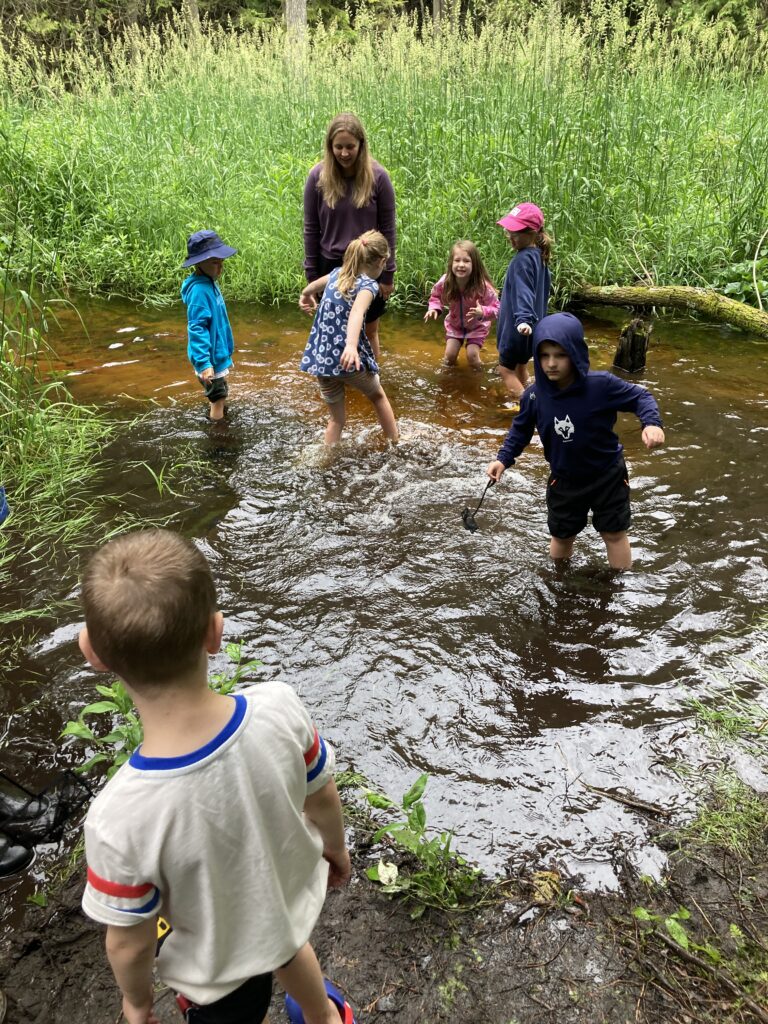
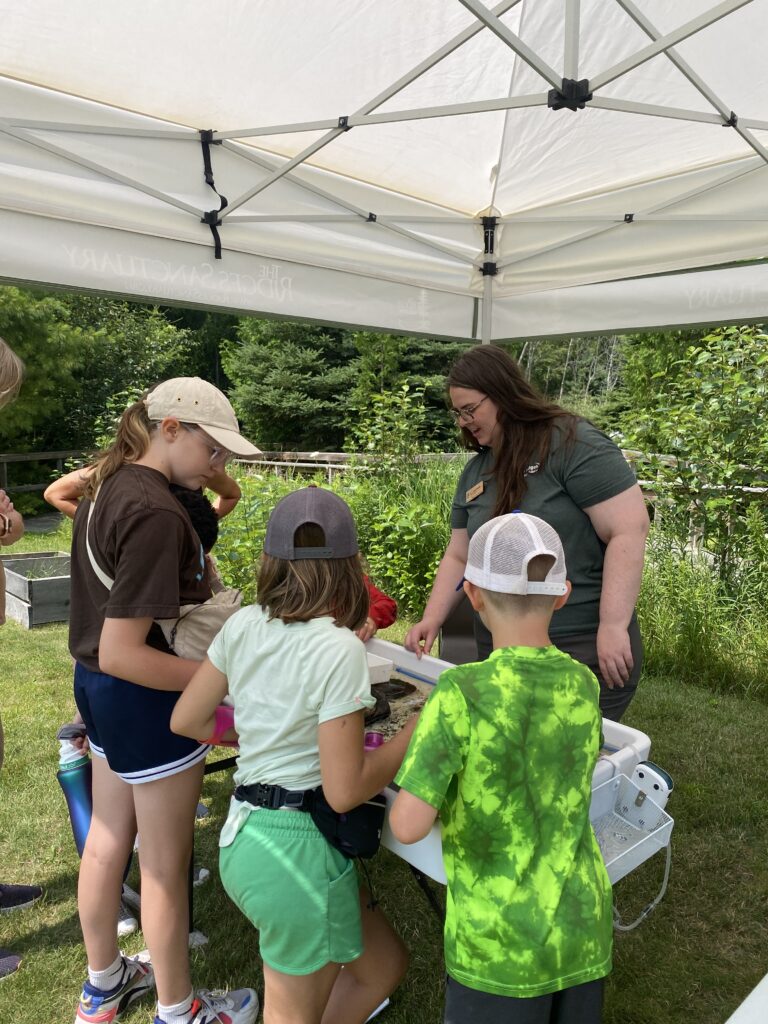
Campers in Critters Club explore the Yellow Trail Stream on the Family Discovery Trail

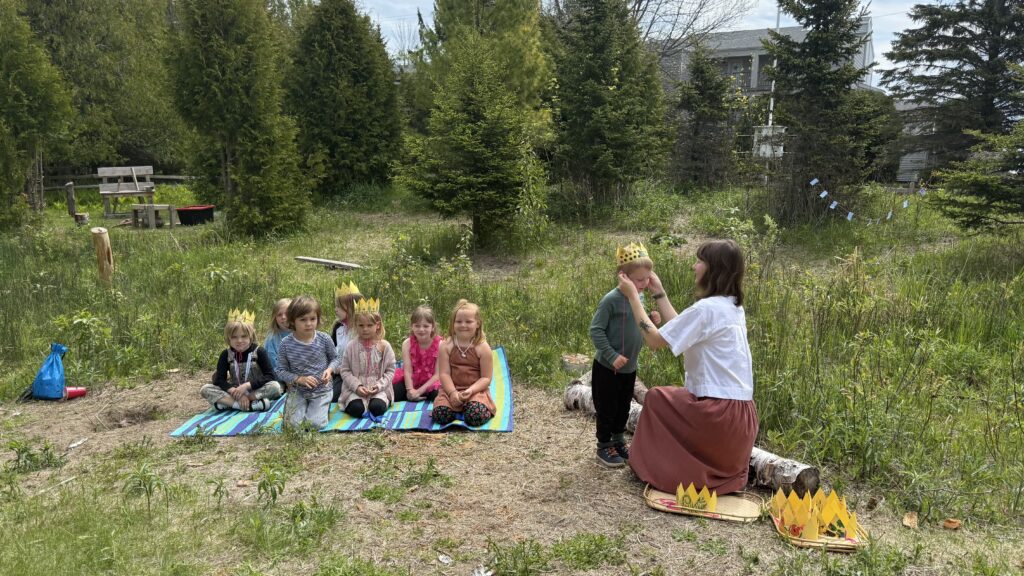
This time of year is one of my favorites because the Sanctuary will once again become a home for children whose families welcome Ridges Educators and the forest as their teachers. As the Dragonfly Nature 4K teacher, I have spent the past weeks excitedly planning out our year in preschool: Where will we go? What will we create? What will we sing? What will we investigate? Of course, sometimes plans are just that. In a nature-based setting, there are endless opportunities for learning. I can recall an instance from late last school year when I was set on teaching a unit about pollinators. I had laid out a sequence of lessons, meticulously prepared materials, created games, and even written a script for myself. Alas, as soon as my students began entering the gate to the preschool yard, they saw water. And mud. And worms. Without hesitation, they began digging an impressively large hole, which they promptly filled with just enough water that they faced little resistance when sliding into it. The worms, gingerly plucked from beneath stumps and excavated from the dirt, were given swimming lessons (these swimming lessons were cut short, for the record). Needless to say, we instead learned about water, and mud, and worms. Mud baths were taken by all, and worm homes were constructed. At the end of the day, they learned more from our mud and water exploration than they ever would have from my pollinator lessons—not because they wouldn’t have enjoyed it—but because the muck had already captivated their attention.
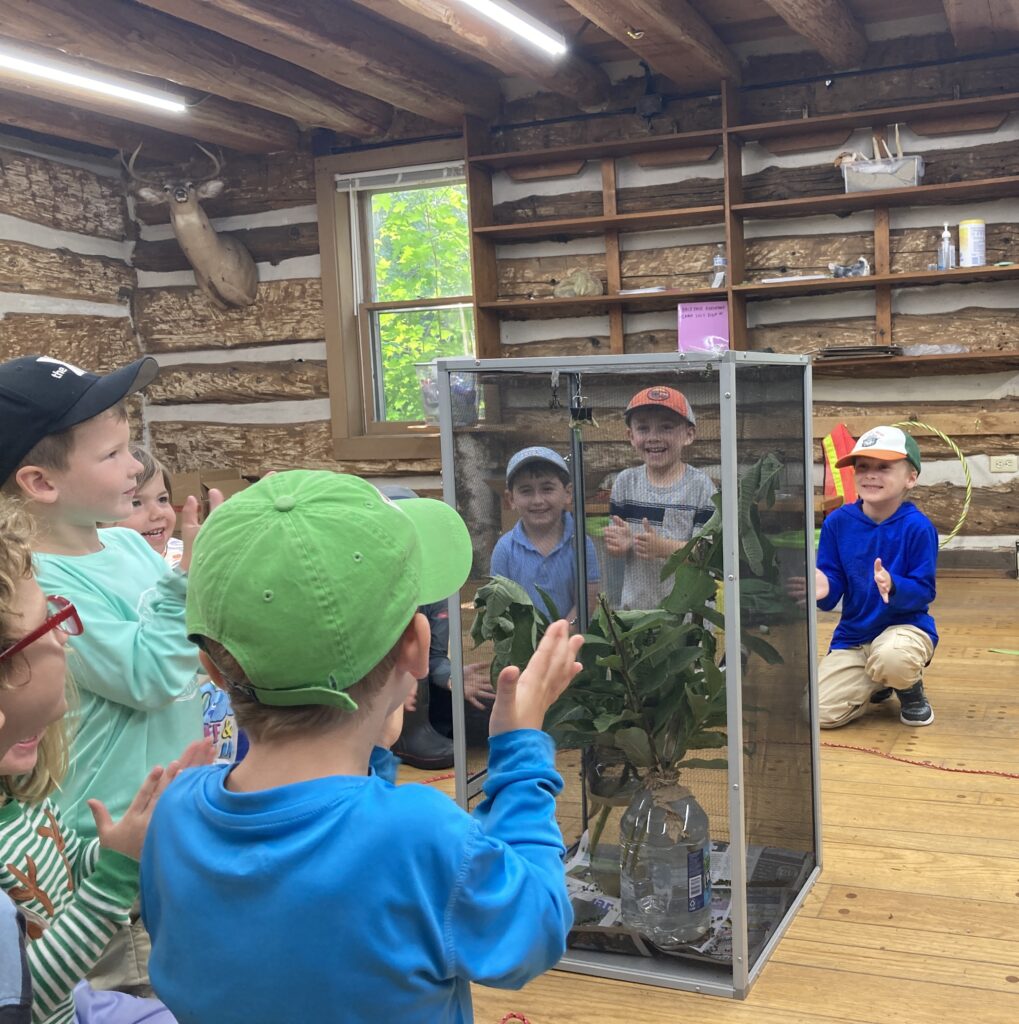
Children in Backpack Adventure Camp celebrate a monarch butterfly emerging from its chrysalis

Leaning into the seasonal offerings of the natural world is a part of all educational programming we do at The Ridges and with our partners. In Dragonfly Nature Preschool, Tiny Trekkers, Forest School, and Forest Days, children witness their environment in all of its phases: the golden light of autumn, the stillness of winter, the thawing squishiness of spring, and the gentle embrace of warmth in early summer. During Backpack Adventure Camp, children experience the Sanctuary and the Family Discovery Trail for one week at a time during the summer through hikes, inquiry-based science activities, and friendship. It is the experiences these children have that build a personal relationship with nature. Forests, meadows, and bluffs quickly become cherished friends who make them laugh, hold their hands, and teach them important lessons about what it means to be a human on this planet.
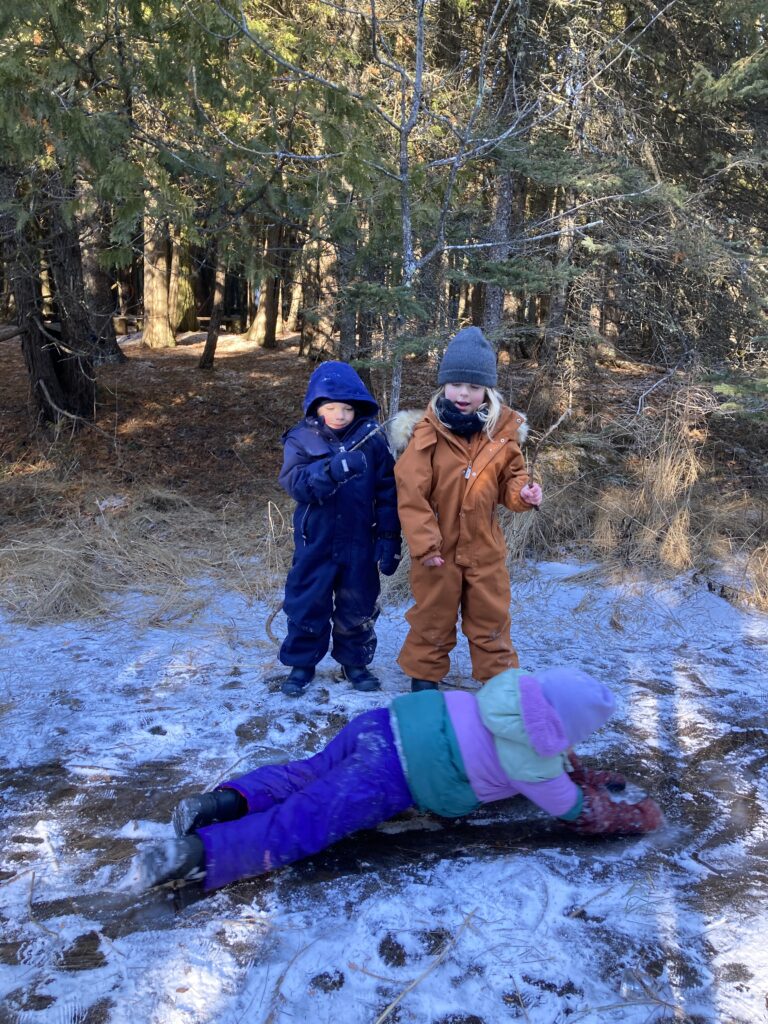
Dragonfly 4K students investigate ice by seeing how far they can slide on their stomachs 

How thankful I am to be a creature who doesn’t migrate or hibernate as this season approaches. The magic is just beginning.

These moments, and the programs, would not be possible without our community members and partners who value curiosity, care of the environment, and the lifelong bond between children and the natural world- principles at the heart of nature-based early childhood education. If you would like to learn more about The Ridges’ commitment to creating deep, personal connections through our year-round education programs, we invite you to visit our Education page. We’d love for you to be part of the journey.
Nature Notes: In Pursuit of UnderstandingCollaborative Research at The Ridges Sanctuary 

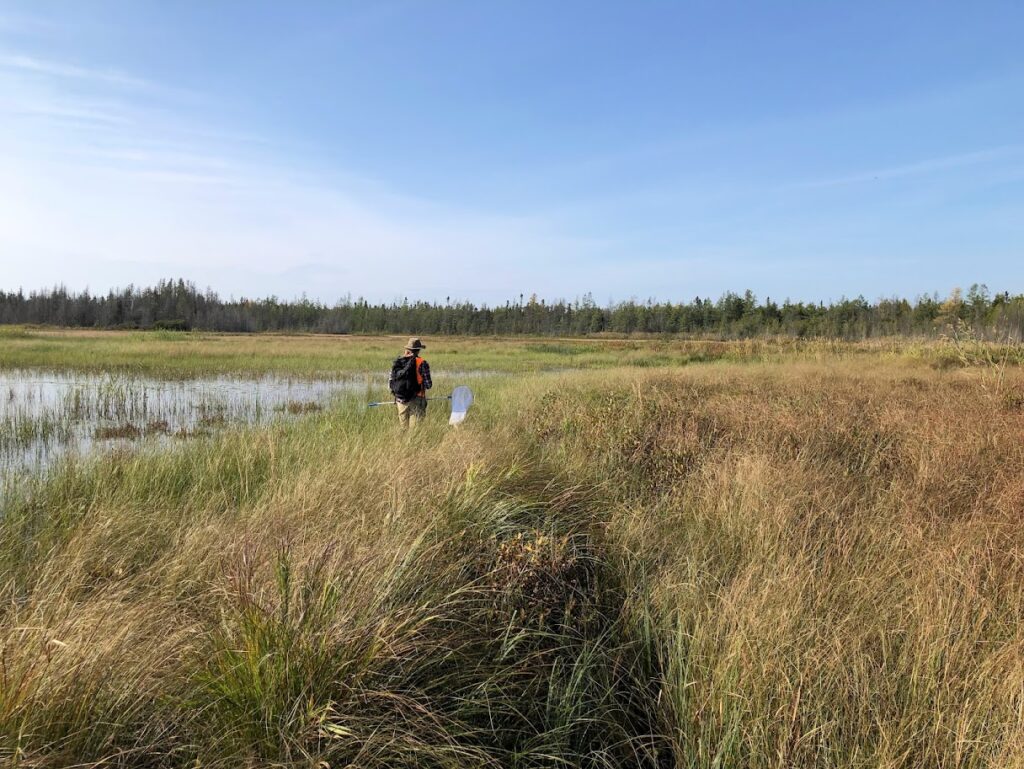
JD Arnston, Odonate Researcher at Pickerel Pond

“The ever-changing plant and animal populations of The Ridges make it mandatory for us to learn more about what exists within The Ridges, what factors cause changes in numbers of rare species, and
how to maintain desirable vegetation and animal numbers in all Ridges habitats.”
—Roy Lukes, 1988.

These words spoken over 35 years ago by legendary naturalist Roy Lukes are as significant now as they were then. At The Ridges Sanctuary, we are fortunate to have several organizations and individuals who value our incredible biodiversity and assist in continuing to learn more about the organisms that comprise our varied communities through inventory and research projects. Because of this incredible diversity, we provide the environment for outside researchers to conduct projects that enhance their academic and organizational information while providing tremendous benefits for The Ridges.

Following a research permit application process, those projects receiving approval add to the knowledge base of the entire scientific community, including us. Whether these studies are directed at gathering baseline inventory data, focused on the symbiosis of species, or trying to understand the intricate relationships between groundwater and Lake Michigan, each adds to the overall picture of our environment for us and future generations.

There are several on-going inventory and research projects that are providing invaluable information regarding the communities that comprise the old “Baileys Harbor Bog” and beyond. Dr. Keir Wefferling, Assistant Professor of Biology at the UW-Green Bay, is working with undergraduate and graduate students to identify and inventory the mosses and liverworts of boreal rich fens, while another student is conducting ridge-by-ridge plant chronological surveys. Another UW-Green Bay project will examine carbon sequestration in sphagnum communities as a function of biodiversity and colony density.

Ridge and Swale Echohydrology Connections

UW Project Deployment

Dr. Steve Loheide, a professor at UW-Madison, along with PhD student Eric Kastelic and a team of undergraduates, have commenced a project on effects of Great Lake water level fluctuations on groundwater and forests in ridges and swale ecosystems. The goal of this research is to quantify the impact of changing Great Lakes water levels on coastal groundwater systems and tree growth patterns. With purposely placed monitoring wells, swale water-level gauges, and tree ring analysis, correlations may be established between lake, groundwater levels, and tree physiological responses. This study will synergistically enhance other projects taking place.

The Ant Study

Postdoctoral Researcher Grant Doering from Arizona State University can be found crawling around on all fours, seeking ant colonies for his work on emergent evolution in ants. While collecting ants for his evolutionary behavioral study, Grant identified two ant species, typically only found in Canada. This suggests that The Ridges and surrounding habitat may function as a southern refugia for these two species.

Moths, Dragonflies and Damselflies

In addition to university-based researchers, The Ridges is fortunate to have individuals assisting in insect biodiversity survey projects. Kyle Johnson is focused on conducting a moth survey with JD Arnston, concentrating on dragonflies and damselflies. Both surveys are yielding extensive species lists with numerous Door County first sightings recorded. As with our plant inventory work, animal researchers are also providing evidence of extensive biodiversity at The Ridges Sanctuary.

Predator Absence and Disease Research

As noted, several projects at The Ridges involve the incredible biodiversity that is all around us. However, one researcher selected this area because we lack a certain apex predator. Michael Menon, a University of Wisconsin-Madison PhD student, is conducting research here because we do not have documented wolf packs howling around. Michael’s work involves trying to determine the impact that wolves have on the health of the state’s deer population, particularly as the deer population’s health involves chronic wasting disease. His hypothesis includes the idea that wolf predation on diseased deer will improve the overall health of the herd. Mr. Menon selected The Ridges to document the behaviors of other carcass scavengers in the absence of wolves and absence of chronic wasting disease. Michael is careful to place his deer “carcs” and trail cameras well off trail and has posted signage explaining his project for wayward hikers.

Building Knowledge for the Future

The forementioned endeavors describe only some of the collaborative environmental research that is taking place at The Ridges. As succinctly stated by Roy Lukes in 1988 and reinforced through the adoption of the 20-year Master Plan, we must strive to learn as much as we can about this natural world of ours through purposeful research.  This knowledge gained is a critical support of our organization’s mission while helping us build on previous work and provide documented information for the present and especially the future.

Images by Tony Kiszonas

To explore these studies in greater detail, see Tony Kiszonas’ article, “Advancing Environmental Knowledge,” featured in the Spring 2025 issue of our Sanctuary Newsletter.

Nature Notes: The Power of Nature for Family Connection

Free Fridays Nature Activity, Photo by Amy Shook

When I think of summer, I think of all the time I get to spend outdoors. I think of the warm (or cool) breezes, enjoying the shade of a tree or umbrella, listening to the cicadas, and not having to wear shoes with laces. I also reflect on all the time I spent outside with my family growing up. Whether we were biking, playing in the backyard, canoeing, swimming, or just having a campfire, I spent many hours of my childhood outside.  

Spending time in nature is very beneficial for individuals but can also be incredibly beneficial for families. Having the time to take in what is around you and purposefully engage with what you are seeing is a great bonding experience. A nature-based experience gives your family a focus on what to do if you aren’t sure how to start! Going on a family nature scavenger hunt, bingo, or having a checklist of birds to see or hear is a great starting place. It is a way for the whole family to work together towards the same goal. You can either make your own activities or simply search online for some options. My family liked to go look for bald eagles or river otters by the Wisconsin River. There is always a way to individually tailor the experience to your family’s unique interests.  

Being outside in nature as a family pulls everyone out from inside where all the screens are. It allows for fresh air, stretching your legs, and the chance to imagine the fun things you may see. It also allows for skills to be cultivated. Fishing as a family is a great outdoor activity and a wonderful way to bond.  I thought fishing was super fun when I was a kid because I got to cast a line AND have a cool tacklebox filled with fun, squishy lures. I even liked to have the worms race on top of my tacklebox! Sometimes I caught a fish too, but that was certainly not my priority. Now as an adult, I remember getting to spend time with my dad and playing outside and that is so special. I’m sure many of you reading this can remember the time spent with your loved ones outside in nature.  

We all have different lives, but I am sure we can all look back on the fond memories of summer and time spent with our families and loved ones. I know for myself, many of those memories center around being outside. At The Ridges, I get to see many other families creating core memories of spending time with family in nature. I hope you’ll take the time to step outside with your family and create your own special moments in the natural world. 

Join Us: Free Fridays at The Ridges Sanctuary

The Ridges Sanctuary offers Free Fridays through August, providing admission to the trails and educational outdoor activities for all visitors at no cost—an ideal opportunity for families and adults to explore nature together. For more information, go to https//ridgessanctuary.org/free-fridays/   

Nature Notes: Research for Restoration: Protecting Native Plants at The Ridges Sanctuary 

Showy Lady’s Slipper Anatomy

Following the idea that “lack of knowledge is as big a threat as any to sensitive species,” (Brzeskiewicz, M. September 25, 2000), The Ridges Sanctuary has the current research goal of developing institutionalized processes and protocols for the preservation and protection of native plant species. Members of our research team have identified the following statements as the major components of our research focus:

  • Problem: Changing environmental conditions threaten the existence of native plants.
  • Vision: Multiple robust colonies of selected plants on Ridges property.
  • Mission: Outplant to create new colonies.
  • Goal: Identify locations likely to support outplanted colonies.
  • Approach: Correlate plant conditions at existing colonies with environmental conditions to identify environmental conditions that support robust colonies.
  • Action: Survey environmental conditions within the Ridges to identify specific locations that could support robust out planted colonies.
    • Mark Polczynski et al

Core Research Framework: From Vision to Action

With these statements as our guide, The Ridges Sanctuary has been working on two multifaceted research for restoration projects to better understand the best methodology for preserving and protecting our native plants, including restoration and translocation of native orchid and dwarf lake iris populations.

Orchids as a Conservation Priority

Because of our organization’s deep-rooted relationship with orchids, assistance from numerous partner organizations, and a fantastic Citizen Science cohort, it was determined that orchid research and recovery would be a priority of our endeavors. We are currently working on an orchid inventory, gathering data to understand specific environmental conditions for orchid growth and reproduction, asymbiotic germination techniques, shade house orchid growth, and determining the best possible restoration/translocation habitats in our Hidden Brook living laboratory area.

Orchids are fascinating plants that have evolved unique characteristics dependent on a multitude of factors that determine their survivorship. As some of these specific parameters are undergoing change, our hope is that the knowledge we are gaining through this project will contribute to the conservation of this marvelous group of plants.

Restoring the Dwarf Lake Iris: A Science-Based Approach

Using our research statements as a guide, the goal of the dwarf lake iris project is to determine the abiotic and biotic conditions needed for maximum flower production, seed production, and seedling recruitment of the federally threatened Iris lacustris.  This work is focused on the enhancement of the population in a manipulated area and establishing populations in secondary locations for restoration/translocation of this iconic plant.

Dwarf Lake Iris Foliage

Monitoring and Habitat Selection with HOBO Data Monitors

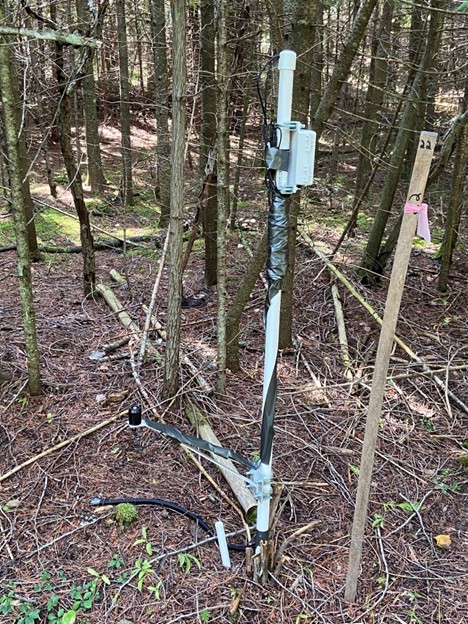
Putting our orchid project protocols to the test as a template, we initially deployed four HOBO monitors to collect data on soil moisture, soil temperature, and light PAR values in three different locations in the Range Light Corridor, and one location in the Hidden Brook boardwalk area. The Hidden Brook HOBO is set in an area of a robust extant population of dwarf lake iris and serves as a monitored control plot while the three initial HOBO deployment areas in the Range Light Corridor collected environmental baseline data before disturbance of the area occurred.  A corridor plant inventory established our overall biodiversity baseline.  Following corridor tree clearing as mandated by the Coast Guard, five dwarf lake iris transplant plots areas were selected based on tree canopy variance and established in October of 2024 with two additional extant plots identified giving us a total of eight dwarf lake iris research plots and one control plot. Additional HOBO monitors were deployed at the transplanted plots to go along with the current monitors. Since the primary research focus is on the light availability for the iris populations, canopy densities were recorded at each plot and will be annually recorded. Along with our other data sets, this information will help direct us in selecting feasible restoration/translocation areas of the sanctuary for the threatened dwarf lake iris.

Hobo Monitor

Both research endeavors are essentially focused on learning as much as we can about these plants to give them a chance of surviving the changes in their environment. We do not want to imagine a time when The Ridges does not have orchids or dwarf lake iris.

Images by Tony Kiszonas

To learn more about the research focus at The Ridges Sanctuary, read our Spring 2025 Sanctuary Newsletter. This edition provides an in-depth look at our current research efforts, including detailed information on our work to better understand the best methodology for preserving and protecting native plants, including restoration and translocation of ram’s head lady’s and showy lady’s slipper orchids, and dwarf lake iris projects — all currently underway.

Nature Notes: Powered by Passion—Community efforts to preserve the Boreal Forest 

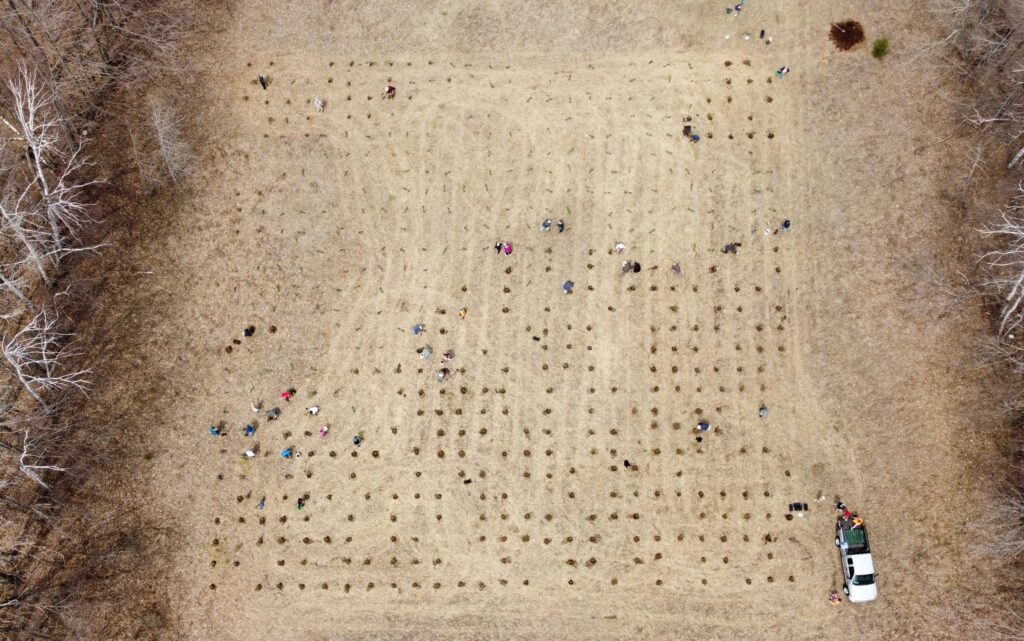
A view of research Plot 3 from above. Over 35 volunteers joined us on Sunday, April 27th to plan over 600 trees within this plot.

When we dreamed up the Boreal Climate Survivability Project in collaboration with the Climate Change Coalition and the Lakeshore Natural Resource Partnership, we knew it was going to be a few things:  

  1. A highly impactful, inspiring and important project, 
  2. An opportunity to engage with volunteers, and
  3. A tremendous amount of work.

While it has been all of those things, one unexpected and profoundly rewarding outcome has been the vibrant community that has formed around this important work.   

The Boreal Climate Survivability (BCS) Project was established to study the adaptability of trees and other species in boreal and temperate forests throughout Door County in the face of climate change. We aim to accelerate the success of reforestation in Door County by planting trees and monitoring the ecological diversity of the ecosystems before and after trees are planted.

  • 108 volunteers
  • 627 volunteer hours
  • 11 days
  • In all weather conditions…and I mean ALL

Putting this vision into action is no small task.

This spring, with the incredible support of our volunteer community, we completed several major milestones. We established five experimental plots and five control plots across three sites: Appel’s Bluff, the Family Discovery Trail, and Logan Creek. Once the plots were in place, the next step was planting. Over the course of three weeks, volunteers planted, mulched, and watered an impressive 2,232 two-year-old trees in the experimental plots. This effort, while ambitious, was made possible thanks to the dedication and hard work of more than 100 volunteers. They have given their time, energy, and enthusiasm to the project. 

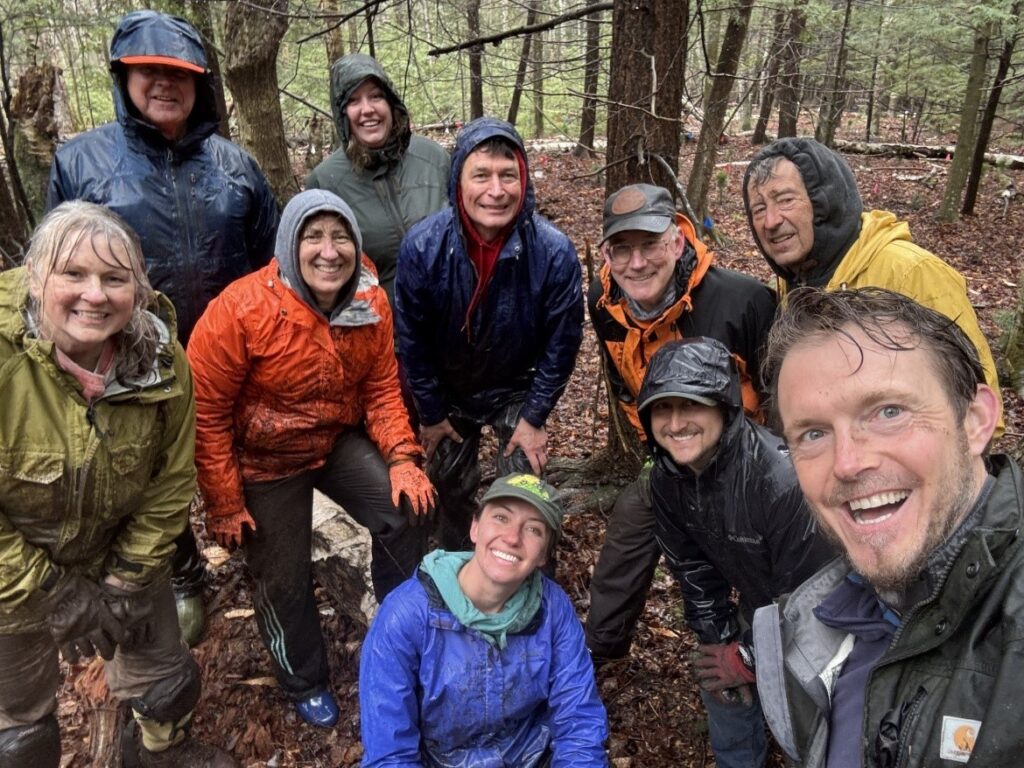
An inch of rain can’t stop us from planting 432 trees at Logan Creek. Photo by Jeff Lutsey.

Since the beginning, the Boreal Climate Survivability Project has been highly collaborative.

Together with our partners in the scientific community and our innovative volunteers, we refined, tweaked, and evolved the protocols in this project. Before the first shovel hit the ground, we gathered with volunteers—not just to share our vision, but to listen. We asked what people wanted to see, and the response was overwhelming. More than 75 individuals expressed interest in learning more, and—most importantly—getting involved. Many shared that this project felt like a rare opportunity to take meaningful action at a time when solutions to the climate crisis can feel distant or out of reach. That energy—that sense of purpose—became the spark that ignited our efforts. It has helped shape the BCS Project into a living example of what’s possible when science and community come together—building hope and resilience for generations to come. 

While the work we have accomplished is significant, this has only been the beginning.

Plot stewardship, biodiversity monitoring, weather condition monitoring and more will continue throughout the year. This fall, we will plant an additional 264 five-year-old trees in the established plots. Our work throughout the rest of 2025 and beyond will lean on the support of our volunteers and citizen scientists.   

We are deeply grateful for the incredible volunteers who have supported this project thus far. Your time, energy, and dedication have made a lasting impact—not just on the work itself, but on the spirit of collaboration that fuels it. Whether you’ve shared your experiences, gotten your hands dirty, or simply shared words of encouragement, your support has been vital to our progress. The Boreal Climate Survivability Project would not be what it is today without the generosity and passion of our volunteers. Thank you for standing with us and believing in the value of this work. 

An abundance of gratitude goes out to Jeff Lutsey, Tony Kiszonas, Sam Hoffman and Victoria Holderer. Thank you for your leadership, vision, and passion behind this project and all the important work you do to make our world a better place. I am inspired by each of you daily and am truly grateful to work alongside each of you to accomplish this incredible work.

To delve deeper into the Boreal Climate Survivability Project, explore the recent article by Jeff Lutsey, Executive Director of the Climate Change Coalition of Door County. It was featured in our Spring 2025 Sanctuary Newsletter. This edition offers an insightful look into the pioneering research that informs our mission and deepens our connection to the natural world.

Photo by Andrew Pirrung

How To Be A Good Environmental Steward

By Jackie Rath

As we consider our roles as individuals and community members, there is a special sense of place that The Ridges Sanctuary and the wider Door County landscape carries. Visitors come from across the country and the world to experience its beauty. It is our responsibility to continue to provide education on why we preserve sensitive habitats and how we promote exploring these natural spaces. Through environmental education and community collaboration, our goal is to foster environmental stewardship: an appreciation of and connection with the natural world that inspires the conservation of nature.  

As conservation efforts on the peninsula continue to grow, practicing environmental stewardship is crucial to the work being done for future generations to experience and appreciate. Carrying practices of environmental stewardship holds true when interacting with natural spaces outside the peninsula. Anyone can practice environmental stewardship where they are by exploring responsibly and through actions we can take to protect and care for the places we love.  

We need to do our part in understanding threats, opportunities and challenges in our communities. Although being a steward may seem daunting, you can start with small practices to incorporate into your daily life. 

Stewardship Practices

  • Develop a Sense of Place: Pay attention to your natural surroundings. Spend time outside to get to know the natural patterns of an area and start noting cyclical patterns or fascinations in your outings.  
  • Go on a Naturalist-Guided Hike: Get outside and learn about the plants, animals, and ecosystems around you from members in our community. Develop a knowledge of local ecology or gain insight from the perspectives of those who have explored these spaces and know the innerworkings of sensitive habitats. Our naturalist-guided hikes are the best way to experience the magic of The Ridges and to share the ongoing environmental stewardship at the Sanctuary.  
  • Care for Door County Leave No Trace Initiative: The Door County Leave No Trace Seven Principles provide a framework of minimum impact practices for spending time in Door County’s outdoors and beyond. Head to www.doorcounty.com/care-for-door-county/leave-no-trace and read about the Leave No Trace 7 Principles. Each principle covers a specific target area and provides detailed information for minimizing impact to the peninsula’s unique landscape, water resources, and outdoor experiences. These frameworks are actions to start implementing in your daily life to care for the land you love.  
    • Door County Leave No Trace 7 Principles 
      • Know Before You Go 
      • Stick to the Trails 
      • Trash Your Trash 
      • Leave It As You Found It 
      • Be Careful With Fire 
      • Keep Wildlife Wild 
      • Share Our Trails, Roads and Natural Resources 
  • Support and donate: There are countless not-for-profit organizations that work to protect and maintain our natural treasures for generations to come. Please consider contributing to organizations and partners so that they can continue to do the work of environmental stewardship.  
  • Community collaboration and investment: Being part of a community of people dedicated to the preservation, education, and research of this unique place is highly rewarding. Learn about local community action and initiatives, show support and get involved. Shop locally, protect, and care for local spaces, and volunteer! It is important to be mindful of the impact from individual actions, and community collaboration is a great way to share resources and ask questions or simply a place to get started. One of many great examples of community collaboration and partnership action is The Door County Big Plant powered by the Climate Change Coalition of Door County. Hundreds of Door County individuals, families, businesses, churches, and non-profit ecological partners rally together to plant thousands of trees every year. To learn more, head to www.climatechangedoorcounty.com/door-county-big-plant and explore and learn about the partners at play. 
  • Citizen Science: As stewards of The Ridges Sanctuary, understanding the critical habitats found within the Sanctuary is vital to establishing proper management, protection of rare and endangered species, and understanding the impacts climate change will have on the boreal forest. There are many opportunities for volunteers of all ages and abilities to get involved at The Ridges Sanctuary, one of them being citizen science. Citizen science is the collection and analysis of data relating to the natural world by members of the general public, typically as part of a collaborative project with professional scientists. The Ridges currently hosts or facilitates several citizen science programs that utilize volunteers to collect important data for a variety of uses. 
  • Share what you care about: Encourage others to get outside with you or volunteer to get more people involved. Share your fascinations and curiosities when out in nature, you never know who you might inspire! We can achieve much more as a collective when passionate individuals work towards a common goal. 

Want to learn more about our current stewardship practices at The Ridges? Visit our Preservation, Research, or Education pages to learn more about our work.

Nature Notes: Art in Nature – Patterns, Contrasts, Cycles, and Inspiration

Art in nature is defined as many things. When I think about art in nature, I feel like I have to understand what nature is. Nature has symmetry and patterns, but it is also unruly and follows no direction. Nature is wild and calm. Nature is predictable and surprising. Nature is inspiring.

Nature’s Design: Order and Wildness

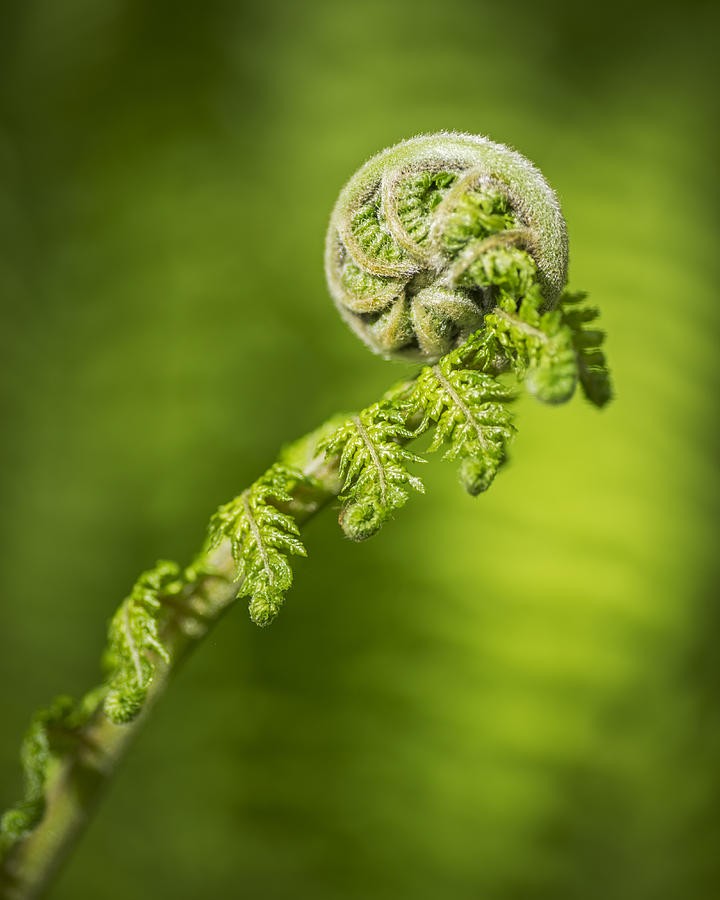
We find symmetry and patterns; we find predictable, repeating phenomenon and uncertainty in shapes and designs. The Fibonacci sequence appears to be a blueprint for many things in the natural world. Each element is the sum of the two elements that precede it, and it occurs in gastropod shells, pinecone bases, and an unfurling fern frond. Nature’s design is also unruly and follows no direction. Wood-boring beetles found in forests eat trees under the bark, leading to the host tree’s slow demise. However, each design left in the wake of the beetle’s destruction is unique.

Nature is wild – it is not tamed or domesticated. Forests grow without cultivation; animals survive by any means necessary. Northern white cedar trees will produce up to nine liters of cones annually, which can mean upwards of two hundred thousand seeds a year.

Nature is calm – like frost creeping along the forest floor, or ice skating across a swale. Morning mist evaporating in the early sunshine to begin the day.

Nature is predictable – we find patterns in seasons, life cycles and ecosystems. We understand that the spring ephemeral flowers bloom quickly across the forest floor so that they receive sunlight before the leaves on the trees burst from their buds and shade the forest floor.


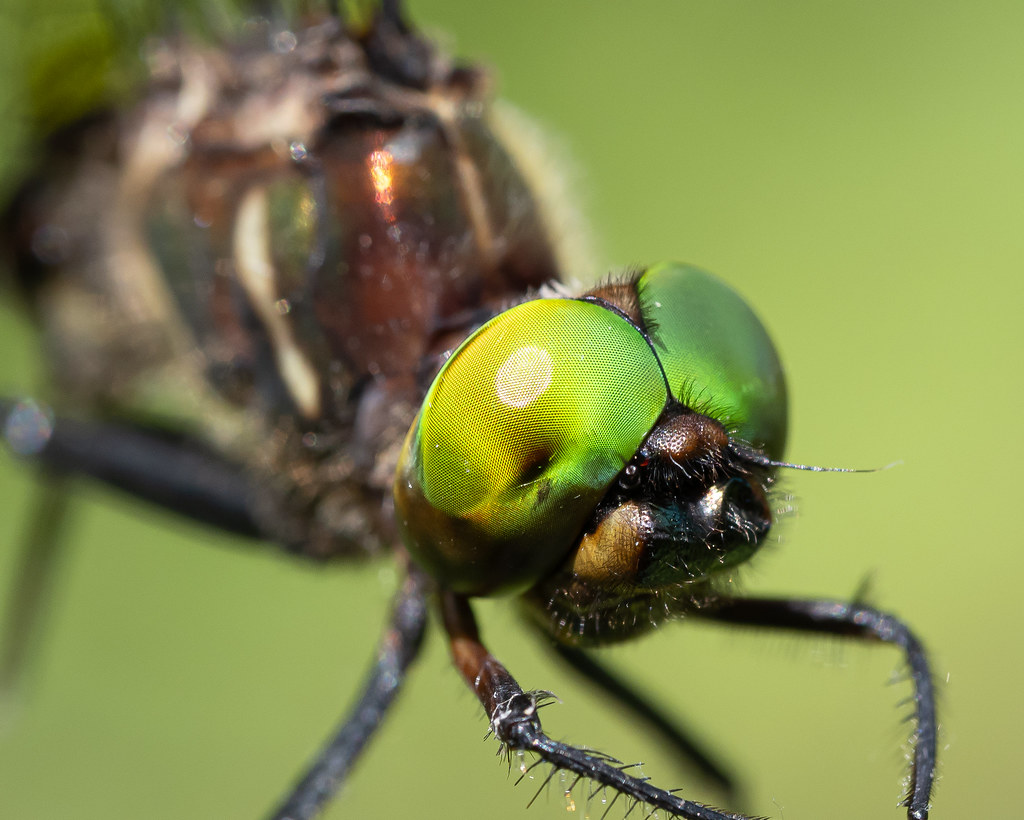
Nature is surprising – dragonflies have compound eyes with up to 28,000 lenses, that allows them to view the world in a panoramic view including ultraviolet and polarized light. To compare to humans, each eyeball has one lens to focus light onto the retina.

Nature is inspiring – the ever-changing-yet-always-constant ecosystems seem to defy itself, but that is what art is. Art is inspiring, wild and calm.

Finding Art in the Natural World

Art is predictable and surprising – I find art in the depths of the forest during spring rainfall. The world is quiet, yet there is the quiet splashing of leaves and needles grabbing raindrops as they fall to the earth. Often, birds take shelter in their nests or cavities.

I find art in the different textures and color variations in moss along the trunks of the northern white cedar trees, to the lichen along the branches in the sky. Moss gathers droplets of water running down the trunks of the trees and slowly absorbs it. Moss cannot grow up, so it grows out. It spans the length of trunks, logs and parts of the forest floor. Human eyes with one lens view the shades of the rich, deep green.

Lichen growing along the branches offer a variety of colors and textures. Lichen can be a soft, pale green, or sunset orange. It can grow tight to the branch like a crustose lichen, or in a sporadic pattern of the fruticose lichen.

Celebrating Nature Through Art

Nature is wild and calm, predictable and surprising. Nature is inspiring. To celebrate Earth Week, homeschool students will be sharing their nature-based art with an art exhibit in the exhibit space at The Ridges Sanctuary between April 19th and 26th. Their art reflects how they see the beauty of nature – its patterns, unpredictability and quiet inspiration – captured through their own creative works.


Earth Week Events

Ridges Roadside Clean Up

Saturday, April 19, 8:30 am – 11 am  

Join us in celebrating Earth Week at The Ridges with a roadside clean up around The Ridges and down Ridges Road! Help us keep our surroundings clean and beautiful by making sure we properly dispose of collected garbage. This opportunity is perfect for individuals, families, or groups looking for volunteer hours and is suitable for all ages.

Fee: Free. Although this is a free volunteer event, we need an accurate count of attendees. Please register in advance here.

2nd Annual Forest School Artist Reception and Celebration

Saturday, April 19, 11 am – noon

Join us in celebrating Earth Day with students from The Ridges Forest School at the 2nd Annual Earth Day Art Show. Various artwork created by the students will be displayed at the Cook-Albert Fuller Nature Center throughout Earth Week.  

Fee: Free. Donations appreciated!

Roundtable Discussion on Reforestation

Thursday, April 24, 6 pm – 7:30 pm

Join experts in the community at the Baileys Harbor Town Hall for a roundtable discussion on reforestation. Learn about the new Boreal & Temperate Forest Climate Survivability project on which Climate Change Coalition of Door County, Lakeshore Natural Resource Partnership, and The Ridges Sanctuary are embarking and what it means for the future of Door County’s forests.

Fee: Free. Donations appreciated!


Nature Notes: Owl Prowling

I recently read Jonathan Slaght’s Owls of the Eastern Ice, about his time in the remote Russian Far East studying the world’s largest owl, Blakiston’s Fish-Owl. It’s as much about the climate and culture of the region as the birds. As with many high-latitude owl species, breeding begins in winter. To understand fish-owl nesting needs, the author endured months of winter conditions that even many of us North Woods aficionados would find challenging. It’s a testament to the endurance of owls as well.

February is when owls are vocalizing regularly to attract mates, maintain pair bonds, and defend territories. It’s a good time to try to detect these secretive, largely nocturnal predators. While I hope you don’t have to endure subzero temperatures and deep snow to do it, you should expect to spend time out in the cold.

Playback is an effective tool that can be used during owl prowling. Playback is playing a bird’s vocalization to elicit a response. A field guide phone app may contain the calls. Imitating a bird’s call with your voice also works if you have that ability. When using playback, always make sure to do so in a way that minimizes disturbing the bird. If a species doesn’t respond after a few calls, move on to a different species. If a bird does respond, stop playing the calls immediately. When using playback, you are making a bird respond to a rival that doesn’t exist, and is not there, which elevates its stress levels. Playback should be used sparsely and rarely. It can become especially problematic in heavily birded areas and close to nests. I use playback when owl prowling and leading walks, and always educate about the stress it causes. If owl prowling on your own, do it at night and start with the smaller owls, then go up in size. Larger owls are predators of smaller owls, so playing a Great Horned Owl call first will likely keep any Eastern Screech-Owls within earshot silent. However, learning owl calls before you depart and letting wildlife present itself to you is a safe and responsible practice! 

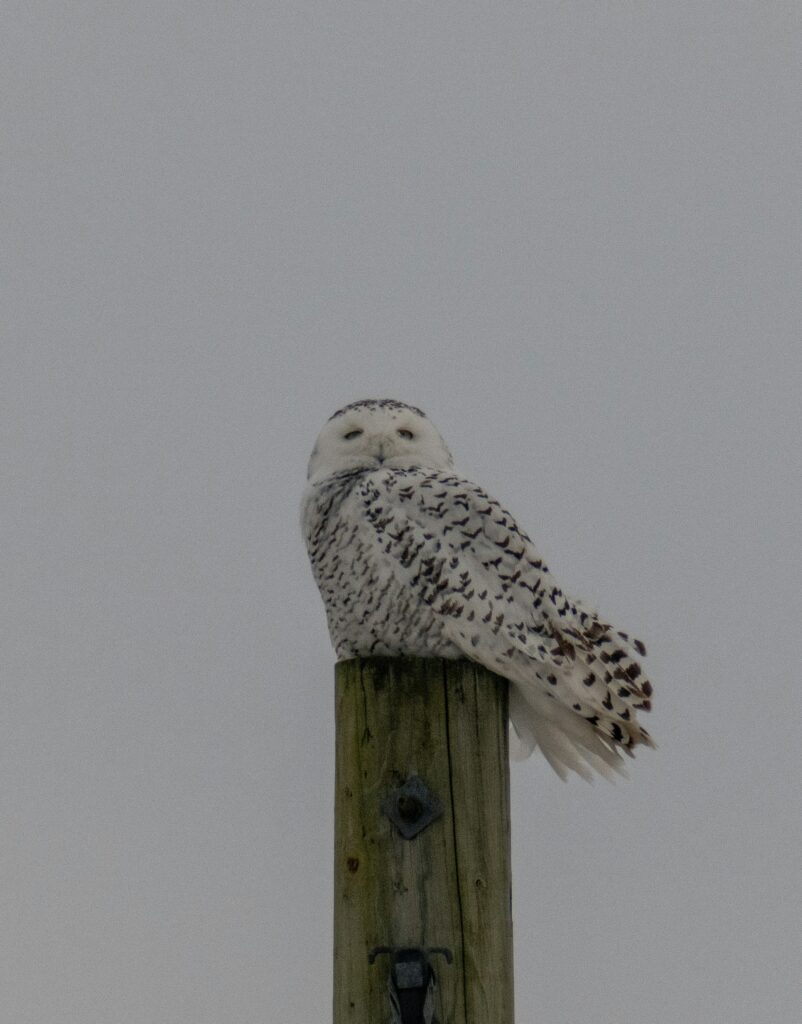
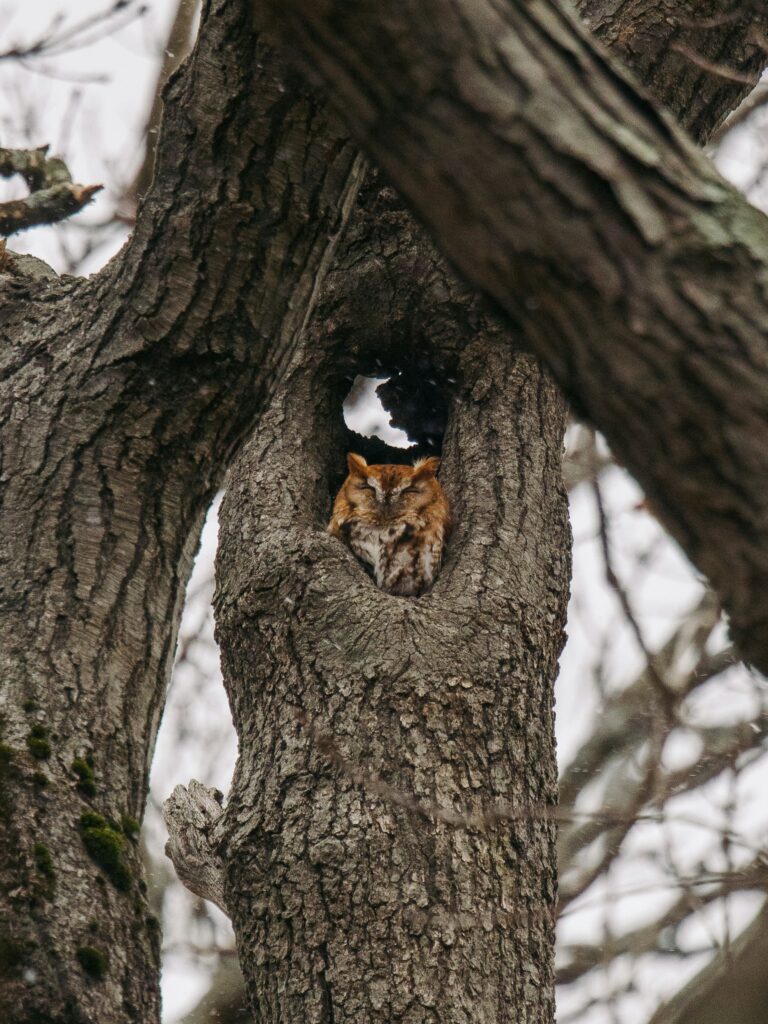
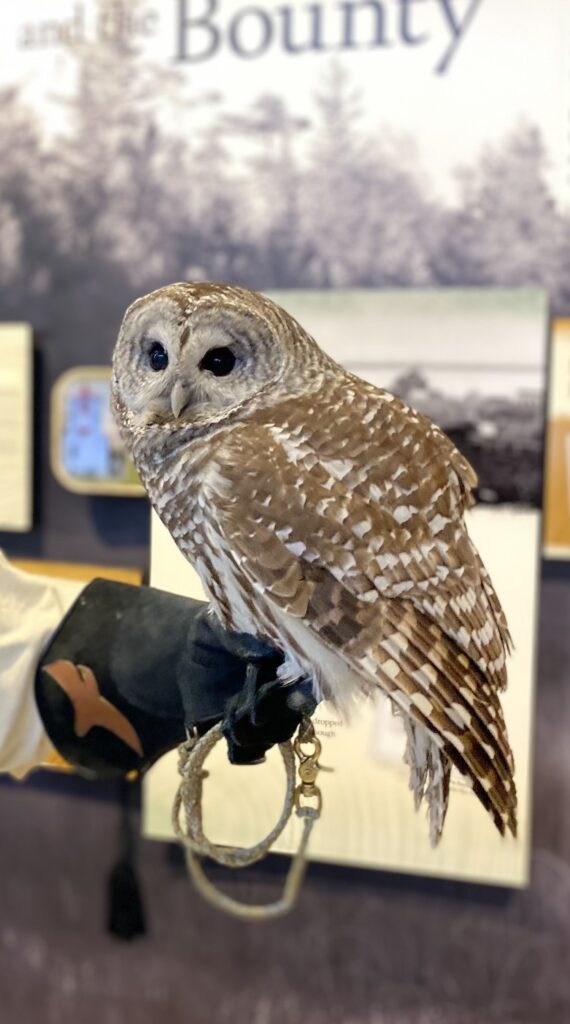
Pictured left to right: snowy owl, eastern screech owl, and barn owl

Owls can also be found during the day through persistence and luck. Snowy Owls actively hunt during daylight, so look for a white lump on a snowy field, landfast ice, beach, farm field, utility pole, or rooftop. Other owls roost during the day in a tree cavity or dense vegetative cover. Other birds can help you locate an owl. If you see crows, jays, or chickadees making a fuss around a particular spot they may be mobbing an owl or other predator. Birds of prey use the element of surprise, so when discovered, it behooves their prey to raise the alarm and get in their face, forcing them to move on. Another trick is to look for owl pellets on the ground and whitewash on the lower branches of trees, signs an owl is or was roosting above. Owls eat their prey whole, later coughing up a pellet of undigestible bones, fur, and feathers. Whitewash is excrement, which is white and liquid in owls. Lastly, look for owls by poking your head into cedars, spruces, and other densely vegetated trees. Groves of trees adjacent to clearings are good places to check. After searching many haystacks you might find the needle, a camouflaged owl resting against the trunk at eye level or above. Take a quick look, then walk away to minimize disturbance.

You can also try bringing owls to you by offering a nest box. A box about twice the size of a bluebird box is suitable for Eastern Screech-Owls and Northern Saw-whet Owls. Barred Owls nest in a significantly larger box. A Barn Owl box should have a ledge on the outside for the fledglings. Where you place the box depends on the species you hope to attract. It is important to not disturb the pair during nesting. Clean the box at the end of the season.

While there are no guarantees you’ll see an owl in the wild if you do brave the cold, I can guarantee you’ll see owls up close during The Ridges’ Owl-O-Rama. On February 28, an owl talk will be followed by an owl prowl. On March 1, activities include building a screech-owl nest box and meeting feathered friends from Open Door Bird Sanctuary in the Nature Center.


Owl-O-Rama 

Owl Prowl

Friday, February 28, 6:00 pm-8:30 pm  

Join a Ridges Naturalist at The Ridges Nature Center to learn about owl species that call Door County home. Then, head down out on a local trail to hear them calling to one another!

Meets at the Cook-Albert Fuller Nature Center, must have vehicle to drive to Prowl location.

Fee: Public $15 | Member $12 | 16 & under $7; Pre-registration is required. Please note: At capacity; registrations no longer accepted.

Owl Nest Box Workshop

Head over to The Ridges Workshop to build Eastern Screech-Owl nest boxes to take home and hang in your backyard. A Ridges staff member will provide you with all the materials you need to assemble your nest box. 

Please note: The nest box building portion of the workshop will include hammering and the use of power tools in an indoor space.

Fee: Public $50 | Member $45; Pre-registration is required.

Open Door Bird Sanctuary Meet and Greet

Stop by The Ridges Nature Center for a fun, family-friendly experience with live birds of prey from Open Door Bird Sanctuary! This free event offers an opportunity to see owls up close and talk with ODBS staff who will be stationed throughout the Nature Center. Ask questions, learn interesting facts about each bird, and discover the unique adaptations that make owls such remarkable creatures. Don’t miss this chance to connect with these amazing raptors!

Fee: Free. Donations appreciated!


Reconnecting with the Natural World Throughout the Winter Season

Going outside in the winter can sometimes seem like more trouble than it’s worth. When the sun sets at 4:30pm and the windchill makes it feel like 5 degrees outside, a book (or more realistically, staring at a screen) can seem much more tempting than a walk in the woods. I always find that during the deep winter months, I feel a little disconnected from the natural world. Somehow, each year the holiday rush and end of year projects overcome my usual priority of spending time outside.  

It’s natural for us as humans to slow down in the wintertime. The days are shorter. The weather is colder. However, slowing down doesn’t have to mean spending less time outside. In fact, spending time outside intentionally can help rejuvenate us, reinvigorate us, and even bring us respite, especially during these long winter months. In the book Losing Eden, Lucy Jones writes: “The return of migratory birds. The constellations of the sky. The shape of an oak leaf. The stripes of a badger. There is a soothing constancy to nature. And of course the transitory nature of the seasons – the changing trees, the behaviour of birds and animals, the turning of the globe, the cycle of life in one year – can also be a reminder that time passes and things heal.” 

In Jones’s book, she explores how humans have become disconnected from the natural world. Jones makes a strong argument for not only spending more time outside but incorporating nature more into our daily lives. She argues that nature is essential to our mental health and happiness. Through reading Losing Eden, along with our other Ridges Reads book club books like Braiding Sweetgrass and Finding the Mother Tree, I’ve been able to reflect on our society’s relationship with the natural world and how little we prioritize it. To lean into Jones’s prescription for us all, I want to share some ideas for how you can reconnect with nature – even when it’s cold outside!  

A Note About Clothing: My mother had one of those cheesy, wooden signs in our mudroom growing up, which read: “There is no such thing as bad weather, only bad clothing.” As much as I made fun of the sign, I find myself thinking of it every time I put on my multiple layers to teach a nature program or shovel snow. Clothing is key! Wool is a great base layer. It’s warmer and safer than cotton to wear in cold temps. If I’m spending a long time outside, I wear one extra layer than I think I’ll need – I’d rather carry an extra layer than regret not bringing one. I even keep an extra pair of gloves and a hat in my car in case I decide to take a last-minute hike. 

Ways to Reconnect During the Quiet Months 

1. Try nature journaling 

Nature journaling is a great way to connect with the world around you every day. You can start by noting the weather conditions, any animals or plants you see, or any changes you notice. I love to look back at my journal through the years to see when pelicans return from their winter habitat or when the paintbrush flowers start to bloom.  

One thing that I love about these snowy months is that conditions are often ideal for identifying animal tracks. Tracks often tell a story about what an animal was doing and where it was going. It’s a fun and easy activity to pick up in your spare time.

Another activity that you can do almost anywhere is to observe birds in your neighborhood. Backyard bird feeders are a great way to identify birds. It’s also a fun way to notice the seasons changing. I still look through my grandmother’s birding journals each year to see when the indigo buntings and orioles will return to our feeder. Observing birds can be as simple as watching trees outside your window and noting what you see each day. They even make window bird feeders now, which are great for apartments! Just be sure to clean your bird feeder regularly and purchase the right type of seeds for the birds you want to attract.  

Observing the conditions right outside your window can be an excellent grounding exercise to help you be present. In addition, by practicing your observation skills, you’re more likely to notice seasonal and environmental changes in your surrounding habitat when they happen. Not to mention, it’s a great way to learn about the plants and animals around your home! 

2. Read a book about the natural world 

Whether you’re interested in learning more about ecology, geology, animal behavior, or how trees communicate, reading is a great way to understand the natural world and connect with it on a deeper level. One of my favorite things to do when reading a good book is to take a break and digest what I’ve just read on a walk. There are even books you can put into practice while you walk! For example, The Lost Art of Reading Nature’s Signs is a great book for learning about how to observe and interpret what’s happening in your habitat. It’s a book you can easily pick up and read a chapter at a time.  

We also have our annual Ridges Reads program series coming up this month! The Ridges Reads book club pick is Losing Eden: Our Fundamental Need for the Natural World and It’s Ability to Heal Body and Soul by Lucy Jones. Our first Ridges Reads program will be a book discussion. We also have two additional Ridges Reads programs this year: Mindfulness Yoga with Deb Fitzgerald and Benefits of Forest Bathing with Jane Burress. If you’d like to join us for these free programs, you can learn more information and register by clicking on the below image:  

3. Join a group activity 

There are so many amazing groups throughout the Door County peninsula: hiking, birding, volunteering, etc. Doing things with other people is a great way to stay motivated and get outside! Whether your goal is to meet new people, explore places you haven’t been to before, learn a new skill, find support through community, or contribute to a good cause, there are others who want to do the same thing. Great places to check out upcoming activities include your local paper’s activity calendar, local coffee shop, library announcement boards, and Facebook groups.  

P.S. The Ridges is always looking for volunteers who like spending time outside!  

4. Connect with Green Spaces 

Connecting with nature can feel both time-consuming and inconsequential when you live in a place with minimal access to green spaces. However, as Lucy Jones indicates in Losing Eden, through various studies, scientists have learned that accessing green spaces, no matter the size, can improve our mental health and wellbeing. Even in urban areas, we can find small green spaces – a city park, a parkway, or a rooftop garden. Here are just a few ideas for spending time outside If you live in an urban area: 

  • find a favorite bench at a local park 
  • find a walking group to explore other parts of your town 
  • plant native flower seeds in your yard, windowsill, or on a roof if you have access to one 
  • visit a nearby botanical garden or arboretum – many are free to residents or students 
  • learn to identify the trees along your street 

I recognize that those of us who live in Door County are privileged to have so many protected spaces to explore. Everyone has different ways of connecting with nature. For some, access to natural spaces is incredibly difficult and takes both time and finances to maintain. The reality is there are many barriers to accessing green spaces. If you do have the time and resources, consider giving back to your community so that everyone can enjoy green spaces where you live. Here are some ideas: 

  • volunteer in a nearby community garden
  • join an organization advocating for green spaces in your area
  • sit in on town/city board meetings to become informed about your neighborhood

These are just a few ideas that I find helpful when I feel like I need a break from spending time inside (a.k.a. watching that Netflix show or working on my computer). There are so many ways to reconnect with the natural world. The most important thing is to find something you enjoy doing outside and to take time for yourself to do it when you can. As Lucy Jones writes, “Nature picked me up by the scruff of my neck, and I rested in her teeth for a while.” 

Sources: 

Jones, Lucy. Losing Eden: Why our minds need the wild. Penguin UK, 2020. 

Looking Back to Move Forward

Hidden Brook Boardwalk, photo by Mike Tittel

What a year it’s been. 

As I sit here at the end of December, reflecting on the incredible year we’re wrapping up, it feels as though August was just three days ago. A running joke in our office is that no matter the day or month, it might as well be six months in the future. Our team is always focused on what’s next—planning the upcoming season of programming for all ages, outlining research initiatives, mapping land management activities, developing newsletters, and more. I can’t help but feel a bit guilty taking a moment to pause and reflect while everyone is deep in planning for next year. But then again, it is no secret how important it is to look back in order to move forward with confidence and strength. 

This past year has truly been one for the books. Thanks to our exceptional staff, we were able to launch new accessible programs, research projects, early childhood education initiatives, land management activities, and more. Our team remains innovative, collaborative, and brilliant, consistently supporting me in my first full year as Executive Director. I can’t imagine a better group to work alongside in advancing our mission to promote positive environmental behaviors through impactful educational experiences, land management, protection, and ecological research. I could not do what I do without each and every one on our team.  

Is this starting to sound like a love letter to our staff? I hope so 😉 Jokes aside, our accomplishments are a direct reflection of the hard work of our team. While not a comprehensive list, here are just a few things we’re proud of accomplishing in 2024:  

Free Fridays – Thanks to a generous grant from 100+ Women Who Care Door County, we launched Free Fridays, an experience designed to provide free access to the Sanctuary and take part in themed activities hosted by our new Naturalist, Amy Shook.   

Boreal and Temperate Forest Climate Survivability Project – In collaboration with our friends at the Climate Change Coalition of Door County and Lakeshore Natural Resource Partnership, we have established a new research project, looking at the survivability of trees in five research plots between The Ridges Sanctuary and Logan Creek Preserves. This project will be vital to community wide reforestation and tree planting efforts. The data collected from this study will inform future efforts as our forests continue to change at the hand of climate change.  

Dragonfly Nature Preschool – In partnership with the Gibraltar Public School District, we launched an entirely nature-based public preschool for students in Door County. This program was especially important to us in our efforts to provide more accessible and affordable programming for our community.  

12 Acre Land Acquisition – Earlier this year, we added 12 acres to the Sanctuary with a primary goal to safeguard groundwater quality and habitats for the Hines emerald dragonfly and migratory birds. This acquisition puts our total area protected to over 1,700 acres.  

RidgesSanctuary.org – Our website got a much-needed facelift. We worked closely with Digital Pollen Collective to design a site that was easy to navigate, visually stunning, and presented our mission front and center. This new site has already done wonders for our digital engagement and online presence.  

Research Partnerships – In 2024 we issued 11 research permits in collaboration with seven organizations worldwide. New efforts like a peatland bee study and four-toed salamander survey, and continued efforts like ant studies, orchid and fungi research and more have advanced our understanding of the boreal forest, as well as furthering the scientific community’s knowledgebase.  

Staff and Board Growth – An important focus this year was growth and development of our staff and board. We added new positions to support Dragonfly Nature Preschool, and a Naturalist position to support our public engagement at the Nature Center. We also added three new members to our board of directors, that met the areas of need identified by our governance committee. This brings our robust and diverse board to 15 directors.  

Master Plan Implementation – It has been a busy year of implementing our 20-year vision. Our Master Plan, approved in 2023 provided an important framework for growth and development in our core mission areas of Preservation, Education and Research. To further deliver on our vision, we have engaged with SmithGroup and The Boldt Company to develop predesign and preconstruction resources for facilities to be included in future capital fundraising initiatives such as a Research Station and Education Station. In addition, we are deep into the development of Phase 0 projects that will have the biggest impact in the shortest time. Phase 0 projects include upgrades to the Kaye and Marshall Cabins to offer year-round programming, reuse of the bathroom facility to offer year-round use while also connecting to municipal sewer and building a new workshop to meet our growing needs for land/property management and programs.  

While this is only a snapshot of our year, this demonstrates the robust work of our organization. Our dedicated staff and board strive to ensure that each of our core mission areas thrive collectively and independently. I am deeply grateful for everything we have achieved and all that lies ahead. Together with our community, we will continue to fulfill our vision of inspiring the conservation of Nature, ensuring that future generations can experience and appreciate the Sanctuary as we do today.  

I look forward to continuing my service with The Ridges and contributing to our future growth. Your role as a champion and ambassador for The Ridges has been invaluable, and we deeply appreciate your support through all our transitions and progress. On behalf of all of us, thank you.

Onward together in conservation,

Katie Krouse, Executive Director