By Amy Shook, Director of Programming and Interpretive Naturalist
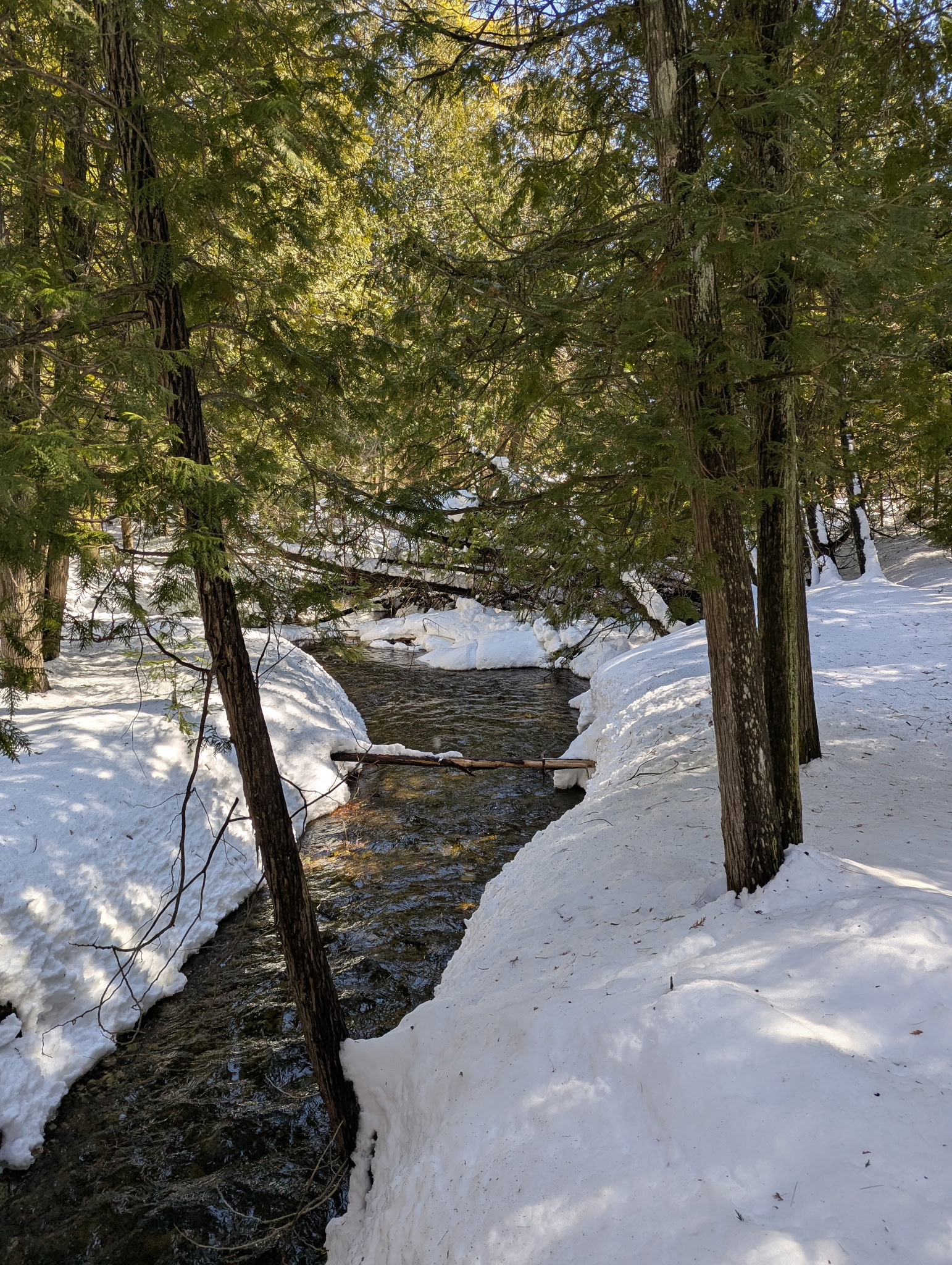
The rushing waters of Hidden Brook in the spring
As the days grow longer and the sun seems to shine just a touch warmer, we look around and think, “Finally. Spring is starting to show up.” And then we get three feet of snow and wonder what will happen next. It may not seem like it, but spring is here and snow is melting away rapidly. The ground isn’t frozen anymore and the air temperatures are staying above freezing during the days. The snow will be gone sooner than we know!
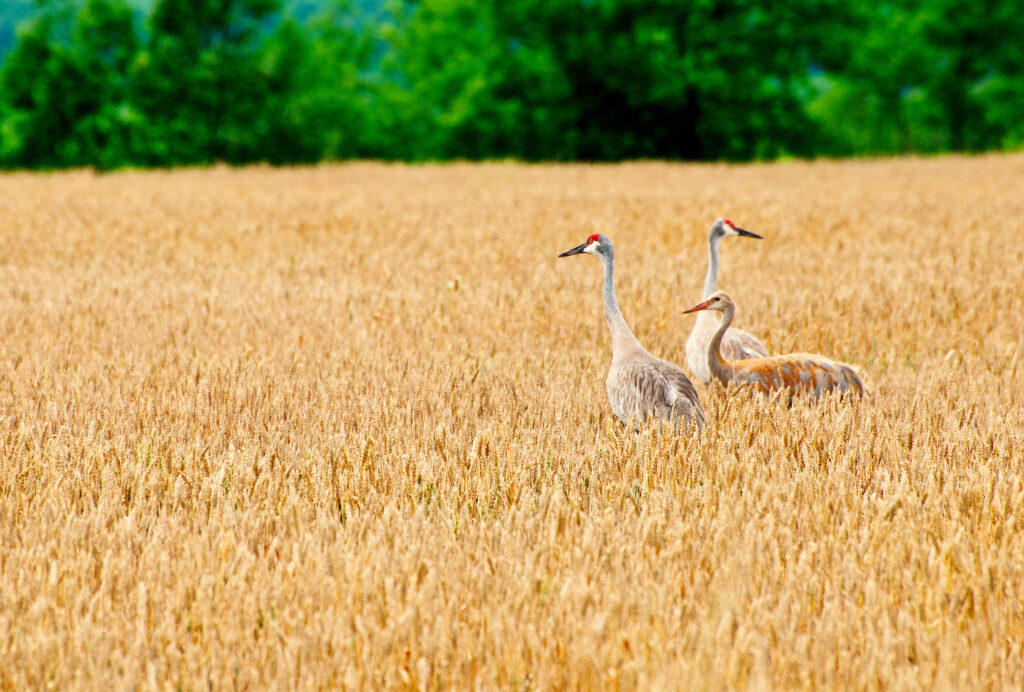
I promise, spring is truly here. Winter just has to give us a final dramatic goodbye on the way out. I have been seeing and hearing signs of spring that make me excited. The swales and Hidden Brook are starting to appear underneath the snow and ice. Take a walk down Hidden Brook Boardwalk and stop and take a moment to listen to the water rushing underneath. On warm sunny days, we have been hearing a few frogs in the swales. Birds are starting to migrate back – this weekend I saw about eight sandhill cranes while driving through the state. We’ve also heard their characteristic calls, one of my favorites, in the Sanctuary.
Now is an amazing time to come and explore the Sanctuary. There is a mixture of longer days, warmer weather, swales and ice melting, and yet there is also snow on the ground to see the stories of what animals have been traveling through. I love seeing animal tracks and marks pressed deep in the snow. The fun thing that can make it a little hard this time of year, is that as the snow melts, animal tracks distort and stretch, making a little rabbit track look as big as a wolf’s! Here are some things to pay attention to out in the Sanctuary:
– Frogs are calling on warm days with sunshine. Not very many yet, but they are starting.
– Snow melting away and green shoots pushing up. All the early spring plants will soon start to become visible and change the color of the forest floor.
– New birds calling, cardinals, robins, red winged blackbirds, and sandhill cranes are all back and loudly announcing their presence.
Spring is so many things. A sign of longer days, a time of refreshing, and a time when we start to long for warm summer days. When I think of spring, I think of all of the animals and plants waking up and rejoining us again. I wait impatiently for those little things that mark a new season starting.
photo by Len Villano
I hope you take some time to join us at The Ridges to celebrate the coming of spring. In April, we celebrate one of those signs of spring with our annual Crane Symposium, April 18-19. We have a full slate of events and opportunities to learn and get involved. Check out the below events for more information and to register for any events.
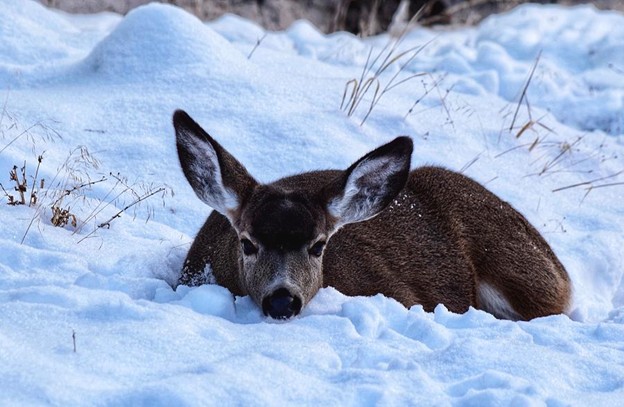
Deer resting in snow, by Dana Hardy (Fine Art America)
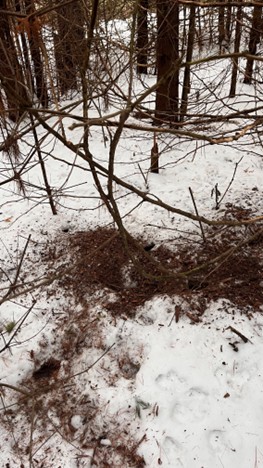
The forest teaches us many things; we just need to know where to look and how to listen. The winter season brings the lesson of life and allows us to see movement of animals in a way that no other season can. Most animals are elusive and not always seen while hiking. However, snow allows us to understand active, resident animal activity in our area through deer beds, middens, scat, and tracks.
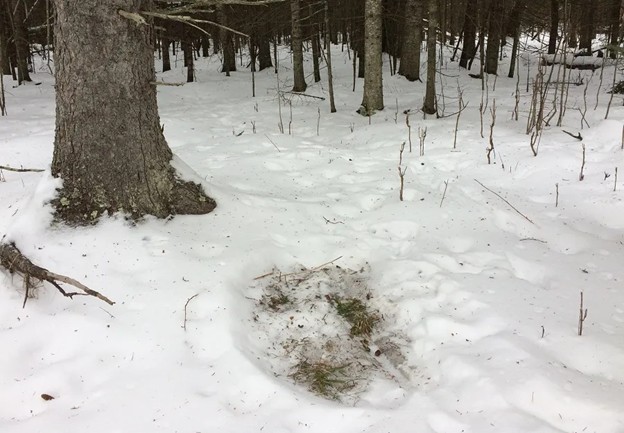
Deer beds are an easy indicator for tracking white-tailed deer in the snow. A deer bed looks exactly what it sounds like — the spot where they slept. When deer sleep on top of the snow, they leave an impression of their body when they leave their bed. When there’s not a lot of snow on the forest floor, a deer bed might melt down to the duff, allowing easy finding! If the snow is heavy and the imprints leave lasting impressions in the snow, limb locations and traces of the neck and head can be observed.
Keep a keen eye out for deer beds. Female deer tend to group together in the winter months. When you find one bed, the odds are pretty good that you’ll find more!
Exploring Red Squirrel Middens
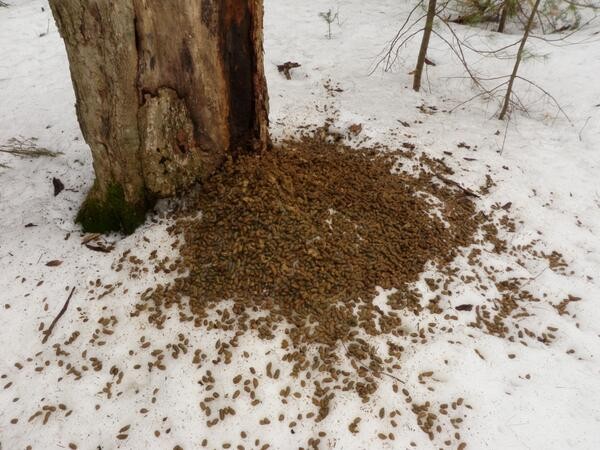
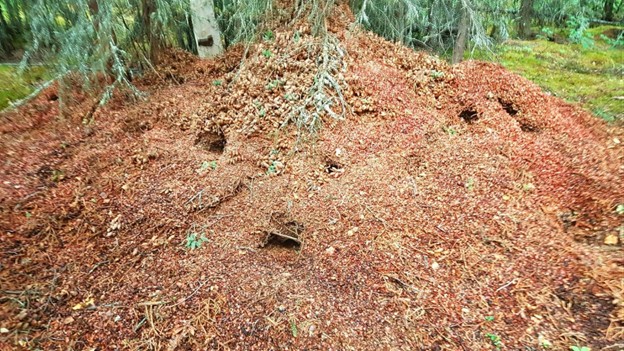
Red Squirrel Midden at Sevastopol’s EcoLab, 2/11/26, by Ana Hinkle
Another way of tracking animal behavior is looking for middens along the bases of trees, around logs, or along stumps. Middens are refuse piles of red squirrels – who have a different survival strategy from the gray squirrels. Gray squirrels scatter their cached food across many locations in their territory. Red squirrels create one location in the center of their territory for their winter food source. During the winter season, when food becomes scarce, red squirrels turn to an abundant food source in a conifer forest: the cones of pine, spruce, fir, and hemlock trees. However, most of the cone is inedible; the red squirrels are only after the seeds inside.
Red squirrels create middens by climbing a branch above the desired location, sift out and eat the seeds and throw out the discard – creating a midden. The accumulating pile of debris creates a storage area for their food, and they keep unopened cones buried under the discarded cone scales. Large middens can store up to 15,000 cones, which is why red squirrels are incredibly territorial. They need to defend their middens to survive the winter season.
See if you can notice any middens. They look like piles of reddish-brown debris, but hidden within are unopened cones of conifer trees in cold storage that hold the key to a red squirrel surviving the winter season.
Scat as a Storyteller
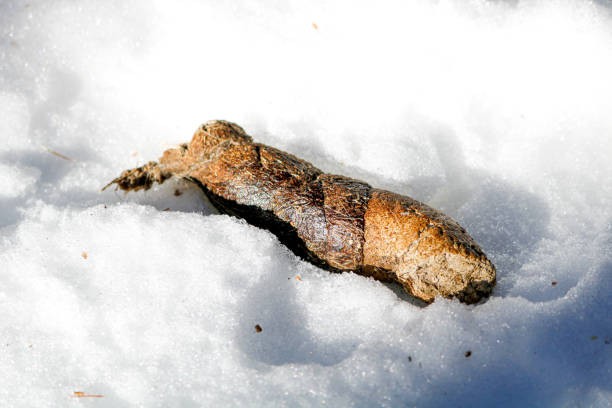
Porcupine Poop by Josh KurekFox Scat, 2/11/21, by Lauraag
Another effective way to track which animals are active in the winter months is to identify scat. Scat (animal droppings) is relatively easy to observe on the high-contrast white backdrop of the snow. For anyone willing to look closely at animal feces in the forest, scat can tell the story of where the animal has been, what it’s been eating, and potentially which animal did the doo doo.
Scat contains remnants of what the animal ate, whether it is berries, fur, or plant fibers. If the excrement is mostly composed of berries or plant fibers, that is an indicator of an herbivore like white-tailed deer, eastern cottontail rabbit or snowshoe hare, North American porcupine, and squirrel species. Other scat contains compacted fur, bones, or feathers. This is most likely the scat of a predator from the weasel family, a North American river otter, or fisher. Finally, if the scat has a combination of plant and animal material, it could belong to an omnivorous animal. Examples include the coyote, red or gray fox, raccoon, or opossum.
Alongside the content of the scat, the shape and location of animal scat can help understand which animals are active in the winter. Due to the high fiber in the plants that herbivores consume, their specialized digestive systems absorb as much moisture as they can and create uniform pellets.
Territorial animals like fishers, coyotes, and foxes will often leave their scat on elevated surfaces to act as a scent post. Their scat is dense and full of material that they cannot digest like fur or hair, bones, or even porcupine quills! Coyote and fox species have similar looking scat; the end of has a long thin rope-like appearance. The tapered point of the scat aids in carrying the scent to communicate with other animals.
The Snow as a Record Keeper
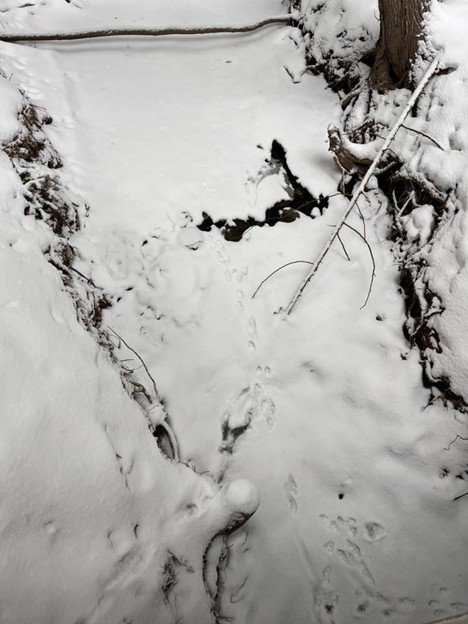
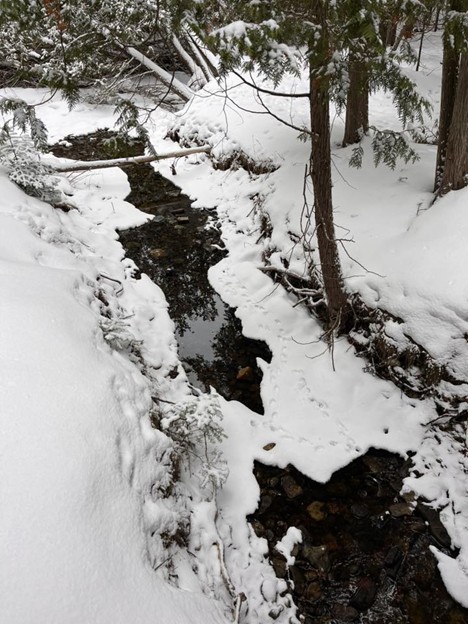
Otter tracks above Hidden Brook at the Sanctuary, 2/5/26, by Ana Hinkle
Animal tracks left in the snow are the most enchanting way to track animals in the winter season. While deer beds show observers where white-tailed deer are resting, middens signify the center of red squirrel territory and hide a large cache of food. Scat can help determine if an animal is an herbivore, omnivore, or predator based on contents, shape, and location. Animal tracks tell a story of where an animal was going and where it came from.
Wildlife tracks allow animal gait and movement to be observed, even without the presence of the animal. Deer and coyotes are diagonal walkers in the forest; their tracks are left in a straight line of alternating prints. Squirrels and rabbits are hoppers; they will leave a distinct pattern that is repeated throughout their path. Otter tracks show exploratory and play behavior in the snow, often leaving belly slides and bounding tracks. Raccoons, skunks, and porcupines are waddlers of the forest; their prints are left in a side-to-side, four-print gait.
It is difficult to find wild animals outside. The groundcover of snow allows us to find evidence of animals in our area through deer beds, middens, scat, and tracks. Through tracks and signs in the snow, the forest reveals its winter lessons.
Nature Notes: Snowy Owls on the Prowl
By Dan Scheiman, PhD, Staff Ornithologist/Visitor Engagement Specialist
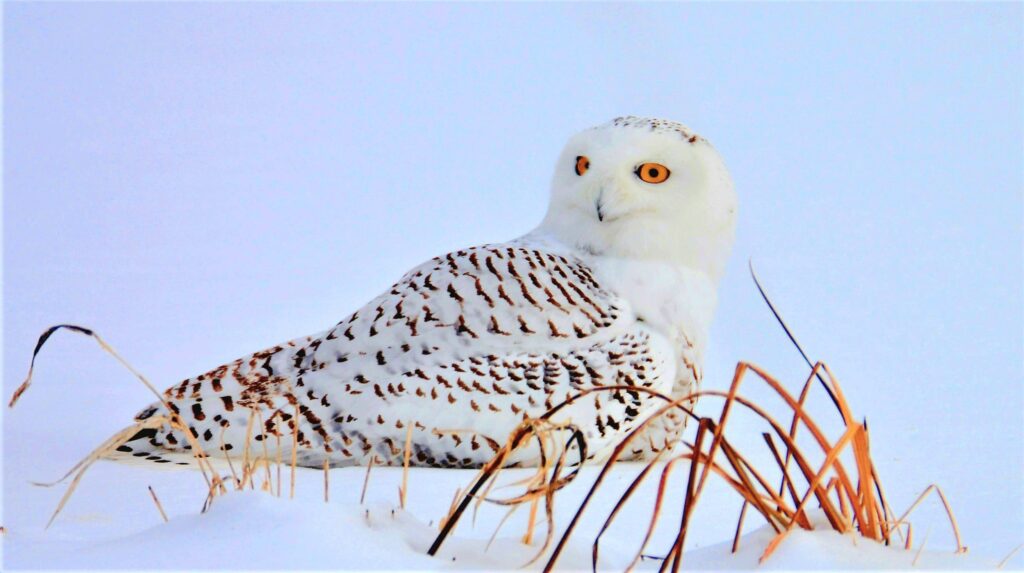
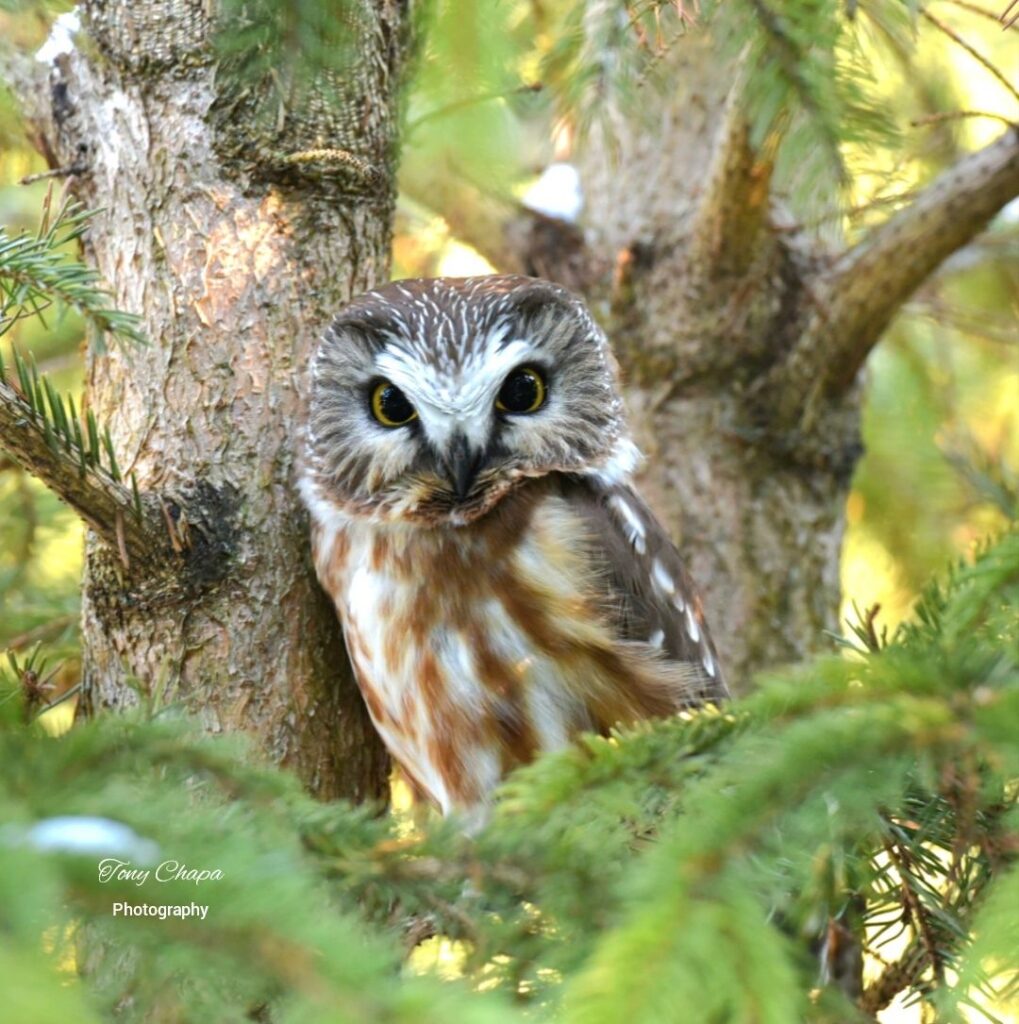
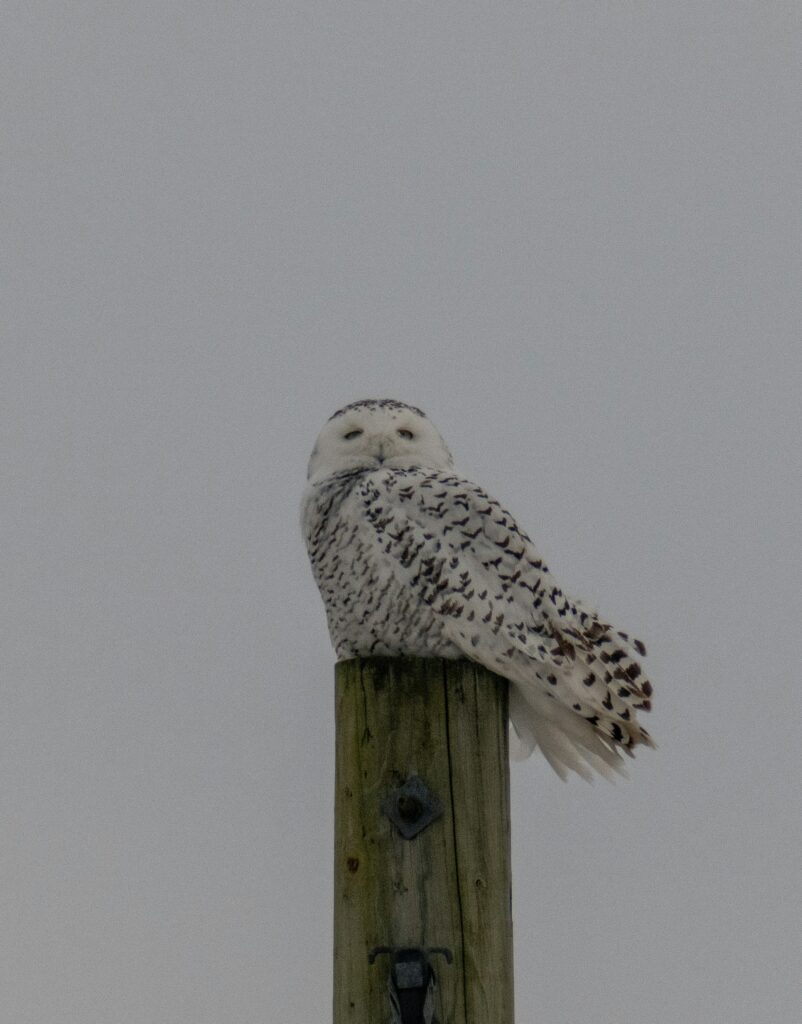
White on White, Looking Right, Tony Chapa
Now that the snow is flying, so too are Snowy Owls. This highly mobile species breeds and winters further north than any other owl. Most people encounter them only when the birds have dispersed far south of their arctic breeding range. Indeed, the causes and patterns of their movements are not understood with certainty, though decades of banding, telemetry, and satellite tracking efforts, in conjunction with environmental data, are shedding new light. Project SNOWstorm is a global collaboration of scientists, banders, and wildlife veterinarians, seeking to better understand this species of conservation concern, and turn science into action to save the species.
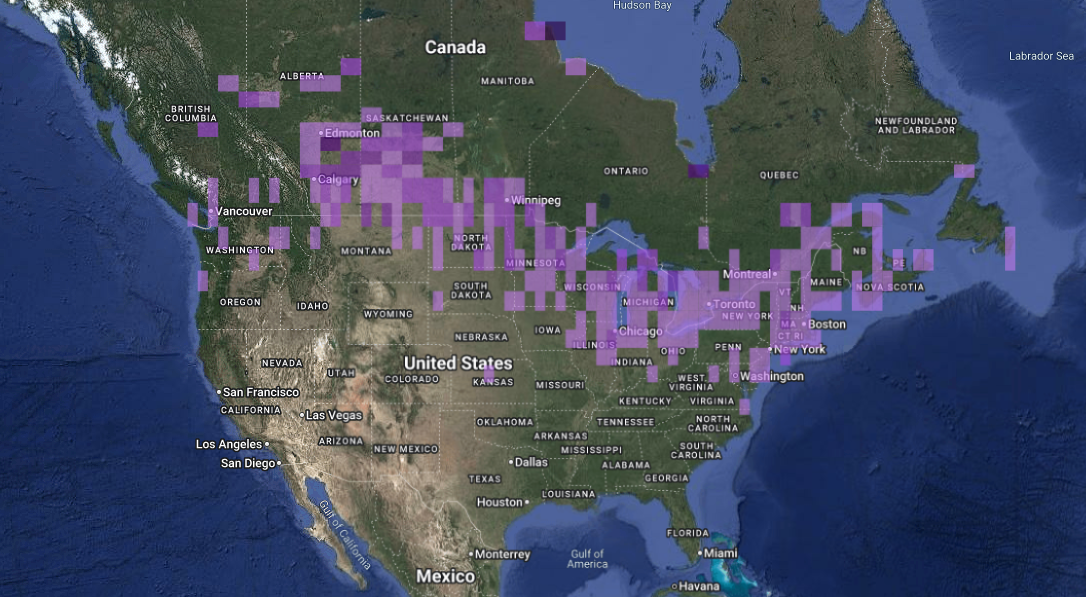
Generally, it is the young of the year that move further south than adults in winter, with some dispersing south every winter. When prey, such as lemmings, voles and ptarmigan, are plentiful, females can lay more eggs (up to 11) and pairs raise more young. More young means a larger and often more southerly “irruption” of Snowy Owls out of the arctic and into southern Canada and the Lower 48. Exactly when an irruption will occur is hard to predict and not as cyclical as once thought. The winter of 2013-14 was a really big one, with birds found as far south as Florida and even Bermuda! This winter is a more modest movement; so far the southern edge is roughly a northwest-southeast line from Alberta to Virginia.
Sightings of Snowy Owls submitted to eBird during November 2025-January 2026. Image provided by eBird (www.ebird.org) and created January 16, 2026.
Adults, meanwhile, are capable of spending the winter in the long dark, cold of the Arctic. They may move long distances, often east-west and across continents in search of food. Some live on the sea ice where they hunt seabirds and ducks along the edge of open water. When time to breed, they may again move long distances, congregating where food availability is high.
Snowy Owls are open country birds. When not in the arctic, they can be found hunting over prairies, marshes, farm fields, coasts, and even airports and towns. It is always exciting to see one! Keep an eye out for a white lump amidst the corn stubble, atop a power pole, or amongst the boulders of a jetty. Always keep a respectful distance, keep your voice down, move slowly, and watch for signs you may be causing stress, such as wide eyes or movement away from you. Never bait an owl to get a closer photo, and do not use tour companies that bait owls. This applies to all owl species. Posting an owl’s exact location might cause a crowd and increased disturbance, which is why some social media groups forbid it. Though they are probably not starving as once thought, they do need rest during the day and freedom to hunt when hungry.
Not all Snowy Owls that come south will survive, of course. Mortality in young, inexperienced birds generally is high. When closer to humans they are at greater risk of car collisions, power line electrocution, rodenticide poisoning and avian flu. Climate change and habitat loss further threaten them and their arctic food web. Snowy Owls have declined by over 30% over the past 25 years, with the global population estimated at fewer than 30,000 adults.
If you see an apparent sick or injured owl, call a licensed wildlife rehabilitator or your state’s wildlife agency. Some birds are lucky enough to be rehabbed and released. A few may end up as educational birds if they cannot fully recover.
Whether glimpsed on a windswept shoreline or perched quietly over an open field, Snowy Owls are a powerful reminder of the connections between the Arctic and our own landscapes—and of the conservation efforts to ensure they remain part of both.
Mark your calendars for Owl-O-Rama, March 6-7, 2026
Two days exploring Door County’s owls—their hunting adaptations, behaviors, and how we can help protect them!
Owl Prowl, Friday, March 6, 6-8:30 pm: Join a Ridges Naturalist at The Ridges Nature Center to learn about owl species that call Door County home. Then, head out on a local trail to hear them calling to one another! Meets at the Cook-Albert Fuller Nature Center, must have vehicle to drive to Prowl location.
Fee: $10 | Members receive a 20% discount; Pre-registration is required.
Eastern Screech-Owl Nest Box Workshop, Saturday, March 7, 12:30-1:30 pm: Head over to The Ridges Workshop to build Eastern Screech-Owl nest boxes to take home and hang in your backyard. A Ridges staff member will provide you with all the materials you need to assemble your nest box. Note: The nest box building portion of the workshop includes hammering and the use of power tools in an indoor space.
Fee: Public $50 | Members receive a 20% discount; Pre-registration is required.
Open Door Bird Sanctuary Meet and Greet, Saturday, March 7, 1-3 pm: Stop by The Ridges Nature Center for a fun, family-friendly experience with live birds of prey from Open Door Bird Sanctuary! This free event offers an opportunity to see owls up close and talk with ODBS staff who will be stationed throughout the Nature Center.
Free Program. Donations appreciated!
Photography Exhibit: Experience the striking owl photography of Tony Chapa in The Ridges Gallery. A Northeast Wisconsin artist, Tony’s work meticulously captures the beauty and individuality of owl species found in Wisconsin and Minnesota.
As the year comes to a close at The Ridges Sanctuary, I find myself feeling incredibly grateful—and honestly, in awe of how much we accomplished together. It feels like just yesterday we were welcoming the new year with big hopes and plenty of unknowns, and now here we are, looking back on a year filled with growth, connection, and inspiring moments.
None of this happened by accident. Every step forward this year was made possible by the people who believe in our work and show up for it in so many ways. Before diving into a few highlights, I just want to say thank you—for your support, your enthusiasm, and for being such an important part of our community.
We began 2025, dreaming about all that was to come. Our board and staff worked tirelessly to finalize PreDesign (conceptual plans) of projects advanced from our 20-year Master Plan approved in 2023. Our board, staff and key stakeholders worked diligently to develop plans for Education and Research that not only support our needs but also look towards growth.
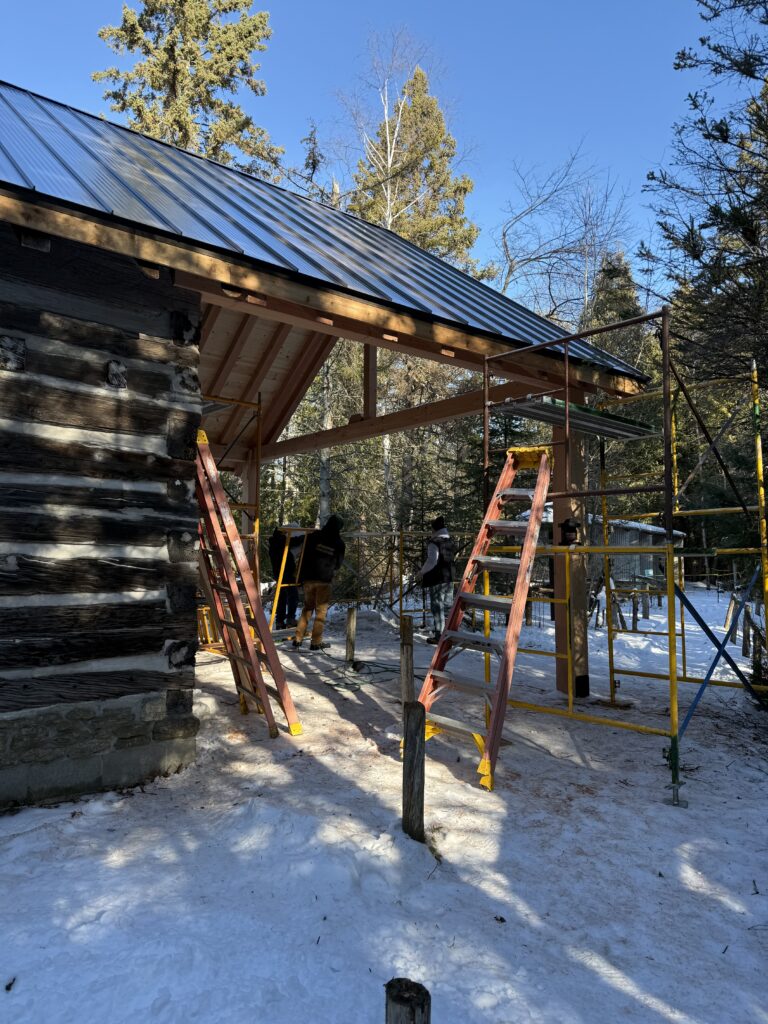
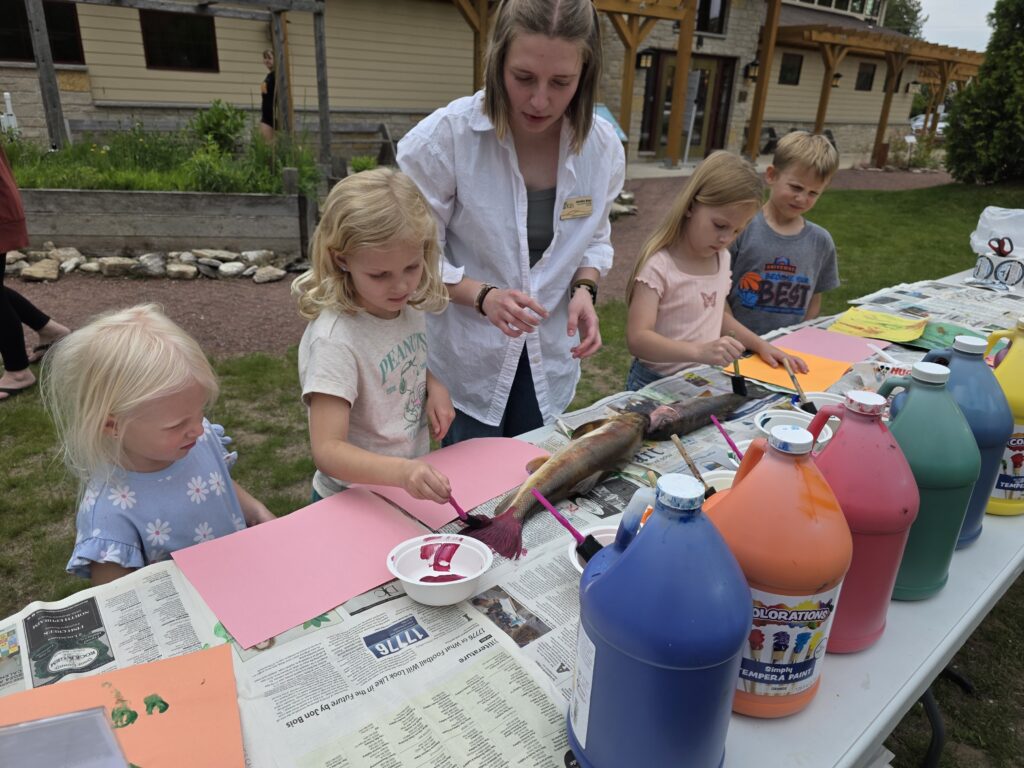
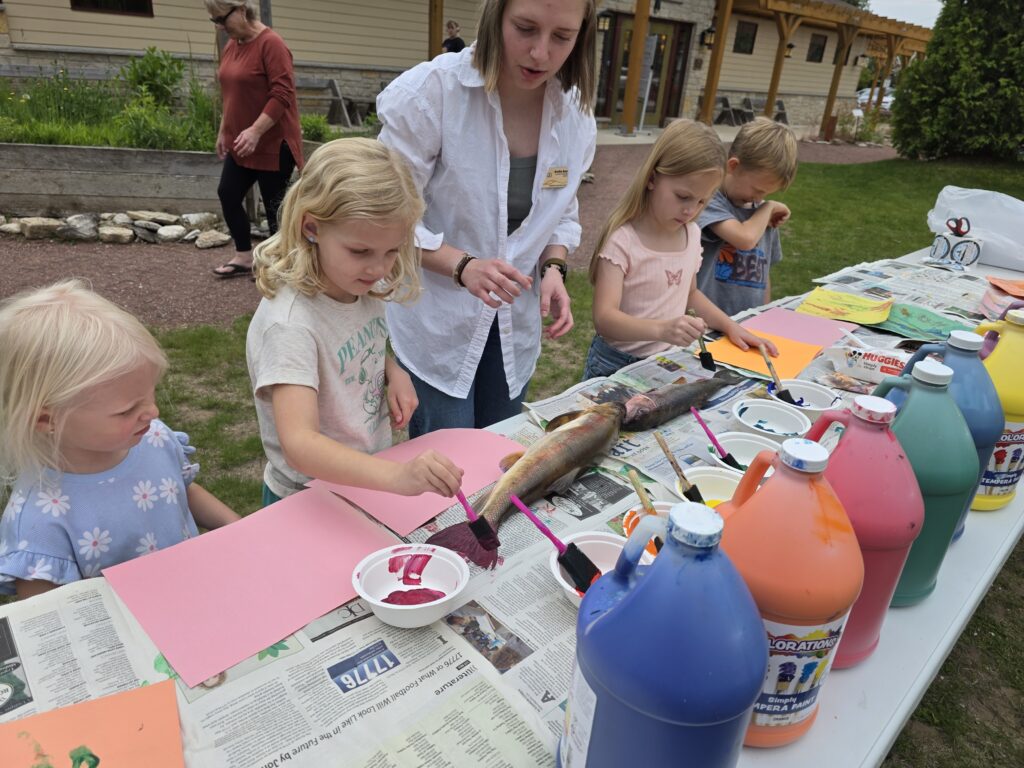
Kaye Cabin enhancement: New overhang expands outdoor, sheltered programmingFree Fridays: Engaging with nature through the art of fish printingWinter tagging day with Boreal Climate Survivability Project volunteersDragonfly Nature Preschool students prepare for outdoor play after snackLogan Creek Stewardship Crew: Boardwalk and bridge replacement
Investing in What We Need Now
Alongside this planning work, we launched a project called Phase Zero, focused on critical infrastructure investments that support our immediate educational and volunteer needs. As I write this, construction is well underway to renovate the Kaye and Marshall Cabins into year-round facilities, along with renovations to the nearby restroom facility to better support year-round programming. This coming spring, we are excited to complete one final Phase Zero project: the construction of a new volunteer workshop to support the incredible—and growing—work of our Wednesday Crew to keep the Sanctuary beautiful and safe. These projects were so generously funded by the Door County Community Investment Fund, The Raibrook Fund, private donors, and the Ridges Sanctuary Master Plan Implementation Fund.
With your enthusiastic support, we also took advantage of an exciting opportunity to install solar panels on the Nature Center, lessening our environmental impact and improving operational sustainability.
Expanding Access, Research and Preservation
While much of my own time this year was dedicated to infrastructure and long-term planning, the rest of our team focused on strengthening programming, expanding research efforts, and preserving the Sanctuary. Together, in 2025, we:
Embedded Free Fridays into our summer experience, providing free, engaging learning opportunities every Friday in June, July, and August—and we’re thrilled to continue this tradition each summer moving forward.
Launched the Boreal and Temperate Climate Survivability Projectin partnership with the Climate Change Coalition of Door County, the Lakeshore Natural Resource Partnership, and the Daybreak Fund—recording nearly 1,000 volunteer hours across an incredible group of dedicated volunteers.
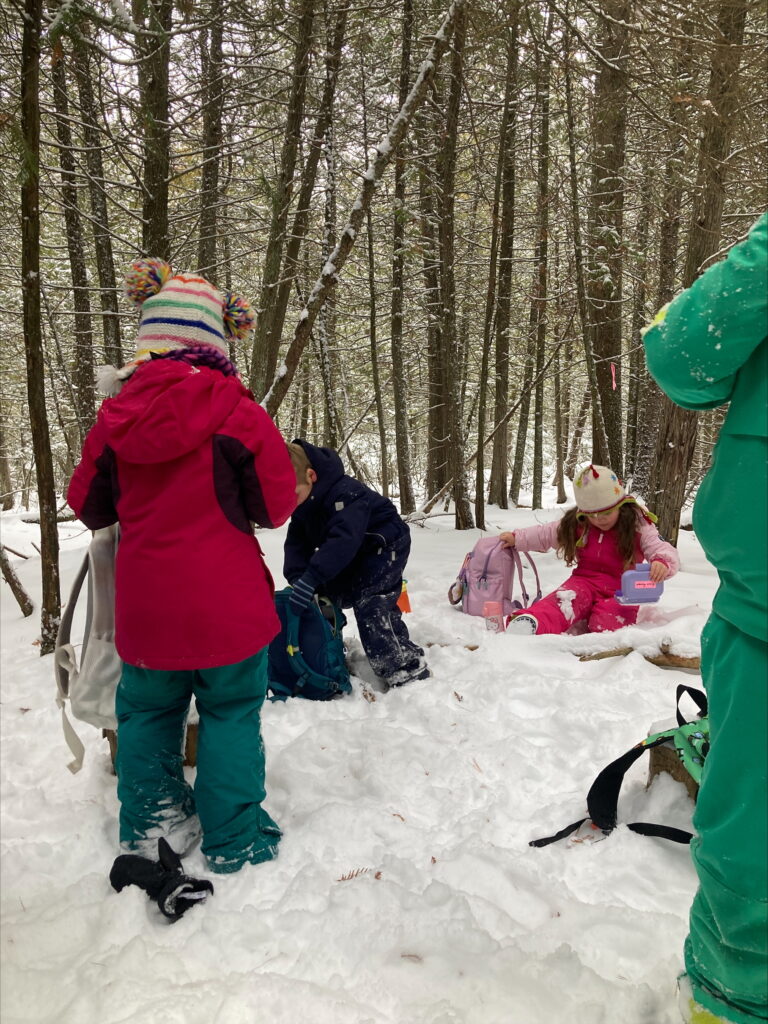
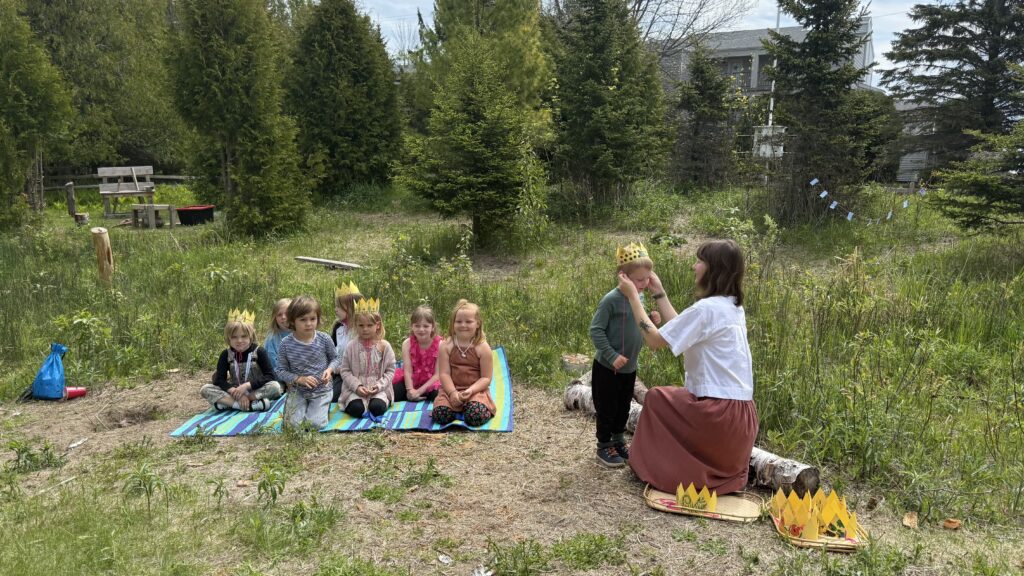
Continued our commitment to education through Dragonfly Nature Preschool, a free public preschool program in collaboration with the Gibraltar Public School District, and expanded Ridges Forest School to serve 18 students for the 2025–2026 school year.
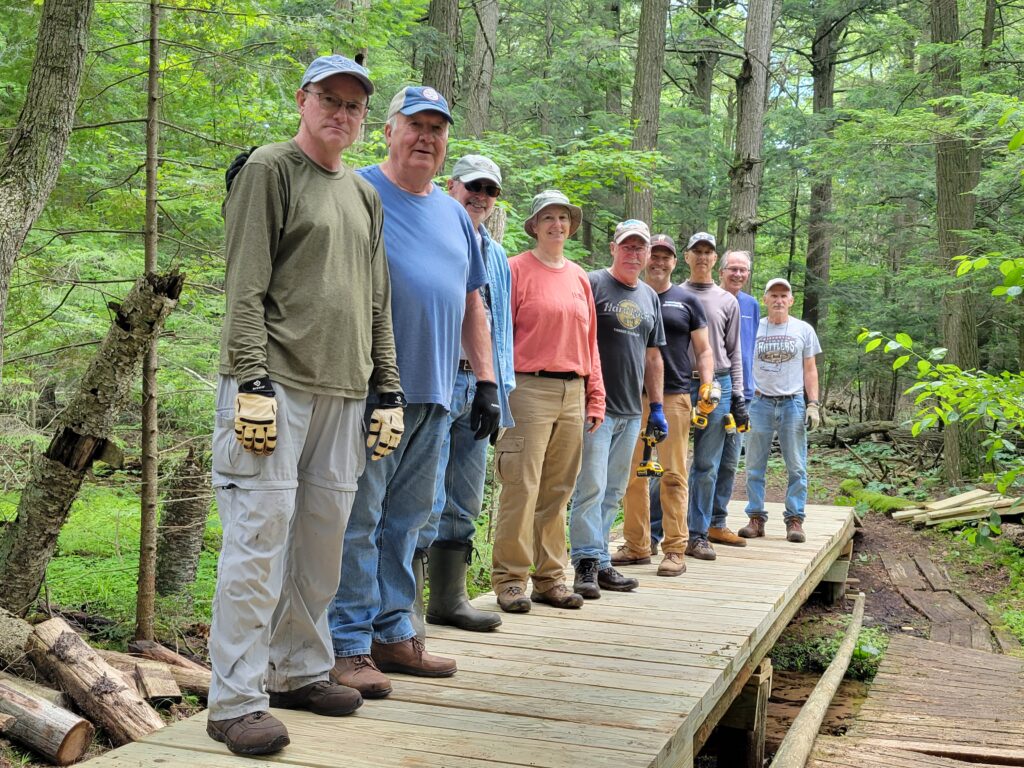
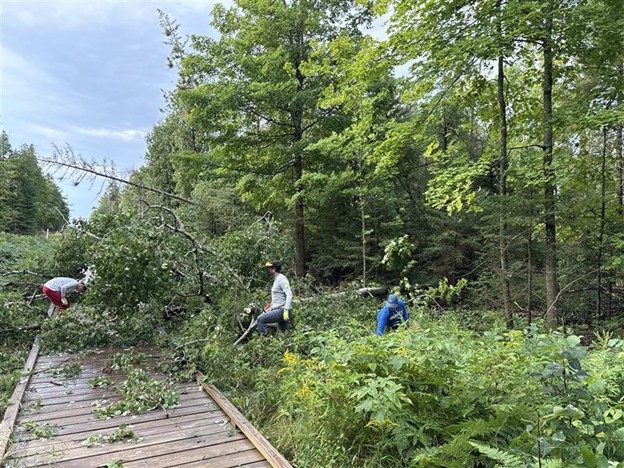
Replaced more than 365 feet of aging boardwalk at the Logan Creek Preserve with the help of our amazing Logan Creek Crew—while our incredible Wednesday Crew replaced nearly 385 feet of boardwalk along rustic trails in Baileys Harbor.
We also welcomed five new staff members to our growing team, whose talents and passion have strengthened our work:
Erik Ellison, Marketing Assistant, supporting visibility and outreach
Victoria Holderer, Applied Research Ecologist, supporting growth in our research and land management
Margaret Brennan, Environmental Interpreter, supporting Dragonfly Nature Preschool and interpretive programming
Eliza Banjanac, Director of Growth Initiatives, supporting fundraising and deeper connection with our members, donors, visitors, and volunteers
Zane Wulliger, Environmental Educator, supporting Forest Days in collaboration with Gibraltar Public School
Truly, the list goes on and on—this is just a snapshot of what we’ve accomplished together this year.
As we look ahead to the coming year, I’m filled with gratitude for this community and excitement for what’s next. Everything we’ve accomplished—and everything still to come—is rooted in the shared belief that this place matters.
Thank you for being part of the work, the vision, and the heart that make the Sanctuary what it is. I can’t wait to see what we continue to build together.
With gratitude,
Katie Krouse
Executive Director
The Ridges Sanctuary
Nature Notes: Season of Change – How Nature Prepares for Winter
By Amy Shook, Naturalist
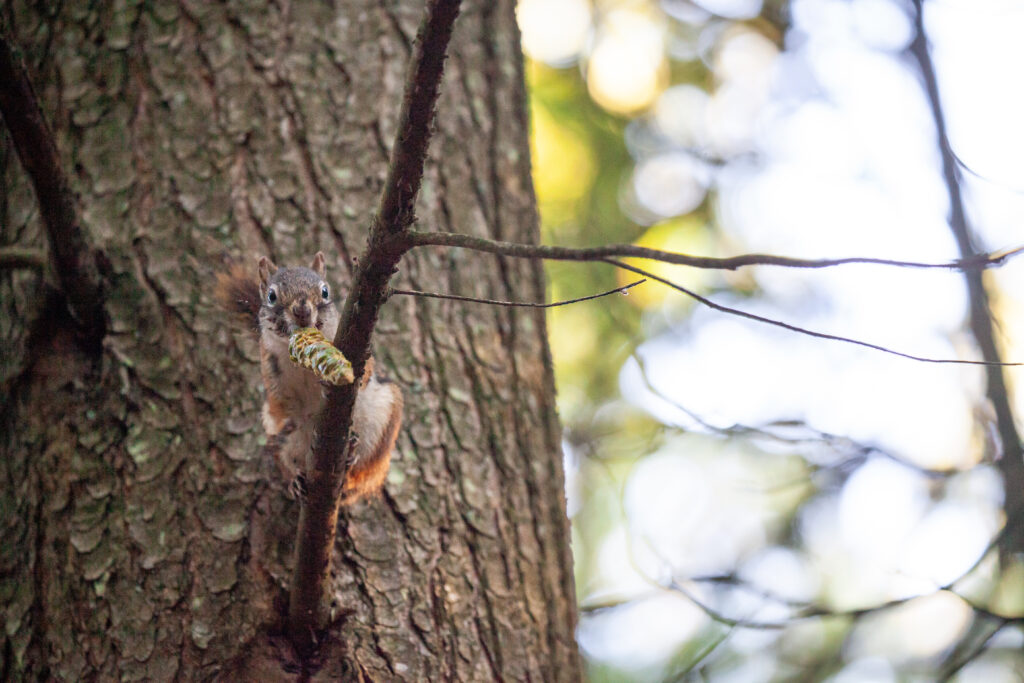
Red Squirrel, by Andrew Pirrung
As we start the transition between fall and winter, we think of everything that we must do. Put away the summer clothes, get outdoor furniture inside, find our snow brushes and shovels, find the heavy boots and mittens. We all have a process and routine for how to go about the transition in seasons. Animals and plants also go through a process to prepare for the transition of fall into winter; their process just looks a little different. Let’s start with some animals we find commonly here at The Ridges, and maybe in your backyard too!
Red squirrels are a common sight – and sound – at The Ridges. In the Sanctuary, a red squirrel is all you are likely to see as red squirrels live in coniferous forests, and we have a boreal forest right here in Baileys Harbor. A boreal forest is dominated by cold loving plants, like red pines, white pines, labrador tea, and wintergreen. Red squirrels are a relatively small species of squirrel that have a reddish tint to their fur and are not quite as bushy tailed as gray squirrels. They primarily eat seeds, with a favorite being seeds from cones, like white pinecones and red pinecones.
If you see an area that looks like a pinecone exploded, it is likely that a red squirrel had a snack there. In addition to smaller explosions of pinecones, red squirrels are also responsible for large piles of pinecone scales and cores. Red squirrels make these piles to help them have food throughout the winter, they are called “middens.” They create these middens by eating the pinecones from a perch in a tree over the area they have chosen for their midden. As they eat the seeds, scales drop down to the bottom and over time form large piles. The piles are used to store unopened pinecones for red squirrels throughout the winter. Red squirrels are active all winter long, so you may see them — or find their paw prints in the snow!
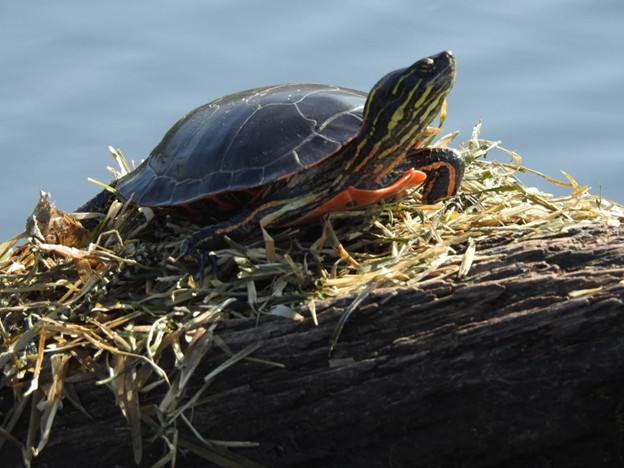
An animal you may not think of in winter, but may wonder about is the painted turtle! Painted turtles are a common sight basking in the sun and swimming in the swales all summer long, but come late fall and winter, they disappear. All turtles are ectotherms, meaning they do not generate their own body heat and do not maintain a stable internal temperature. They rely on the sun and external sources for body temperature, so as the weather gets colder, so do painted turtles. As it gets cooler, the turtles will swim toward deeper waters and head to the mud. They don’t hibernate —they brumate!
Brumation is a period of inactivity in reptiles during the winter months, and this is how they survive. Brumation requires painted turtles to go through some very big changes to make it so that they are able to survive in these cold conditions. The metabolic rate of painted turtles drops by about 90%, so that they do not need food or oxygen (Jackson DC 2002). This slows the turtles down, and you may even see them moving sluggishly under clear ice! While it may seem frightening to hold your breath and not eat all winter long, turtles have evolved to survive our cold conditions. Once the ice has thawed, the turtles will become more active, metabolism will increase, and you’ll see them basking on sunny, warm spring days.
Painted Turtle by Wendy Beilfuss
I’ve talked about a couple animals we have here in the Sanctuary that survive our winters, but what about the plants? With our boreal forest, we have many conifers and evergreens. I use both terms because they are not necessarily the same type of plant. Conifers reproduce through using cones —think white pine (white pinecones), tamarack (tamarack cones), and red pine (red pinecones). Evergreens are plants that retain their needles (leaves) all winter long, like white pine, wintergreen, labrador tea and northern white-cedar. Conifers can be evergreen, but not all are.
Tamaracks are conifers that are not evergreens. Tamarack are deciduous conifers, meaning they produce cones (conifer) but lose their needles every fall. If you visit The Ridges in late October, you might just see our tamarack turning from green to a brilliant gold color as they prepare to drop all their needles. Tamarack do this as a strategy to survive our harsh winters.
Having needles or leaves all winter can open trees up to frost and ice damage of the tissues within the tree, which can harm the overall health of the tree. Leaves and needles are exposed and have no serious protection from the cold, which is why deciduous trees lose them in the fall. Tamarack have evolved that the most energy efficient way for them to survive winter is losing and regrowing new needles each year. This reduces the damage done to the tree in the winter and allows them to grow fresh new needles. New needles can photosynthesize quickly and allow the tree to recuperate any energy spent growing new needles.
In contrast, white pine trees, which are conifers AND evergreens, retain their green needles all year. While tamarack have evolved to lose their needles and regrow each spring, white pine have evolved so that keeping their needles all year is more energy efficient than losing them. White pine have a thick, waxy substance called a cuticle that covers their needles to protect them from the damage of ice and freezing. In addition, retaining their green needles all year means that they can continue to photosynthesize and create energy, even in the cold months. This cuticle layer and the shape and flexibility of white pine branches helps with shedding snow to prevent it from accumulating and breaking branches as well.
Winter is a time where many think about hunkering down, but it’s one of my favorite times of year. I love to see all the changes that happen around me as the world seems to slow down. Take some time to enjoy the winter months outdoors and maybe you’ll have a new appreciation for the adaptations that so many animals and plants make to survive our winters.
Nature Notes: Learning from the Land – Summer Naturalist Highlights at The Ridges
By Anna Foster, Director of Programming
Each summer, The Ridges Sanctuary welcomes summer interns who bring fresh perspectives, curiosity, and dedication to our work. Through hands-on projects that connect education, storytelling, and stewardship, they help advance our vision to inspire the conservation of Nature. This year, summer interns Annika Buhr and Julia Maynard took on independent internship projects. These projects delved into what could be learned from the ecological and human stories woven into Ridges lands.
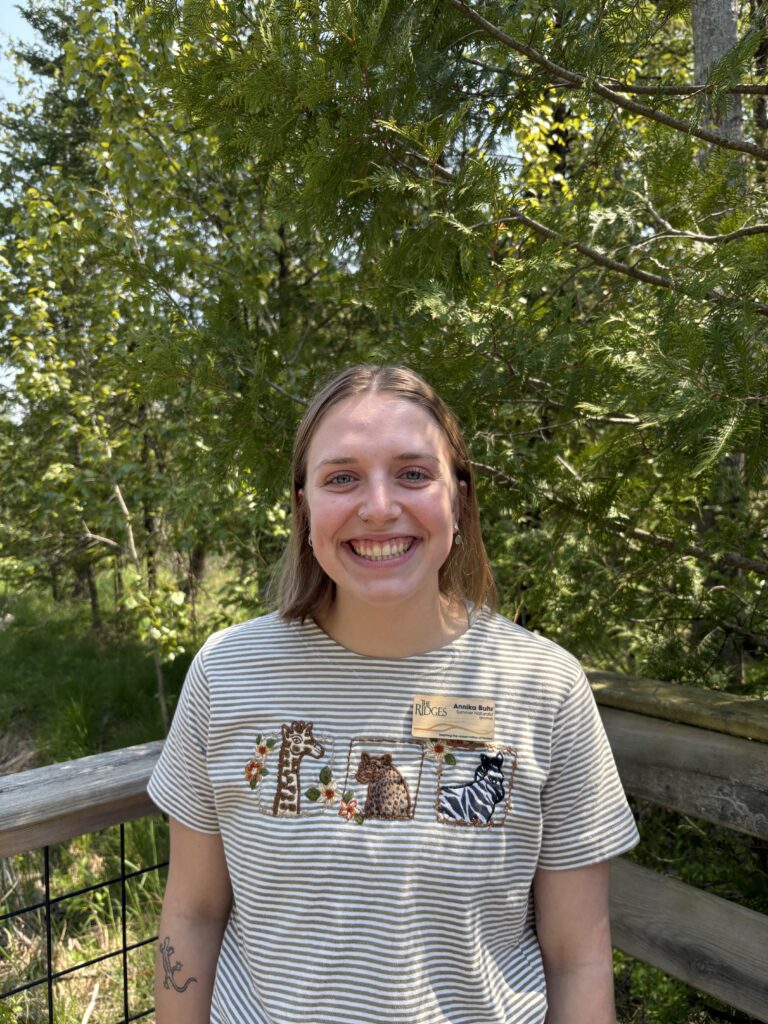
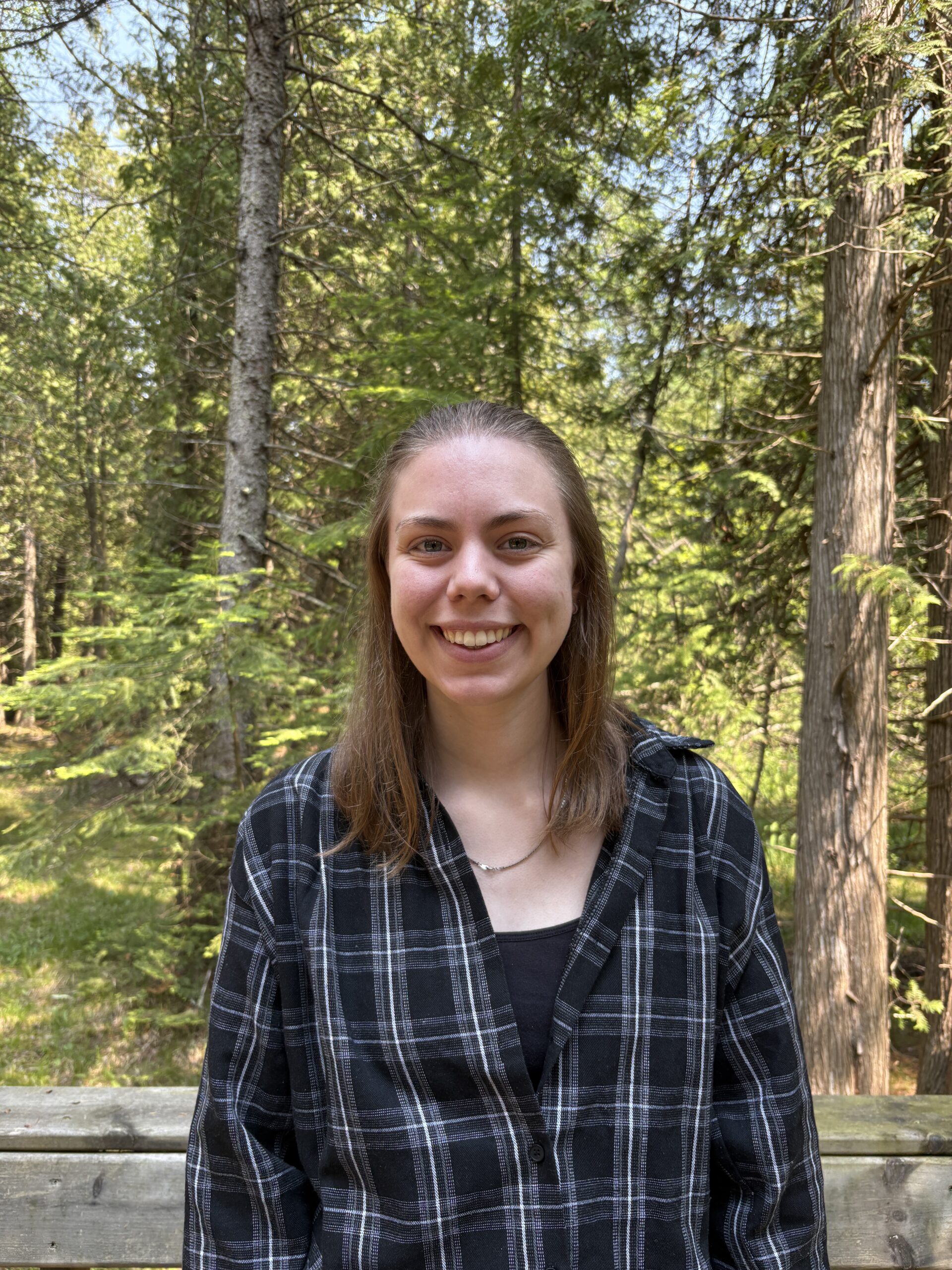
Annika Buhr was the 2025 Summer Naturalist at The Ridges. Her position included helping with Backpack Adventure Camp, leading Sanctuary Guided Hikes, helping visitors at the front desk, and working on an independent project on nurse logs of The Ridges Sanctuary.
From Denver, CO, Annika is a student at Colorado State University. She is majoring in Biological Sciences with a minor in Mathematics. She is excited to continue her studies in botany in Colorado and anticipates graduating in the spring of 2026.
Julia Maynard was a 2025 WisCorps Summer Naturalist Placement at The Ridges. Her position also included helping with Backpack Adventure Camp, leading Sanctuary Guided Hikes and helping visitors at the front desk. Her independent project was on unique stories and uses of plants found in The Ridges.
From Winona, MN, Julia graduated from The University of Wisconsin – LaCrosse in 2024 with a major in Theatre Performance and minors in Environmental Studies and Sustainability and Costume Design. She now lives in LaCrosse and continues to serve through WisCorps.
Project Highlights
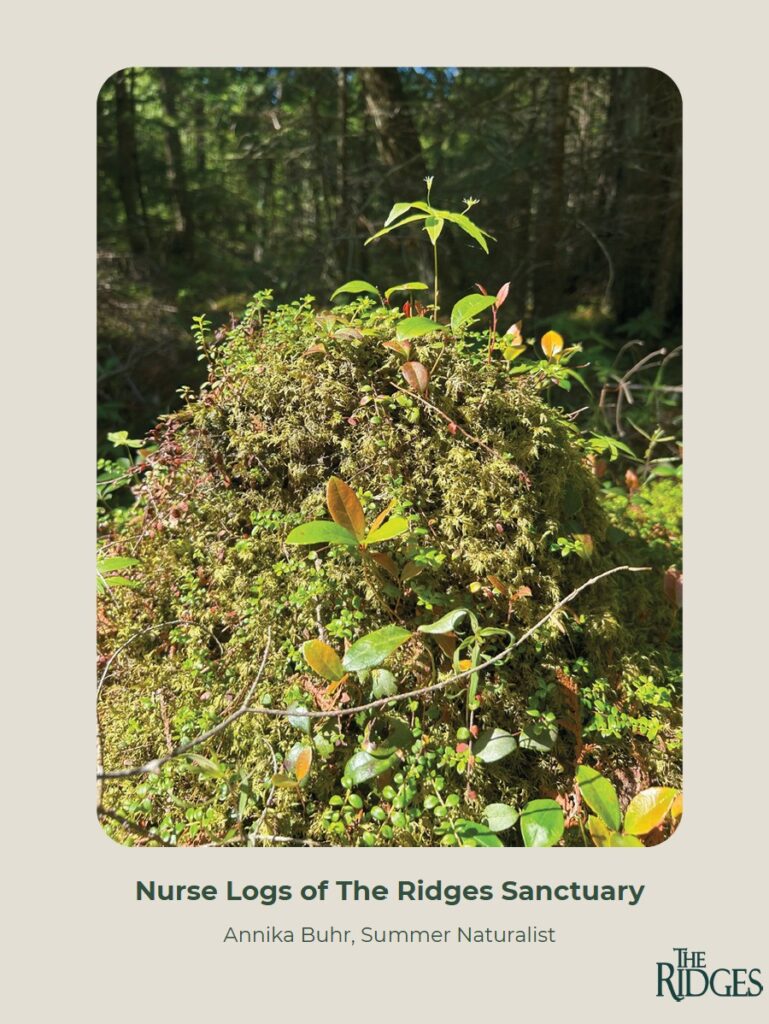
Nurse Logs of The Ridges Sanctuary
Annika’s summer project explored the vital ecological role of nurse logs — fallen trees that foster new growth and sustain life in the forest. Her work resulted in two resources for visitors to enjoy: a beautifully designed brochure and map highlighting prominent nurse logs along Sanctuary trails, and an in-depth article on their importance within the ecosystem.
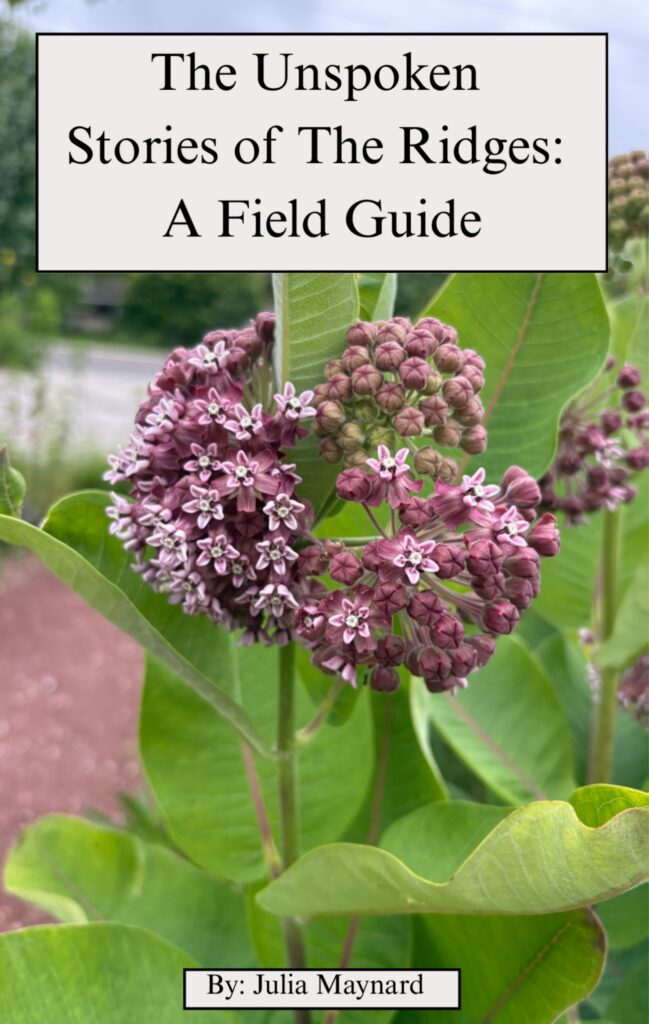
Unspoken Stories of The Ridges
Julia’s summer project, Field Guide of Unspoken Stories, highlights the unique stories and personal connections people have with the plants of The Ridges Sanctuary. Through interviews, reflection, and exploration, she created a beautifully illustrated guidebook featuring photos and narratives that share how volunteers, naturalists, and longtime members experience and value the Sanctuary’s flora. The Guide invites readers to see The Ridges through the lens of memory and meaning.
Reflection & Impact
These independent internship projects remind us that conservation is both a science and a story — rooted in data, but also in human experience. We’re grateful to Annika and Julia for their curiosity, creativity, and commitment to sharing what they learned from the lands at The Ridges with others.
Nature Notes: Is The Ridges Haunted?
By Anna Foster, Director of Programming
“Is The Ridges Haunted?”
It’s a question we get asked more often than you might think, especially at this time of year. There are many places in Door County that are known to be haunted, but The Ridges isn’t one of them. However, over the years I’ve heard enough tales from staff and volunteers to suggest otherwise.
It makes sense that people have stories of strange occurrences at The Ridges, given that the organization is in its 88th season and has multiple historic buildings on the property. Ghost stories are par for the course when it comes to historic buildings, especially those that have housed many families over the years. This raises the question: are these stories true, or is it just people’s imaginations getting the best of them?
Admittedly, I love a good ghost story. I also love learning the history of old buildings and how the people who came before us inhabited the same spaces we do today. I tend to collect these stories because it helps me feel well acquainted with a place. Having worked with so many people connected to the organization’s history over the last eight and a half years, I’ve collected quite a few intriguing tales.
To answer the question of whether The Ridges is haunted, and to celebrate the spooky nature of the season, I thought I’d share just a few of the stories. You can be the judge of whether you think The Ridges has some supernatural residents. Maybe you don’t believe in ghosts, or maybe some of you have your own experiences to add to the list…
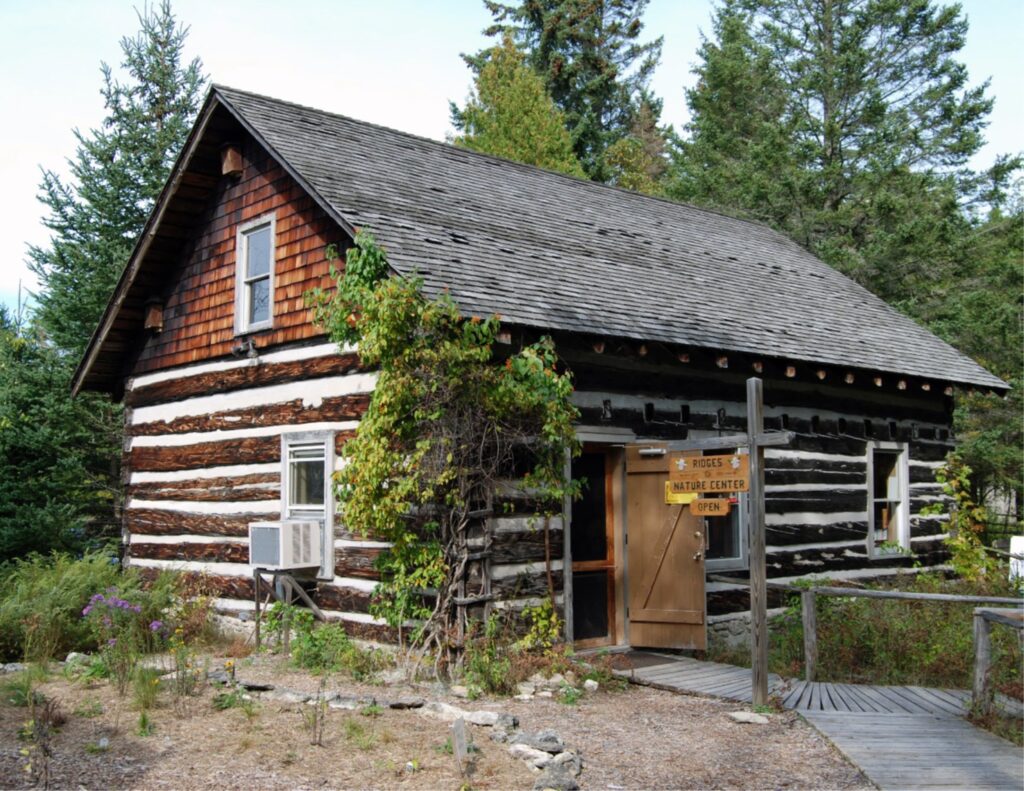
The Kaye Cabin, former Ridges Nature Center, is now used for Natural Christmas and youth programs.
The Kaye Cabin
Many people remember the cabins as the old Nature Center of The Ridges. The building holds special memories for many of our volunteers. One day about three years ago, a summer intern told us her grandmother (a longtime volunteer) didn’t like to go up into the attic of the Kaye cabin. When asked why, she said it was because she didn’t like seeing the burn marks from the girl that died there.
Naturally, my reaction was along the lines of, “What now???” At the point of this conversation, I had been going up into the Kaye cabin attic for about six years. Surely, the burn marks were from a small fire or were present on the lumber before the cabin was constructed. The intern’s insistence on her grandmother’s recollection led to more historical digging on my part.
The Kaye Cabin was constructed in 1853 on the farm of Orville Kaye in Kolberg (southern Door County). In the early 1900s, the Lessmillers moved in. They had two children, one of whom was Almita. Looking through Roy Luke’s records, I found an old newspaper article clipping. It turned out that the volunteer had been right.
The tragic death of Almita was a shock to myself and the other Ridges staff members I told. It was a sad story that has faded through the decades of different staff members and cabins uses. Many people tell stories about The Ridges back in the day, but having access to the newspaper article made us all very aware of the space and time spent there.
To be clear, those who have heard footsteps upstairs or have felt like someone is watching them have never talked negatively about it. If Almita’s spirit is in the Kaye cabin, she hasn’t bothered anyone, at least not that I’m aware of. The cabins always have been and continues to be a special space, loved by many campers, students, and hikers.
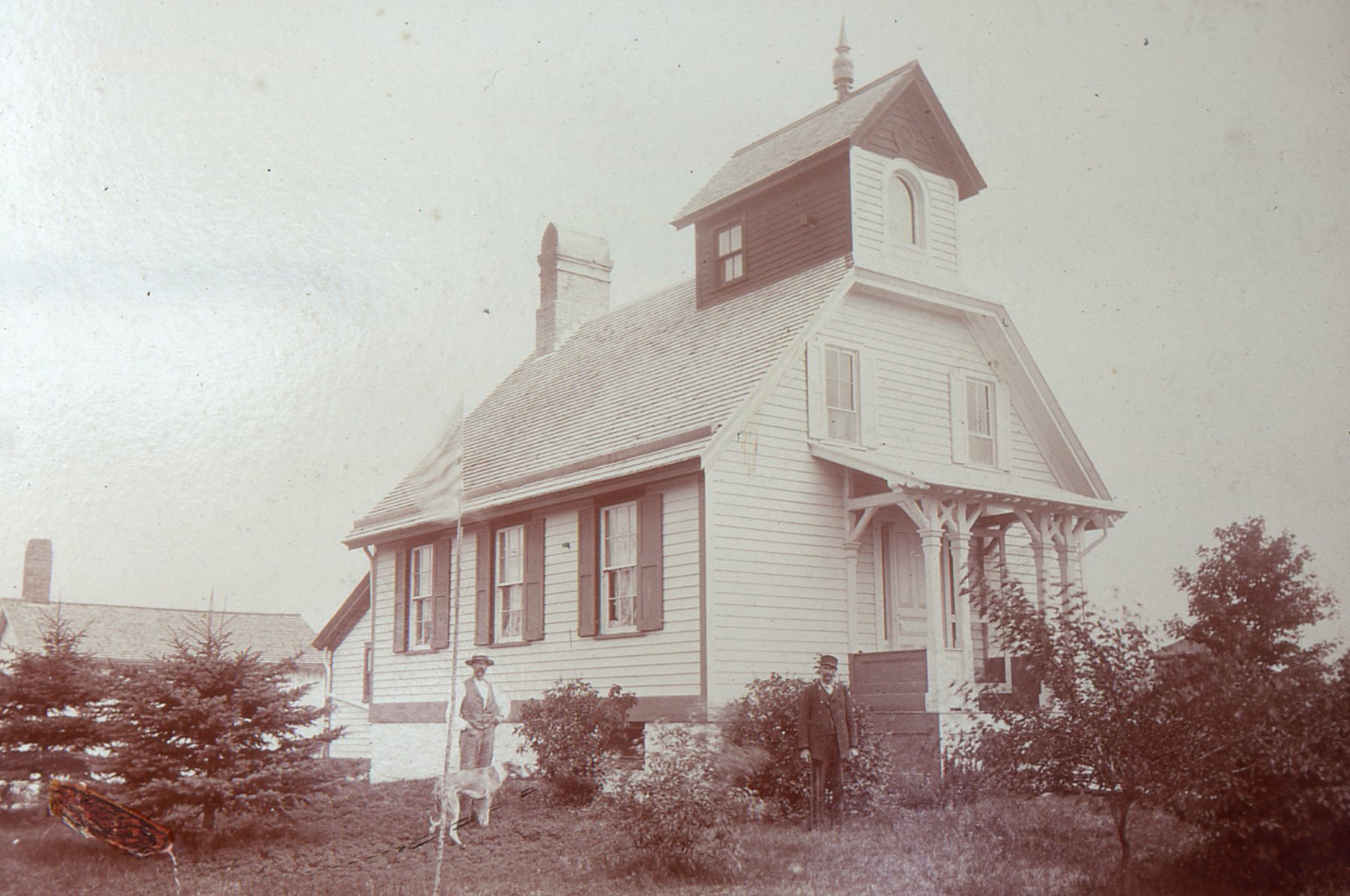
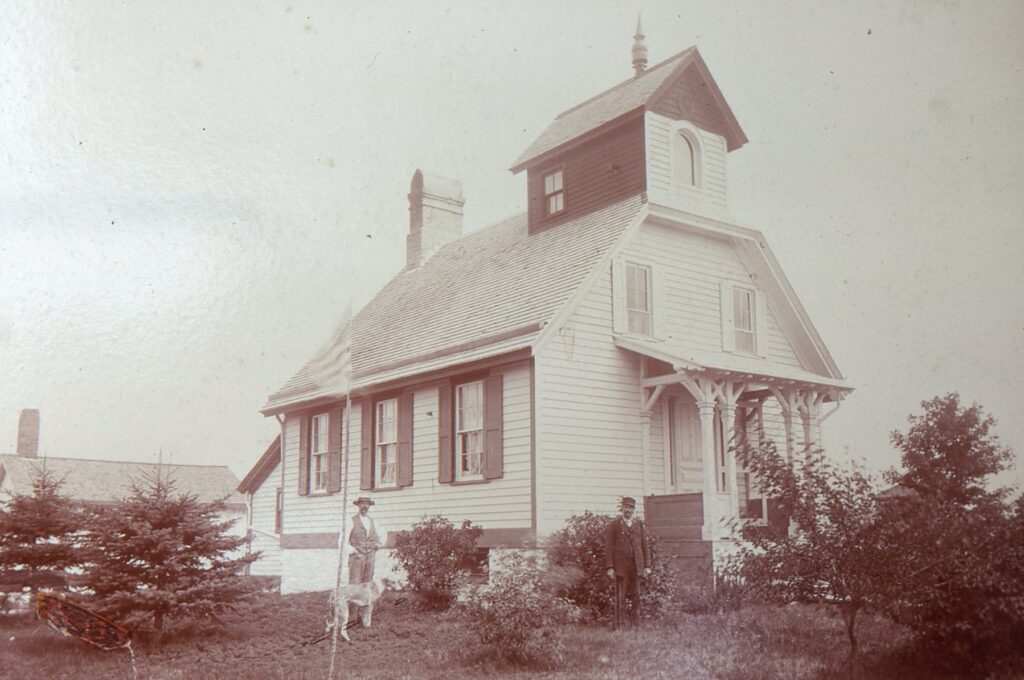
The Upper Range Light
Henry Gattie, the last Baileys Harbor range lights keeper and friend, at Upper Range Light, circa 1907. Photo by Ed Miller
The Range Light sparks the most questions about ghosts at The Ridges. Constructed in 1869, the Range Lights were home to eight different Range Light Keepers and their families, a Lutheran minister and his family, and several Ridges Directors before it became the organization’s office space in the 2000s. Upon the construction of the “new” Cook-Albert Fuller Nature Center in 2015, staff moved to the Nature Center, and the Range Light was restored to the period of the last Range Light Keeper, Henry Gattie.
As with pretty much any lighthouse anywhere, there have been several unexplainable occurrences inside the building. Here are a few examples:
A staff member was using the Range Light shower one evening after their water had been cut to do some plumbing work. She was in the shower downstairs while her partner was upstairs. In the middle of her shower, she heard a blood curdling scream. She jumped out of the shower and ran upstairs, only to find her husband sitting and reading. He hadn’t heard anything. Was this a ghost? And if so, who?
One of our Environmental Educators lived in the Upper Range Light two winters ago. She had several otherworldly occurrences while she lived there. For example, when her family stayed in the Range Light while visiting her, they came downstairs to find that her plants had been tipped over. She had no pets. They could find no explanation as to why or how this might have happened. After they found the plants, her brother told her he felt as though someone had been standing over his bed, watching him the entire night.
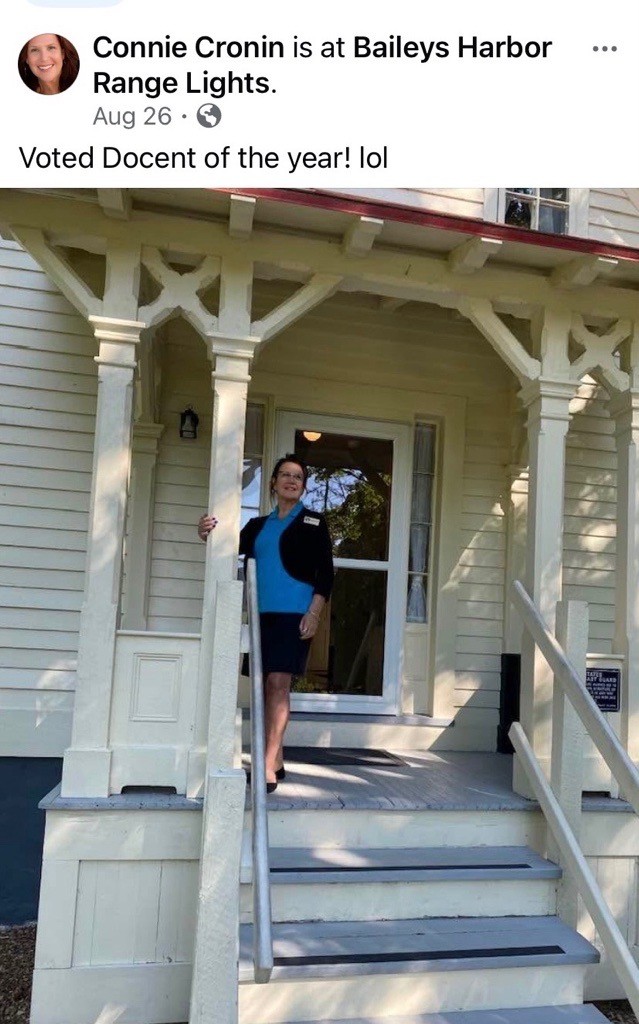
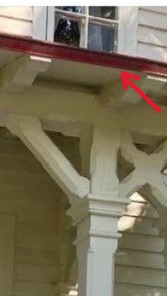
We have a wonderful live-in docent program at the Upper Range Light, in which volunteers stay a week in the Range Light, opening the building for tours each day and teaching visitors about the history of the Range Lights. The docents who were in the Range Light during the last week of August this year, Don and Connie, had more than one strange occurrence during their stay. First, Connie posted a photo online to friends and family, updating them about their stay at the Range Light. Friends started commenting on the photo, suggesting that either a Range Light Keeper or a skull could be seen in the photograph (see below). Connie and Don think the man others commented on seeing could be Fabian Truedell, the first Range Light Keeper. The second unexplainable occurrence had Don and Connie truly spooked. After a long day of giving tours of the Range Light, the two went upstairs to relax. It was dusk at the time, which is when the Sanctuary closes to visitors. Shortly after sitting down, Don and Connie both heard loud knocking at the back door. Before they could get up and make their way downstairs, they heard more knocking. Don recalls, “I ran downstairs, figuring someone from the Nature Center was stopping by. Went immediately to the back door, no one there. Popped my head out and looked around the building and nothing. Went to the front, looked around from all angles and no one. We both had the hair on our arms standing on end. What was the knocking?”
The most recent encounter comes from our Naturalist and adamant ghost-story-hater, Amy. Amy’s parents were staying in the Upper Range Light this fall as live-in docents. After a long day of programming, Amy decided to sleep on the cot in the Range Light rather than drive down to her house Sturgeon Bay in the dark. As she was lying on the cot in the bedroom that evening, she heard laughter coming from the living room downstairs. Amy’s parents were asleep, and no one was nearby outside. She immediately thought it had to be the laughter of Henry and Eve Gattie, the last Range Light keepers. Eve and Henry loved to entertain guests, and she said it sounded just like people were having a nice time at a dinner party. Although it sounded friendly and kind, the next day Amy vowed never to stay in the Range Light again.
Henry and Eve Gattie, U.S. Lighthouse Society News
Photo submitted by Don and Connie during their stay at the Upper Range Light
Close up of the Upper right Range Light window
I did some digging into the history of the Range Lights just to see if there could be any explanation for these occurrences. The only record of a death I could find was that of Lucy Shaler. Her husband, Marcus Shaler, became the Range Light keeper in September of 1872. His time at the Range Light was short. An outbreak of typhoid fever swept through Door County in the winter of 1874-1875. Tragically, Lucy succumbed to the illness that winter. Marcus’s grief was so consuming that he resigned from the post of Range Light Keeper in April of 1875.
Henry Gattie was the Range Light keeper for 27 years until 1923, when the lights were converted to an unmanned system. He was very fond of the Range Lights and often checked in on the buildings, even after he and his wife Eve moved to Cana Island. The two eventually retired but visited the Range Light often. The house is restored to the period of Henry Gattie’s time as Range Light Keeper.
Were these strange occurrences in the Range Light the presence of the ghost of Henry? Could it be someone else who lived there? Or are there perfectly reasonable explanations for these experiences? We may never know. However, part of our programs is to tell the story of Henry Gattie and the other Range Light Keepers, the hard and isolating work they did, and what life was like here in Baileys Harbor back when the Range Lights were built in 1869.
The Ridges is a special place to many people. The organization was founded by a group of people who desperately wanted to protect the land for future generations, which is something that all staff, volunteers, and anyone who has been involved in the organization over the years share with one another. Many people comment on how The Ridges feels “different” or “special” when they’re out on the trails, like there’s some unknown energy that makes itself known to those who venture out into the depths of the Sanctuary. Whether the history of the buildings or of the area have influenced this energy, or it’s just something intangible about the place, we can all agree that The Ridges is worth protecting for those who will come after us. Staff do their best every day to care for and respect everything within the Sanctuary, including the historic buildings and spooky spirits inside.
These are just a few of many tales from volunteers, staff, and friends of The Ridges Sanctuary. Do YOU have any spooky experiences to add to this list? I’d love to know! Email me at anna@ridgessanctuary.org.
Celebrate Halloween with Us!
While these stories are actually pretty spooky, we do offer more family-friendly ways to celebrate the Halloween season!
Friday, October 24 | 4:00 pm – 6:00 pm
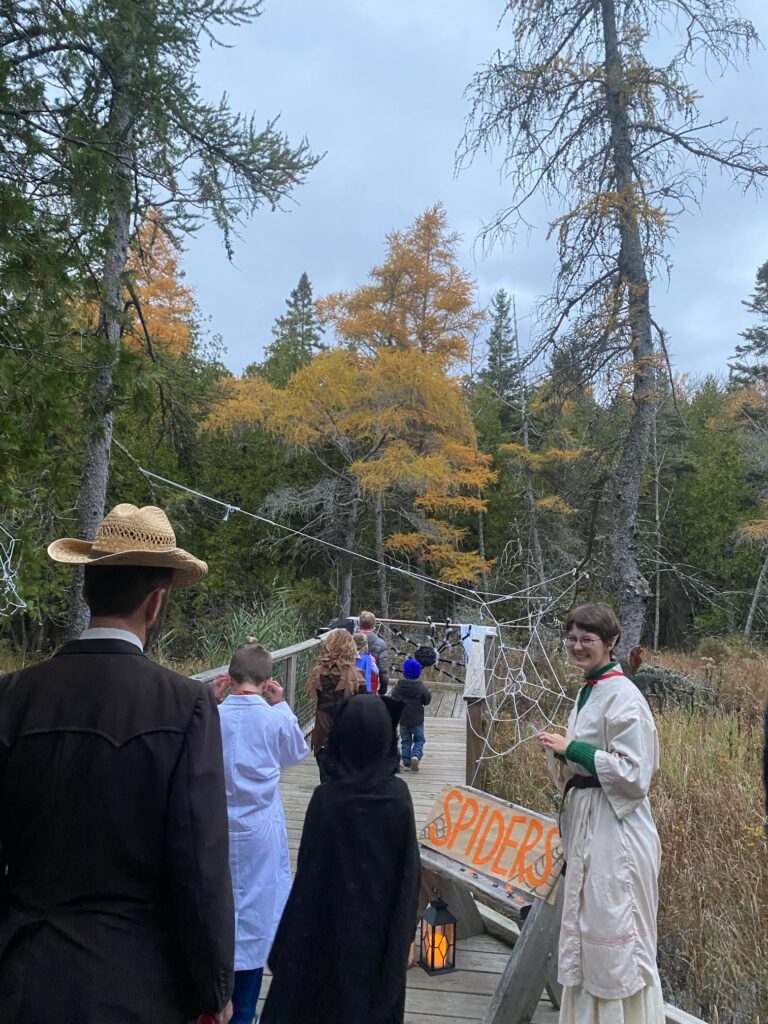
Join us for our annual Halloween Hike at The Ridges! Stop by the Nature Center to register, then enjoy a self-guided walk along the Hidden Brook boardwalk! Staff will be at stations along the way to teach you about some of the nighttime critters we find in the Sanctuary. After your hike, enjoy warm cider and a fire on the front lawn. This walk is appropriate for families with children of all ages.
The Swale Tale: How an unusual Door County landscape is helping researchers learn how Great Lake water levels affect groundwater and forests in coastal areas.
Because of the incredible diversity of habitats that make up The Ridges Sanctuary, numerous outside organizations utilize this area for their research. The Ridges is home to organisms not found anywhere else in the county—or the entire state. The following article on the Ridge and Swale Ecohydrology project, a partnership that provides a better understanding of the intricate relationship between groundwater and Lake Michigan. This research adds to an overall picture of our environment for us and for future generations. This project was made possible through support from the University of Wisconsin Water Resources Institute, with fieldwork by a graduate student from the University of Wisconsin-Madison and undergraduate students from the University of Wisconsin-Platteville, University of Wisconsin-Madison, and William and Mary.
Originally published by Andrew Savagian, UW-Madison Aquatic Sciences Center
Landscapes tell a story. That can be obvious to the casual observer traveling around the state, whether it’s taking a scenic fall drive through the Driftless Area in southwest Wisconsin, exploring the potholes and drumlins of Kettle Moraine State Forest near Milwaukee, or kayaking among the water-etched sea caves off Lake Superior’s Apostle Islands.
To the trained eye, those landscapes also tell a story, but one goes beyond a quick photo and may provide answers to important research questions. University of Wisconsin-Madison Professor Steven Loheide, graduate student Eric Kastelic, Freshwater@UW summer students Lucie Carignan and Ella Flattum, and collaborators are focusing their collective scientific gaze on a particular section along Door County’s southeast coast for clues to a decades-old question: How do Great Lakes water level changes affect groundwater and forests along our coasts?
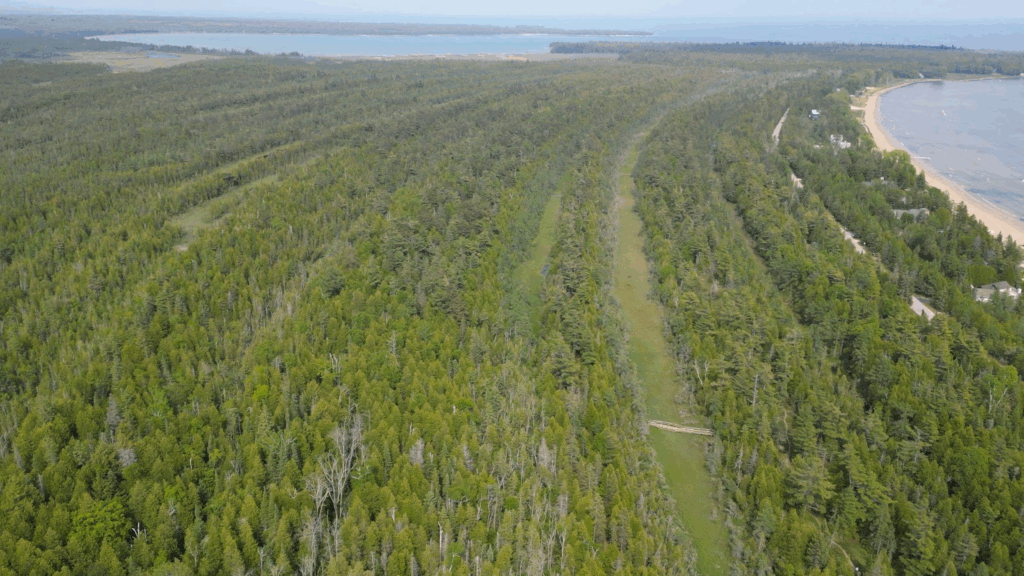
The Ridges Sanctuary is a 1,700-acre nature preserve tucked along the bottom half of Door County as it pokes into Lake Michigan just above the community of Bailey’s Harbor. Initially established in 1937 as Wisconsin’s first land trust, the sanctuary is a National Natural Landmark noted for a rich concentration of rare plants, including 25 species of orchids. What really sets this place apart from other preserves, however, is the 30 or so swales and crescent-shaped ridges that line the sanctuary from west to east.
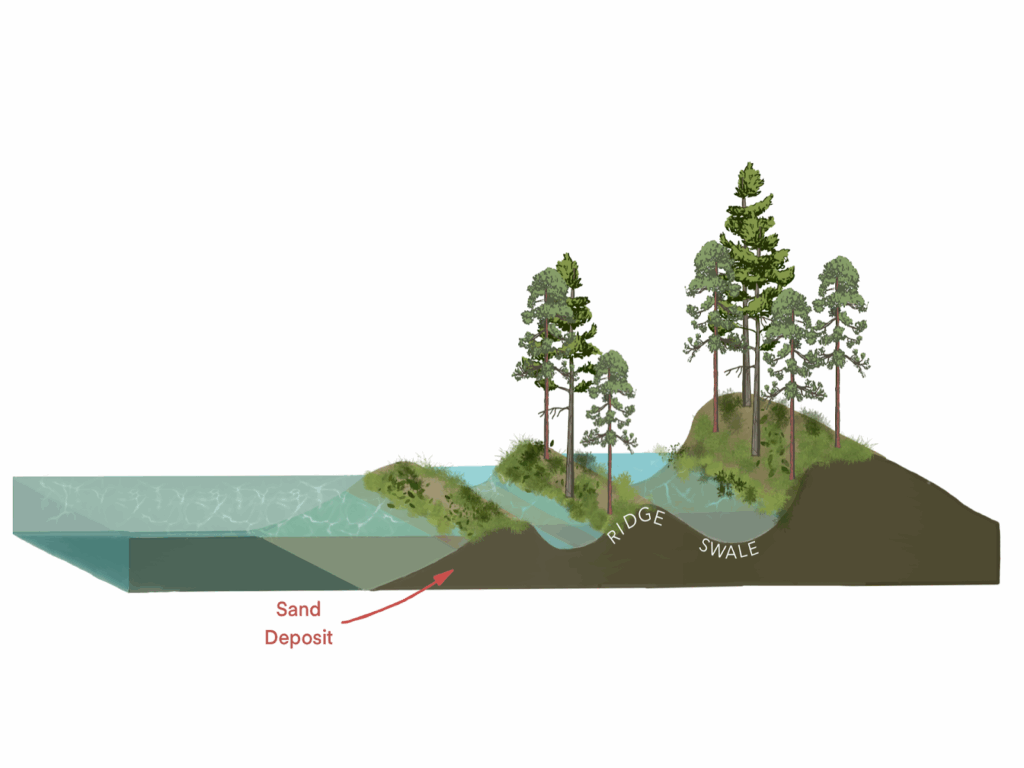
These are the areas where Loheide, Kastelic, and team have concentrated their efforts. The sandy formations represent former beaches caused by changes in Lake Michigan water levels during the past millennia. Each is peppered with black and white spruce, balsam fir, and white pine. Between these ridges are swales, which are wet, lower areas, each containing their own collection of diverse marsh and bog flora.
In ridge and swale ecosystems, forested ridges and marshy wetlands run in long strips parallel to the shore, like here at the Ridges Sanctuary.
“What we’re interested in is how the Great Lakes and the changing water levels within the Great Lakes affect the ridge and swale ecosystems,” said Loheide. “There’s a tight connection between the surface water, the Great Lakes, and then the groundwater, which is underneath the subsurface but is feeding the wetlands and feeding the forests in these systems.”
Scientists have known for some time that water levels fluctuate in all five Great Lakes. Historically they change not just annually but over several decades with the record high being more than 6 feet higher than the record low. For Loheide, what he and his fellow researchers are most interested in are more recent water level changes.
“On short, seasonal scales, you might have a foot of variability from high water levels in one year to low water levels in that same year,” explained Loheide. “But when you look at it at a longer time frame, we see that there are cycles. For instance, in the early 2000s through about 2012-2013, we were in a low water state. That whole time, there were still ups and downs every year, but we were at low water levels, and then we went from near record lows then to record highs in 2017, 2018, and 2019. That really quick swing is something that we’re interested in.
“There’s always been a lot of variability, but we’re seeing what seems to be sometimes faster changes from low water level conditions to high water conditions, so more extremes. And we’re actually going through the same thing right now,” said Loheide. “The high-water levels of 4-6 years ago are now dropping to below average water levels on Lake Michigan.”
Those faster water level changes could have greater impact on coastal ecosystems, and that’s where Loheide’s team has zeroed in their research efforts.
“Even since last year, lake levels have gone down about 10 inches. What does that mean for the groundwater system? Are we draining water out of the groundwater system? How much change in storage is there of our groundwater resource, and how does that affect other hydrologic and ecological processes?”
Great Lakes water levels impact the groundwater levels within ridge and swale ecosystems, as seen here in a cross-section created by Lucie Carignan.
Not just water and systems may be impacted, Loheide added. “We’ve been studying trees and groundwater in Wisconsin for over a decade now, and we’ve been surprised by some of the things we’ve learned, that groundwater is used by trees. Even in a wet climate like Wisconsin where we get a lot of rain, we’re seeing that trees, particularly if they’re in sandy soils that drain really quickly, do depend on shallow groundwater, and if they have access to shallow groundwater, they do better.”
Given we know Great Lake levels fluctuate and those levels are connected to our coastal ecosystems, the team is looking at the Ridges and those funky swales lining the landscape to help them sketch out the rest of the story. “Our interest in the swales is knowing that we have lake levels that are driving changes in groundwater levels, how does that affect the ecosystem?” Loheide noted. “How does that affect tree growth? How does that affect whether the forest might be vulnerable to either drought conditions where there’s limited water availability and the trees don’t have access to shallow groundwater, versus what happens during really high lake stages, and you end up with the roots of the plants being saturated, having low oxygen availability that can be fatal to the trees?”
The team has developed an ecohydrological observatory at The Ridges, which besides the cool name is also a great way to continuously monitor groundwater levels and changes that occur daily as the trees start to use water, from when the sun rises higher in the sky and exerts its considerable influence on the flora to when things start to shut down in the evening.
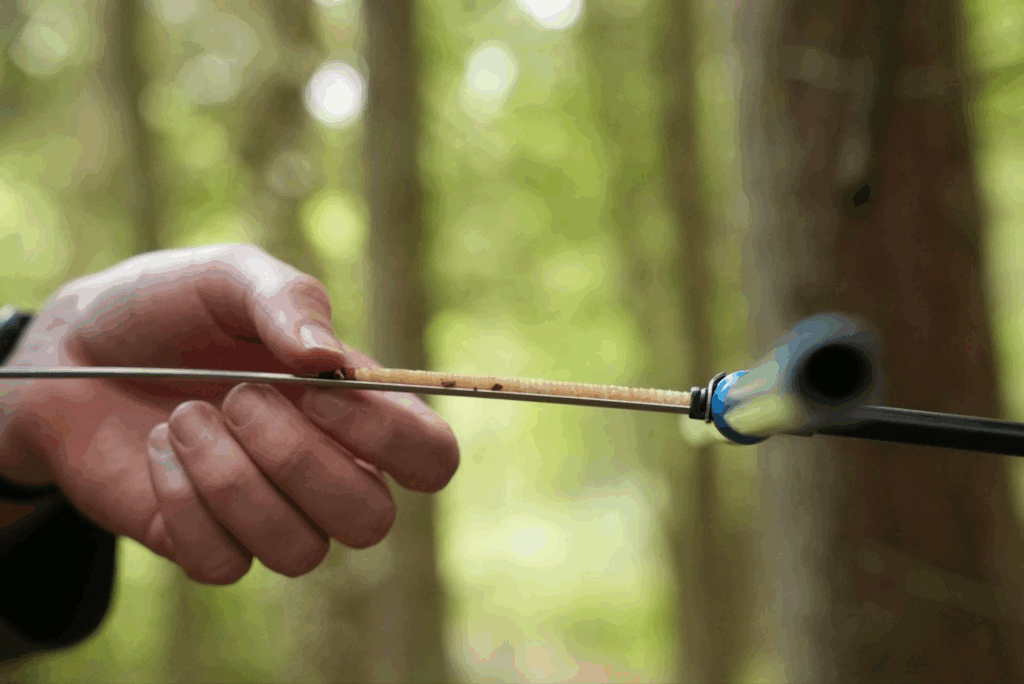
Loheide’s team, however, is looking beyond daily data. “We’re really hoping to leverage long-term data sets, and that’s coming from the trees themselves. If we core the trees, we can see variability in the annual growth. When conditions are good, when you’re getting the right amount of rain, when groundwater’s at the right level, we see larger growth rings. But, we see narrow growth rings during dry years or years where groundwater is not available, or even when groundwater’s too shallow,” said Loheide. “So that gives us an opportunity to not just have the data we collect during this two-year project, but to have a record that extends over a hundred years with some of these older trees.”
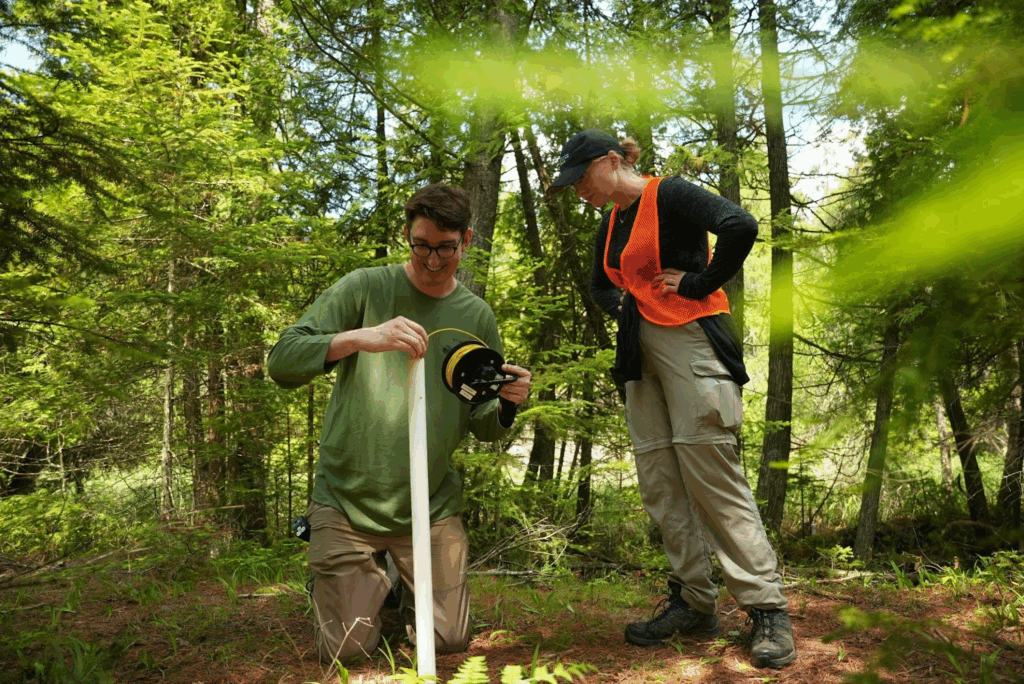
Graduate student Eric Kastelic and undergraduate researcher Lucie Carignan check in on a groundwater monitoring well that they installed at the Ridges Sanctuary, which gives them groundwater level measurements multiple times every hour. By taking tree cores of red and white pine trees, the research team can analyze tree growth patterns going back almost 150 years.
The two-year project window Loheide references comes from funding through the Aquatic Science Center’s Water Resources Institute. Additional work was done by Joe Binzley (Hilldale Undergraduate Researcher 2025, UW-Madison) and collaborators from the Ridges Sanctuary, UW-Platteville TREES Lab, and the Wisconsin Department of Natural Resources.
Loheide said that the findings his team develops could be used to better understand how extreme changes in water levels impact groundwater and flora not only at the Ridges but also for other areas throughout the Great Lakes.
“We’re hopeful that we can use remote sensing tools to try to compare other sites, and if satellite data can show us how transpiration or water use might be changing,” Loheide said. “There are new satellites out there that are at fine scale that we might actually be able to see and map out the spatial variability within ridge and swale wetlands, and then also compare among them what the response is.
“We’re excited about what the future holds.”
Nature Notes: Helping Wisconsin Bats
By Anna Foster, Program Director
Imagine walking down a boardwalk by the light of the moon, feeling the cool breeze from Lake Michigan through the boreal forest, and hearing the distant call of a Barred owl marking its territory.
Sanctuary Night Hikes are a popular program because they are completely immersive and require participants to engage with all their senses.
Our initial connection with the forest is through our senses. Smells, sounds, and textures are all incorporated into our sense of place. In fact, there is no better way to understand the forest than to observe it.
Whether you’re participating in a Night Hike, a Sanctuary Guided Hike, a workshop, or simply taking a solitary walk on the trails, experiencing the Sanctuary is, by nature, sensorial. You are more likely to remember how to identify a white pine tree if you can see the tree, feel the bark, and count the bunches of pine needles. Programs also allow Ridges staff to teach people about organisms that they wouldn’t be likely to learn on their own.
Perhaps the most controversial portion of our Night Hikes is when we observe bats swooping over the swales. Participants often murmur or cringe in disgust. I understand their reaction. Bats have a strong connotation with disease – particularly rabies. However, bats play a critical role in our ecosystems. They eat flying insects, like mosquitoes and other agricultural and woodland pests. They are also responsible for reducing diseases such as West Nile Virus (1) and help Wisconsin farmers produce about 500-700 million dollars in crops every year through pest prevention (2).
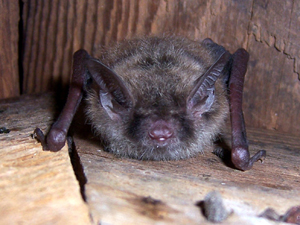
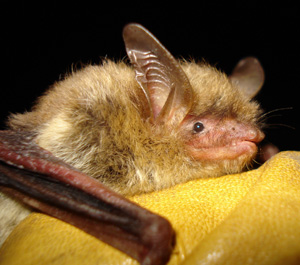
Pictured Left to Right: big brown bat, little brown bat, northern long-eared bat
Wisconsin is home to eight species of bats: Cave bats include the big brown bat, the little brown bat, the northern long-eared bat, and the tricolored bat. These bats spend winters hibernating in cave sites called hibernacula. Tree bats include the silver-haired bat, the eastern red bat, the hoary bat, and the evening bat. These bats spend their summers in Wisconsin, migrating south in the winter months (3).
The Ridges hosts bat programs and workshops to spread awareness of Wisconsin bat species and White Nose Syndrome. The acquisition of an acoustic monitor in 2023 allowed us to conduct bat surveys during the 2024 summer season. On the evening of June 18th, Ridges staff unexpectedly captured twelve recordings of the northern long-eared bat in the Sanctuary!
Unfortunately, the northern long-eared bat is rarely recorded in the state of Wisconsin and is federally endangered and listed as “threatened” in the state (4). Northern long-eared bat populations have been severely impacted by white-nose syndrome, a fungal disease that has spread across the eastern and central United States over the past 17 years. In some locations, hibernacula have lost up to 95% of their populations (5). In Door County, white-nose syndrome has killed over 90% of cave bats. Horseshoe Bay Cave bat populations dropped from 1,100 bats in 2015 to 24 bats in 2019. Luckily, some populations have survived (6).
While humans cannot catch white-nose syndrome, they can spread it. Thoroughly decontaminating clothing or material worn in a cave can help prevent disease from spreading between cave environments. In fact, decontamination is required for any person entering or exiting caves in Wisconsin to help prevent the spread of the disease.
There are additional ways to help Wisconsin’s bats. The Ridges holds several programs in October to bring awareness to Wisconsin bat species, including a Bat House Workshop. Bat houses can be important summer roost sites and provide shelter for bats in our area. During the workshop, Ridges staff provide materials and instructions to build a bat house. Participants also receive instructions for installing and maintaining their bat houses. If you can’t make the Bat House Workshop, the Wisconsin DNR has detailed instructions for building bat houses.
Protecting habitat is another critical component to helping to restore bat populations in Wisconsin. Bats rely on healthy wetlands and forests for food and shelter throughout the summer months. Ensuring that bats have access to these resources will help populations recover from white-nose syndrome (4). The 1,700 acres of the Sanctuary provides both wooded habitat for bat roosts and wetlands for hunting grounds. Other protected places in the county also provide critical habitat for bat populations.
Lastly, education about Wisconsin’s bat species is paramount to their recovery. We share information about bats on Night Hikes and in other programs to dispel prevalent misconceptions about them, and to teach people how important they are to ecosystems like the boreal forest. At the very least, we hope people smile rather than cringe when they see bats flying above them in the night sky!
Bat Facts 1. Bats can live a long time for their size. The oldest recorded bat in Wisconsin was at least 32 years old! 2, Bats are the only mammals that have adapted to true flight. 3. Insectivorous bats use clicks to echolocate. Their clicks are ultrasonic, meaning they are outside the range of human hearing. 4. A single little brown bat can eat 1,000 mosquito-sized insects in an hour. 5. Northern long-eared bats are especially good at hunting moths! Moths have a hard time hearing the high-frequency calls that northern long-eared bats produce.
Photo Credits: big brown bat, Dave Redell via eekwi.org; little brown bat, WDNR Staff via apps.dnr.wi.gov; northern long-eared bat, Dave Redell via eekwi.org.
Wisconsin Department of Natural Resources. “Echolocator.” Echolocator, May 2023. chrome-extension://efaidnbmnnnibpcajpcglclefindmkaj/https://wiatri.net/inventory/bats/news/pdf/2023MayEcholocator.pdf.
Want to learn more about bats from the Americas? Come join University of Dubuque professor Dr. Gerald Zuercher as he offers an informative program about bats that will inspire you to think more fondly of them! Suitable for ages 12 & up.
Let’s chat about Wisconsin bats! Join Ridges staff on a hike through the Sanctuary, stopping to learn about the unique adaptations and life cycle of bats. Stop along the way to capture bats on an acoustic monitor. Suitable for ages 14 & up.
Location: Cook-Albert Fuller Nature Center
Fee: Public $15 | Member $12 | 16 & under $7
Nature Notes: Do not go Gentle into that Climate Crisis
By Tony Kiszonas, Director of Research
Sad to admit, but I was never much into poetry, with a few exceptions. One of these exceptions is “Do not go gentle into that good night” by Dylan Thomas. As with growing older, we must “rage, rage against the dying of the light” regarding our changing climate. To simply shrug our shoulders and grab the nearest recliner is not raging against death or climate change.
Buying time for ourselves and our climate requires purposeful actions. Actions that may require immense energy, but rage often does. Little things, big things, and everything in between may end up making a huge difference as we try to buy more time for ourselves and the world around us.
Our environment deserves all the rage that we can muster. We can’t be absolutely certain that putting up solar panels will be enough to prevent additional sea level rise. But it might. We can’t be sure that walking more and driving less will keep polar bears around long enough for them to adapt. But it might.
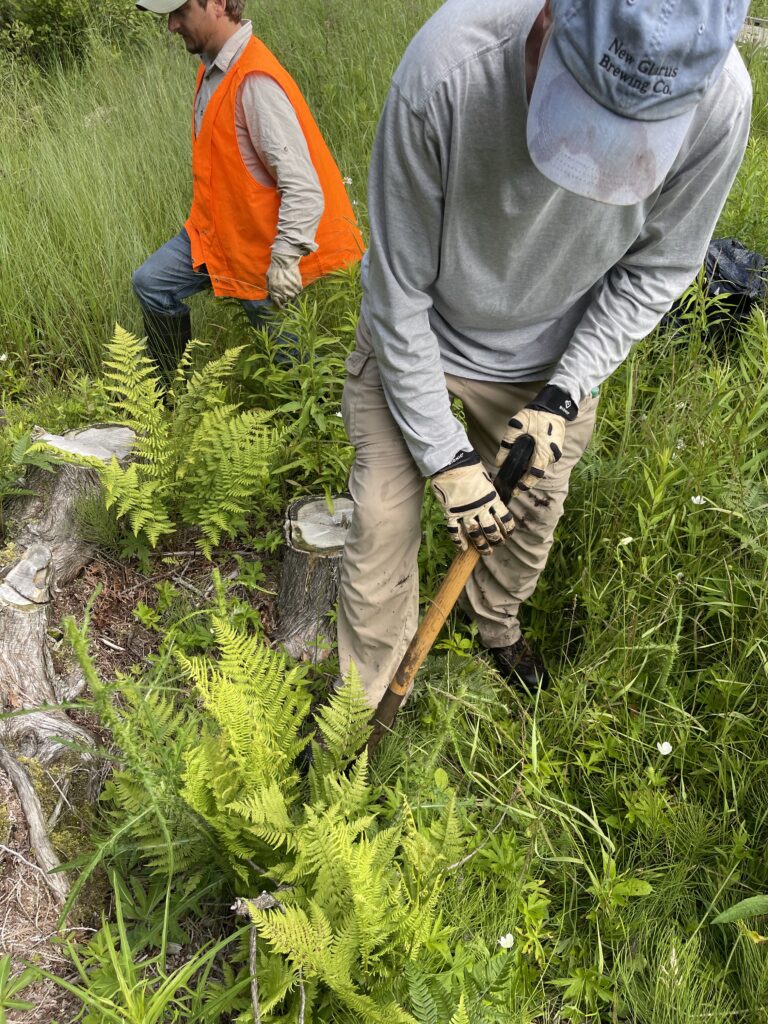
Ridges volunteers remove invasive plants—species that thrive under climate change conditions that favor rapid spread and growth, disrupting native ecosystems.
Planting Rage: Fighting Climate Change One Tree at a Time
Planting trees is hard work and expensive but has a tremendous potential to have an impact on the increasing carbon dioxide in the atmosphere. But are some tree species more efficient than others? Are all ecosystems conducive to reforestation or afforestation?
The Boreal and Temperate Mesic Forest Climate Survivability Project, led by the Climate Change Coalition of Door County, is attempting to provide clarity on these and additional questions:
How will our forests change when the climate changes?
Which trees will “win” …and which will not?
Will the boreal lower boundary move north?
What will be the larger environmental impact?
The Door County Experiment
“This project will take advantage of the ecology and environmental research culture in Door County to pilot a study on the survivability of trees over time. Five half-acre test plots are planted on land owned and conserved by The Ridges Sanctuary, each with a respective control group. These sites were chosen to represent different ecosystems found in the Door Peninsula. The study will utilize genetically unique tree varieties including conifers, and deciduous trees. At each planting site, soil conditions, tree survivorship and growth, and flora and fauna ecosystem biodiversity data will be collected.” —Jeff Lutsey, Executive Director, Climate Change Coalition of Door County (CCCDC)
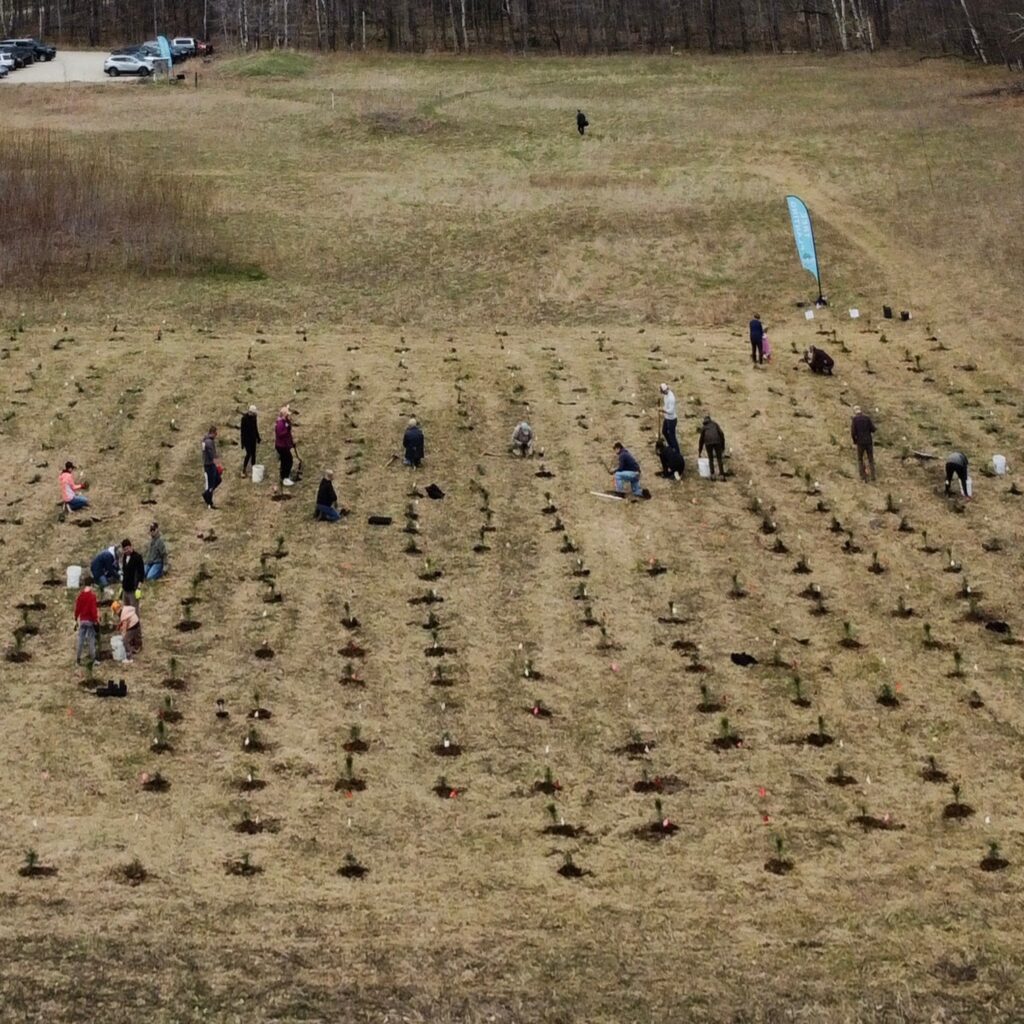
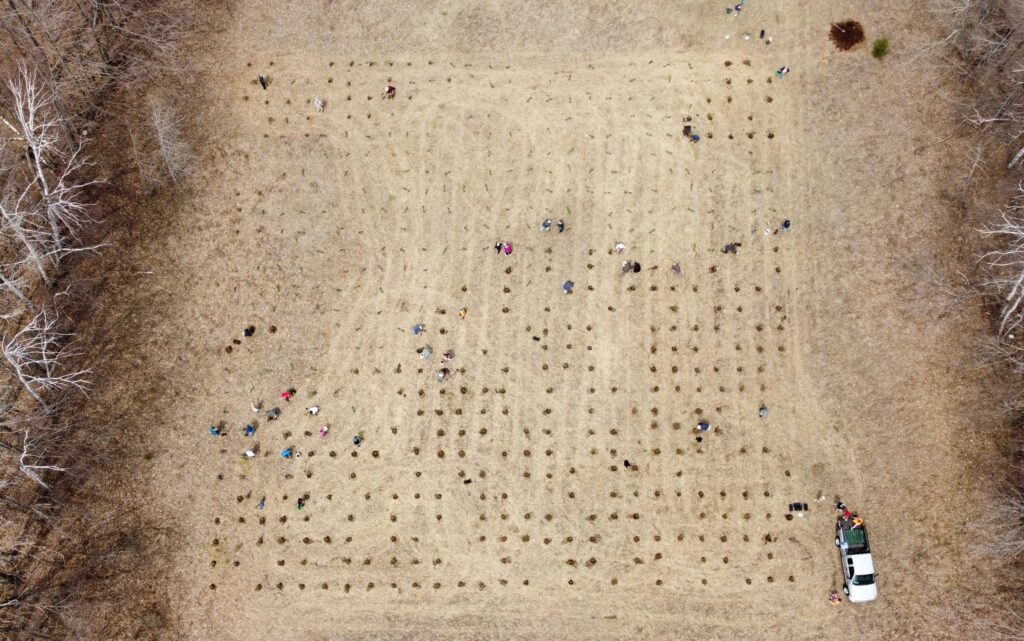
Over 35 volunteers joined us in April to plant over 600 trees within this temperate mesic plot site.
The project will provide answers to make the planting of trees as effective and efficient as possible so that we can be more certain of the overall outcomes. This project is definitely an example of not “going gentle into that good night.”
Through their sweat and blisters, numerous volunteers are raging against climate change. Volunteers who fully realize that the results of these efforts may not be known before their own “good night.” This project represents a unified effort to gain the necessary knowledge to confidently rage against climate change.
Clean-up at The Ridges following recent storm damage—highlighting the rising potential for increased storm intensity.
No Guarantees—Only Responsibility
The Boreal and Temperate Mesic Forest Survivability Project represents only one attempt when there are countless things that we can all do now that may slow down this crazy fast change in our climate. None of these efforts come with a guarantee, but collectively a difference can be made.
Doing nothing is oppositional to the moral obligation of trying something. Doing nothing is simply going gentle when our natural world is counting on us to rage.
Nature Notes: Fall into the Rhythm of Learning
By Libby Humphries, Environmental Educator
Summer is beginning to bow its head. All around us at The Ridges, signs of Autumn are near. Tufts of bergamot and Joe-pye-weed reach up to the sky to offer the last sips of nectar to pollinators. Evenings approach ever-sooner, tinged with a crisp coolness. The Sanctuary is quieter, too; having paired up, built their nests, and watched their offspring fledge, the birds have little to say nowadays. Soon though, that lull will be replaced with the delighted squeals of children arriving for another season of nature-based early childhood education. As nature begins to wind down, we are ramping up for the school year.
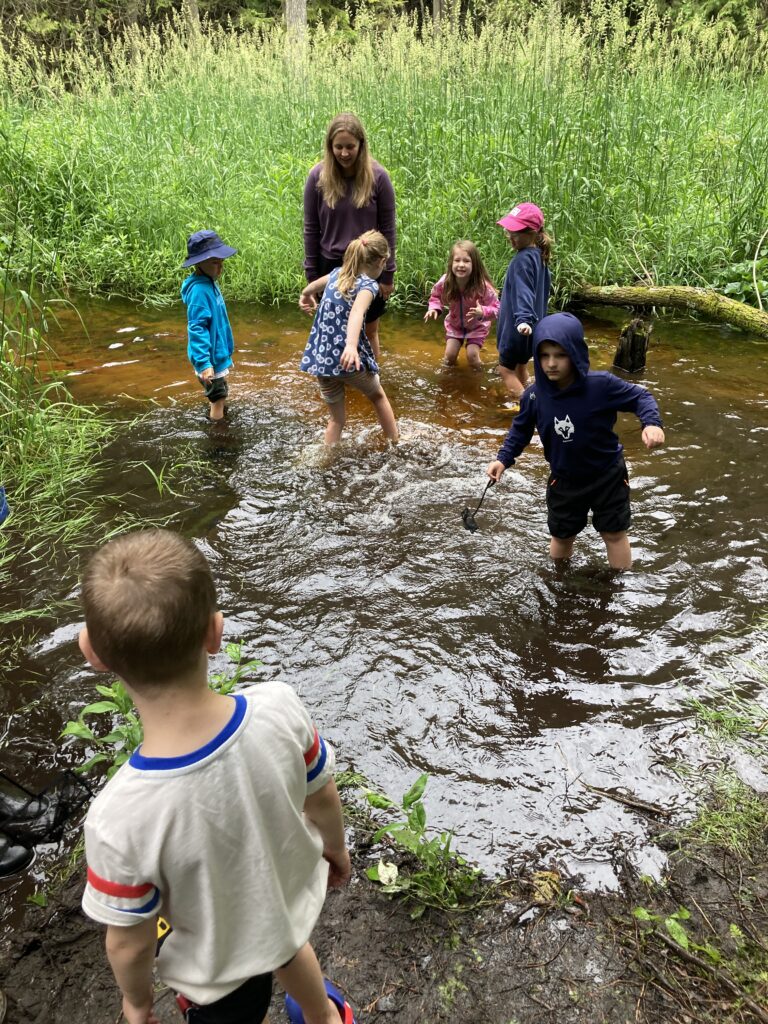
Campers in Critters Club explore the Yellow Trail Stream on the Family Discovery Trail
This time of year is one of my favorites because the Sanctuary will once again become a home for children whose families welcome Ridges Educators and the forest as their teachers. As the Dragonfly Nature 4K teacher, I have spent the past weeks excitedly planning out our year in preschool: Where will we go? What will we create? What will we sing? What will we investigate? Of course, sometimes plans are just that. In a nature-based setting, there are endless opportunities for learning. I can recall an instance from late last school year when I was set on teaching a unit about pollinators. I had laid out a sequence of lessons, meticulously prepared materials, created games, and even written a script for myself. Alas, as soon as my students began entering the gate to the preschool yard, they saw water. And mud. And worms. Without hesitation, they began digging an impressively large hole, which they promptly filled with just enough water that they faced little resistance when sliding into it. The worms, gingerly plucked from beneath stumps and excavated from the dirt, were given swimming lessons (these swimming lessons were cut short, for the record). Needless to say, we instead learned about water, and mud, and worms. Mud baths were taken by all, and worm homes were constructed. At the end of the day, they learned more from our mud and water exploration than they ever would have from my pollinator lessons—not because they wouldn’t have enjoyed it—but because the muck had already captivated their attention.
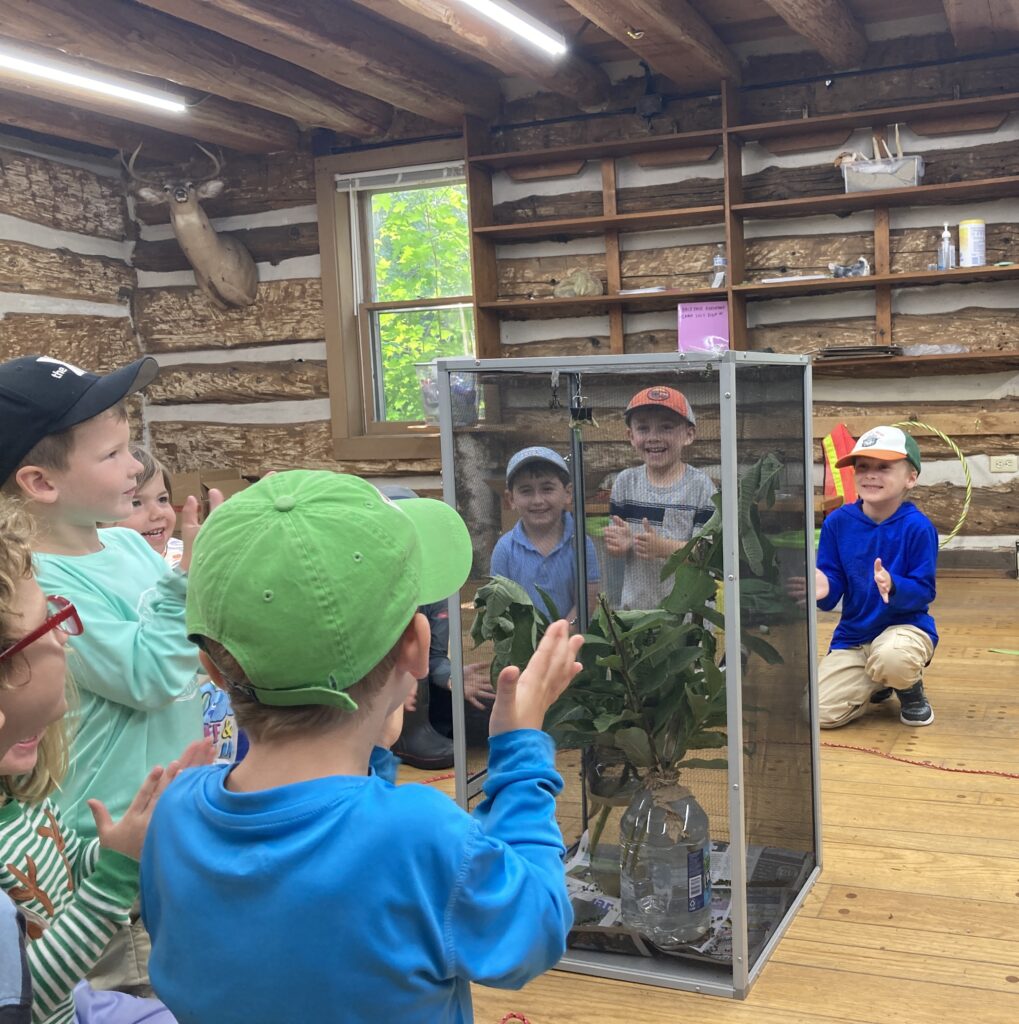
Children in Backpack Adventure Camp celebrate a monarch butterfly emerging from its chrysalis
Leaning into the seasonal offerings of the natural world is a part of all educational programming we do at The Ridges and with our partners. In Dragonfly Nature Preschool, Tiny Trekkers, Forest School, and Forest Days, children witness their environment in all of its phases: the golden light of autumn, the stillness of winter, the thawing squishiness of spring, and the gentle embrace of warmth in early summer. During Backpack Adventure Camp, children experience the Sanctuary and the Family Discovery Trail for one week at a time during the summer through hikes, inquiry-based science activities, and friendship. It is the experiences these children have that build a personal relationship with nature. Forests, meadows, and bluffs quickly become cherished friends who make them laugh, hold their hands, and teach them important lessons about what it means to be a human on this planet.
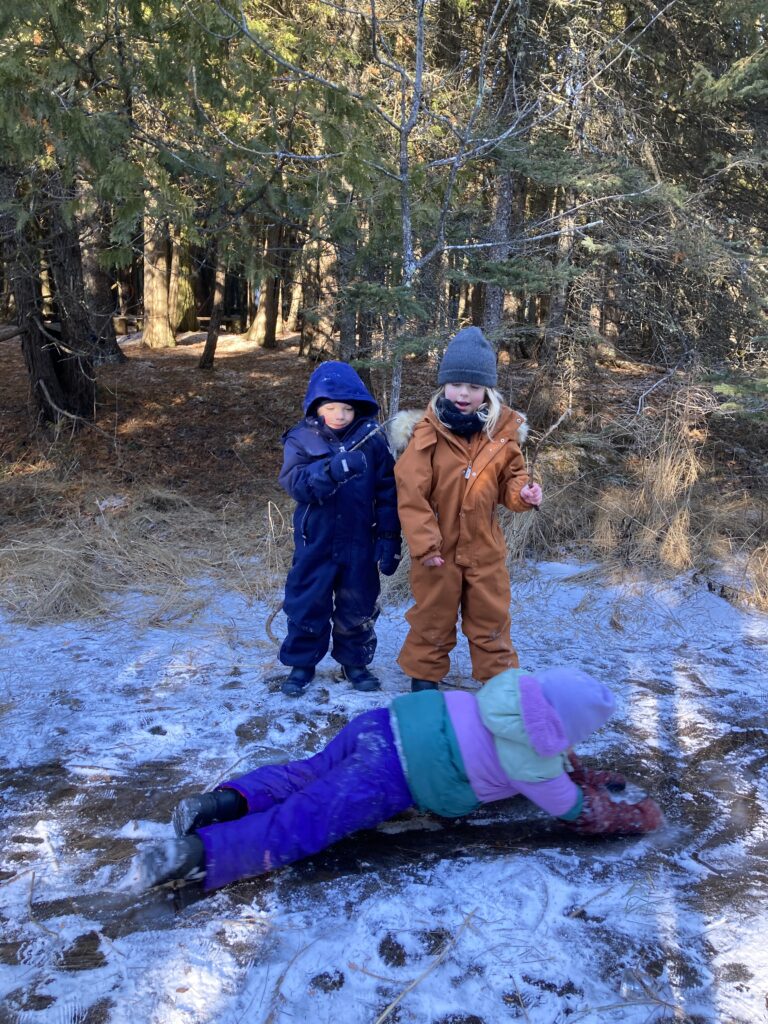
Dragonfly 4K students investigate ice by seeing how far they can slide on their stomachs
How thankful I am to be a creature who doesn’t migrate or hibernate as this season approaches. The magic is just beginning.
These moments, and the programs, would not be possible without our community members and partners who value curiosity, care of the environment, and the lifelong bond between children and the natural world- principles at the heart of nature-based early childhood education. If you would like to learn more about The Ridges’ commitment to creating deep, personal connections through our year-round education programs, we invite you to visit our Education page. We’d love for you to be part of the journey.
Nature Notes: In Pursuit of Understanding—Collaborative Research at The Ridges Sanctuary
By Tony Kiszonas, Director of Research
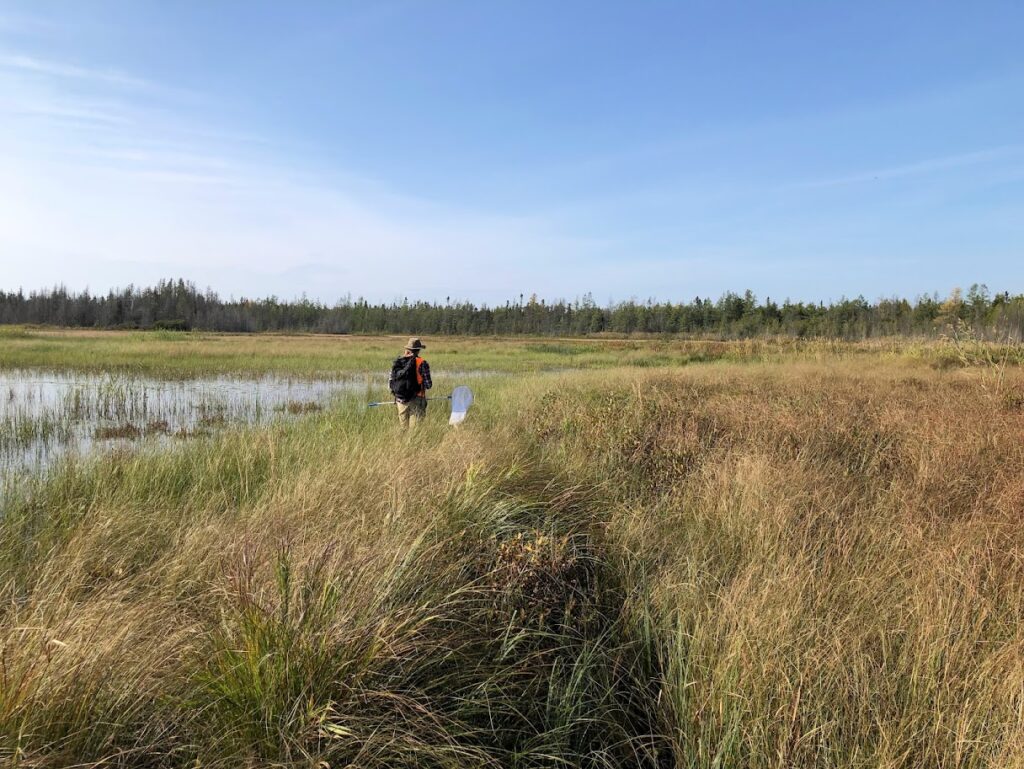
JD Arnston, Odonate Researcher at Pickerel Pond
“The ever-changing plant and animal populations of The Ridges make it mandatory for us to learn more about what exists within The Ridges,what factors cause changes in numbers of rare species, and how to maintain desirable vegetation and animal numbers in all Ridges habitats.” —Roy Lukes, 1988.
These words spoken over 35 years ago by legendary naturalist Roy Lukes are as significant now as they were then. At The Ridges Sanctuary, we are fortunate to have several organizations and individuals who value our incredible biodiversity and assist in continuing to learn more about the organisms that comprise our varied communities through inventory and research projects. Because of this incredible diversity, we provide the environment for outside researchers to conduct projects that enhance their academic and organizational information while providing tremendous benefits for The Ridges.
Following a research permit application process, those projects receiving approval add to the knowledge base of the entire scientific community, including us. Whether these studies are directed at gathering baseline inventory data, focused on the symbiosis of species, or trying to understand the intricate relationships between groundwater and Lake Michigan, each adds to the overall picture of our environment for us and future generations.
There are several on-going inventory and research projects that are providing invaluable information regarding the communities that comprise the old “Baileys Harbor Bog” and beyond. Dr. Keir Wefferling, Assistant Professor of Biology at the UW-Green Bay, is working with undergraduate and graduate students to identify and inventory the mosses and liverworts of boreal rich fens, while another student is conducting ridge-by-ridge plant chronological surveys. Another UW-Green Bay project will examine carbon sequestration in sphagnum communities as a function of biodiversity and colony density.
Ridge and Swale Echohydrology Connections
UW Project Deployment
Dr. Steve Loheide, a professor at UW-Madison, along with PhD student Eric Kastelic and a team of undergraduates, have commenced a project on effects of Great Lake water level fluctuations on groundwater and forests in ridges and swale ecosystems. The goal of this research is to quantify the impact of changing Great Lakes water levels on coastal groundwater systems and tree growth patterns. With purposely placed monitoring wells, swale water-level gauges, and tree ring analysis, correlations may be established between lake, groundwater levels, and tree physiological responses. This study will synergistically enhance other projects taking place.
The Ant Study
Postdoctoral Researcher Grant Doering from Arizona State University can be found crawling around on all fours, seeking ant colonies for his work on emergent evolution in ants. While collecting ants for his evolutionary behavioral study, Grant identified two ant species, typically only found in Canada. This suggests that The Ridges and surrounding habitat may function as a southern refugia for these two species.
Moths, Dragonflies and Damselflies
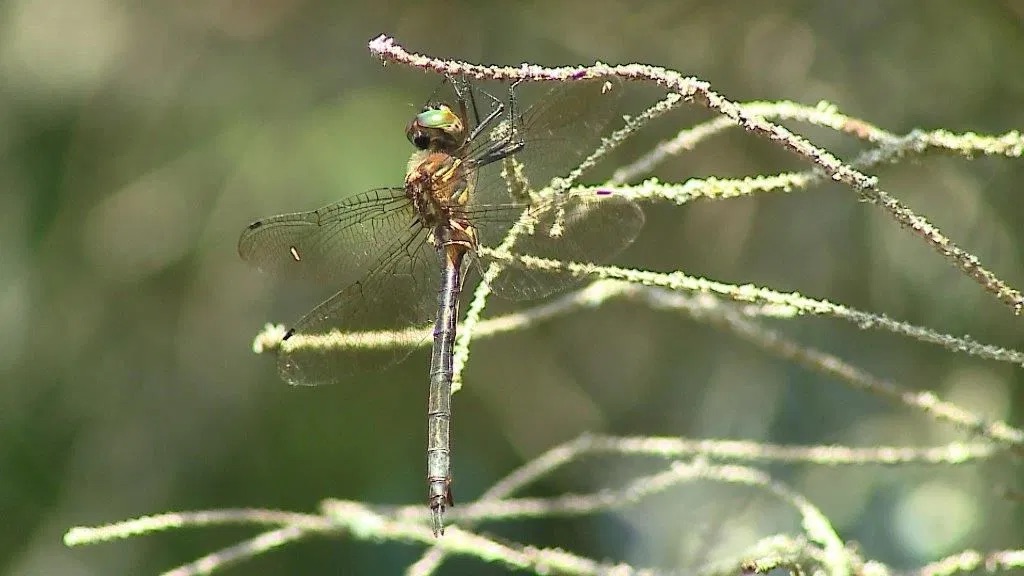
In addition to university-based researchers, The Ridges is fortunate to have individuals assisting in insect biodiversity survey projects. Kyle Johnson is focused on conducting a moth survey with JD Arnston, concentrating on dragonflies and damselflies. Both surveys are yielding extensive species lists with numerous Door County first sightings recorded. As with our plant inventory work, animal researchers are also providing evidence of extensive biodiversity at The Ridges Sanctuary.
Predator Absence and Disease Research
As noted, several projects at The Ridges involve the incredible biodiversity that is all around us. However, one researcher selected this area because we lack a certain apex predator. Michael Menon, a University of Wisconsin-Madison PhD student, is conducting research here because we do not have documented wolf packs howling around. Michael’s work involves trying to determine the impact that wolves have on the health of the state’s deer population, particularly as the deer population’s health involves chronic wasting disease. His hypothesis includes the idea that wolf predation on diseased deer will improve the overall health of the herd. Mr. Menon selected The Ridges to document the behaviors of other carcass scavengers in the absence of wolves and absence of chronic wasting disease. Michael is careful to place his deer “carcs” and trail cameras well off trail and has posted signage explaining his project for wayward hikers.
Building Knowledge for the Future
The forementioned endeavors describe only some of the collaborative environmental research that is taking place at The Ridges. As succinctly stated by Roy Lukes in 1988 and reinforced through the adoption of the 20-year Master Plan, we must strive to learn as much as we can about this natural world of ours through purposeful research. This knowledge gained is a critical support of our organization’s mission while helping us build on previous work and provide documented information for the present and especially the future.
Nature Notes: The Power of Nature for Family Connection
By Amy Shook, Naturalist
Free Fridays Nature Activity, Photo by Amy Shook
When I think of summer, I think of all the time I get to spend outdoors. I think of the warm (or cool) breezes, enjoying the shade of a tree or umbrella, listening to the cicadas, and not having to wear shoes with laces. I also reflect on all the time I spent outside with my family growing up. Whether we were biking, playing in the backyard, canoeing, swimming, or just having a campfire, I spent many hours of my childhood outside.
Spending time in nature is very beneficial for individuals but can also be incredibly beneficial for families. Having the time to take in what is around you and purposefully engage with what you are seeing is a great bonding experience. A nature-based experience gives your family a focus on what to do if you aren’t sure how to start! Going on a family nature scavenger hunt, bingo, or having a checklist of birds to see or hear is a great starting place. It is a way for the whole family to work together towards the same goal. You can either make your own activities or simply search online for some options. My family liked to go look for bald eagles or river otters by the Wisconsin River. There is always a way to individually tailor the experience to your family’s unique interests.
Being outside in nature as a family pulls everyone out from inside where all the screens are. It allows for fresh air, stretching your legs, and the chance to imagine the fun things you may see. It also allows for skills to be cultivated. Fishing as a family is a great outdoor activity and a wonderful way to bond. I thought fishing was super fun when I was a kid because I got to cast a line AND have a cool tacklebox filled with fun, squishy lures. I even liked to have the worms race on top of my tacklebox! Sometimes I caught a fish too, but that was certainly not my priority. Now as an adult, I remember getting to spend time with my dad and playing outside and that is so special. I’m sure many of you reading this can remember the time spent with your loved ones outside in nature.
We all have different lives, but I am sure we can all look back on the fond memories of summer and time spent with our families and loved ones. I know for myself, many of those memories center around being outside. At The Ridges, I get to see many other families creating core memories of spending time with family in nature. I hope you’ll take the time to step outside with your family and create your own special moments in the natural world.
Join Us: Free Fridays at The Ridges Sanctuary
The Ridges Sanctuary offers Free Fridays through August, providing admission to the trails and educational outdoor activities for all visitors at no cost—an ideal opportunity for families and adults to explore nature together. For more information, go to https//ridgessanctuary.org/free-fridays/
Nature Notes: Research for Restoration: Protecting Native Plants at The Ridges Sanctuary
By Tony Kiszonas, Director of Research
Showy Lady’s Slipper Anatomy
Following the idea that “lack of knowledge is as big a threat as any to sensitive species,” (Brzeskiewicz, M. September 25, 2000), The Ridges Sanctuary has the current research goal of developing institutionalized processes and protocols for the preservation and protection of native plant species. Members of our research team have identified the following statements as the major components of our research focus:
Problem: Changing environmental conditions threaten the existence of native plants.
Vision: Multiple robust colonies of selected plants on Ridges property.
Mission: Outplant to create new colonies.
Goal: Identify locations likely to support outplanted colonies.
Approach: Correlate plant conditions at existing colonies with environmental conditions to identify environmental conditions that support robust colonies.
Action: Survey environmental conditions within the Ridges to identify specific locations that could support robust out planted colonies.
Mark Polczynski et al
Core Research Framework: From Vision to Action
With these statements as our guide, The Ridges Sanctuary has been working on two multifaceted research for restoration projects to better understand the best methodology for preserving and protecting our native plants, including restoration and translocation of native orchid and dwarf lake iris populations.
Orchids as a Conservation Priority
Because of our organization’s deep-rooted relationship with orchids, assistance from numerous partner organizations, and a fantastic Citizen Science cohort, it was determined that orchid research and recovery would be a priority of our endeavors. We are currently working on an orchid inventory, gathering data to understand specific environmental conditions for orchid growth and reproduction, asymbiotic germination techniques, shade house orchid growth, and determining the best possible restoration/translocation habitats in our Hidden Brook living laboratory area.
Orchids are fascinating plants that have evolved unique characteristics dependent on a multitude of factors that determine their survivorship. As some of these specific parameters are undergoing change, our hope is that the knowledge we are gaining through this project will contribute to the conservation of this marvelous group of plants.
Restoring the Dwarf Lake Iris: A Science-Based Approach
Using our research statements as a guide, the goal of the dwarf lake iris project is to determine the abiotic and biotic conditions needed for maximum flower production, seed production, and seedling recruitment of the federally threatened Iris lacustris. This work is focused on the enhancement of the population in a manipulated area and establishing populations in secondary locations for restoration/translocation of this iconic plant.
Dwarf Lake Iris Foliage
Monitoring and Habitat Selection with HOBO Data Monitors
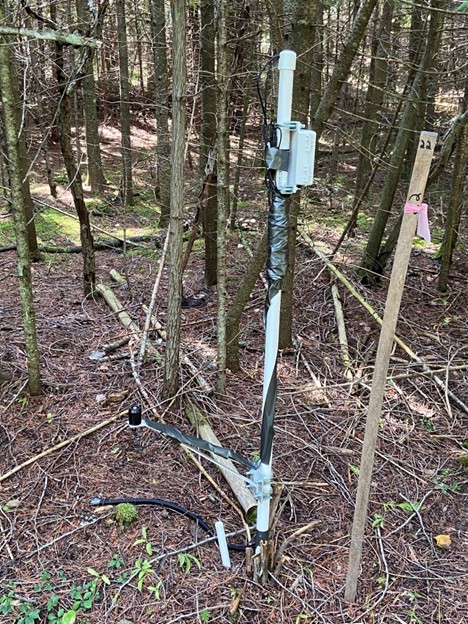
Putting our orchid project protocols to the test as a template, we initially deployed four HOBO monitors to collect data on soil moisture, soil temperature, and light PAR values in three different locations in the Range Light Corridor, and one location in the Hidden Brook boardwalk area. The Hidden Brook HOBO is set in an area of a robust extant population of dwarf lake iris and serves as a monitored control plot while the three initial HOBO deployment areas in the Range Light Corridor collected environmental baseline data before disturbance of the area occurred. A corridor plant inventory established our overall biodiversity baseline. Following corridor tree clearing as mandated by the Coast Guard, five dwarf lake iris transplant plots areas were selected based on tree canopy variance and established in October of 2024 with two additional extant plots identified giving us a total of eight dwarf lake iris research plots and one control plot. Additional HOBO monitors were deployed at the transplanted plots to go along with the current monitors. Since the primary research focus is on the light availability for the iris populations, canopy densities were recorded at each plot and will be annually recorded. Along with our other data sets, this information will help direct us in selecting feasible restoration/translocation areas of the sanctuary for the threatened dwarf lake iris.
Hobo Monitor
Both research endeavors are essentially focused on learning as much as we can about these plants to give them a chance of surviving the changes in their environment. We do not want to imagine a time when The Ridges does not have orchids or dwarf lake iris.
Images by Tony Kiszonas
To learn more about the research focus at The Ridges Sanctuary, read our Spring 2025 Sanctuary Newsletter. This edition provides an in-depth look at our current research efforts, including detailed information on our work to better understand the best methodology for preserving and protecting native plants, including restoration and translocation of ram’s head lady’s and showy lady’s slipper orchids, and dwarf lake iris projects — all currently underway.
Nature Notes: Powered by Passion—Community efforts to preserve the Boreal Forest
By Katie Krouse, Executive Director
A view of research Plot 3 from above. Over 35 volunteers joined us on Sunday, April 27th to plan over 600 trees within this plot.
When we dreamed up the Boreal Climate Survivability Project in collaboration with the Climate Change Coalition and the Lakeshore Natural Resource Partnership, we knew it was going to be a few things:
A highly impactful, inspiring and important project,
An opportunity to engage with volunteers, and
A tremendous amount of work.
While it has been all of those things, one unexpected and profoundly rewarding outcome has been the vibrant community that has formed around this important work.
The Boreal Climate Survivability (BCS) Project was established to study the adaptability of trees and other species in boreal and temperate forests throughout Door County in the face of climate change. We aim to accelerate the success of reforestation in Door County by planting trees and monitoring the ecological diversity of the ecosystems before and after trees are planted.
108 volunteers
627 volunteer hours
11 days
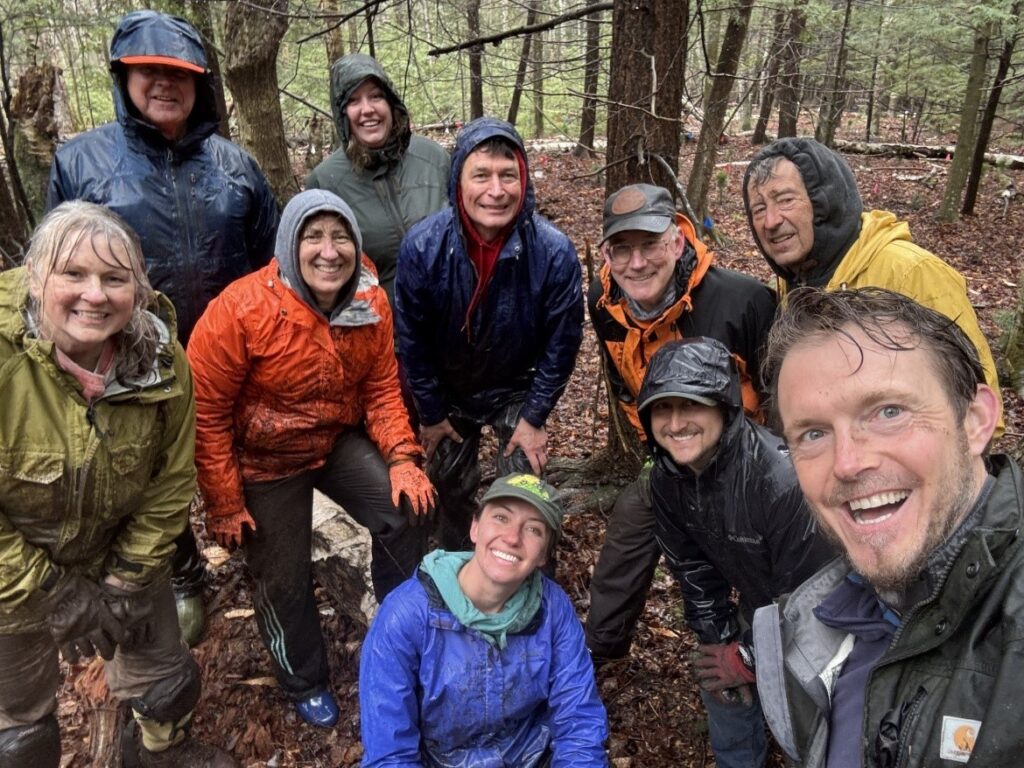
In all weather conditions…and I mean ALL
Putting this vision into action is no small task.
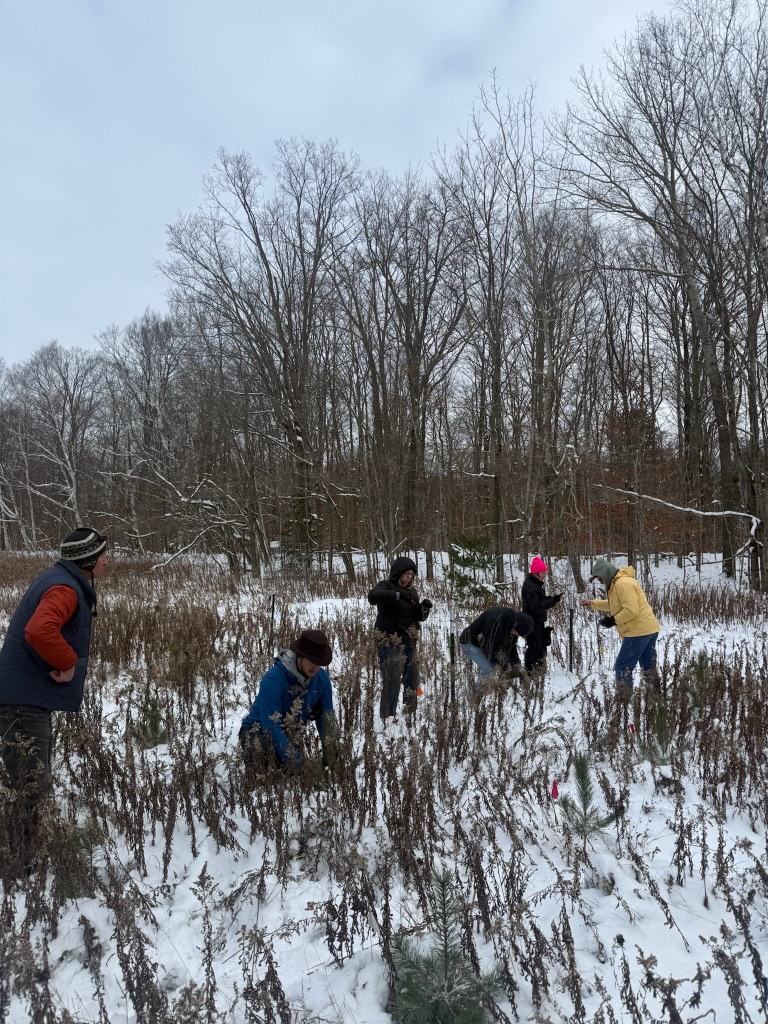
This spring, with the incredible support of our volunteer community, we completed several major milestones. We established five experimental plots and five control plots across three sites: Appel’s Bluff, the Family Discovery Trail, and Logan Creek. Once the plots were in place, the next step was planting. Over the course of three weeks, volunteers planted, mulched, and watered an impressive 2,232 two-year-old trees in the experimental plots. This effort, while ambitious, was made possible thanks to the dedication and hard work of more than 100 volunteers. They have given their time, energy, and enthusiasm to the project.
An inch of rain can’t stop us from planting 432 trees at Logan Creek. Photo by Jeff Lutsey.
Since the beginning, the Boreal Climate Survivability Project has been highly collaborative.
Together with our partners in the scientific community and our innovative volunteers, we refined, tweaked, and evolved the protocols in this project. Before the first shovel hit the ground, we gathered with volunteers—not just to share our vision, but to listen. We asked what people wanted to see, and the response was overwhelming. More than 75 individuals expressed interest in learning more, and—most importantly—getting involved. Many shared that this project felt like a rare opportunity to take meaningful action at a time when solutions to the climate crisis can feel distant or out of reach. That energy—that sense of purpose—became the spark that ignited our efforts. It has helped shape the BCS Project into a living example of what’s possible when science and community come together—building hope and resilience for generations to come.
While the work we have accomplished is significant, this has only been the beginning.
Plot stewardship, biodiversity monitoring, weather condition monitoring and more will continue throughout the year. This fall, we will plant an additional 264 five-year-old trees in the established plots. Our work throughout the rest of 2025 and beyond will lean on the support of our volunteers and citizen scientists.
A special thanks goes out to the Gibraltar Ecology Club and the Rotary Club of Door County North. They collectively planted 864 trees between two plots!
We are deeply grateful for the incredible volunteers who have supported this project thus far. Your time, energy, and dedication have made a lasting impact—not just on the work itself, but on the spirit of collaboration that fuels it. Whether you’ve shared your experiences, gotten your hands dirty, or simply shared words of encouragement, your support has been vital to our progress. The Boreal Climate Survivability Project would not be what it is today without the generosity and passion of our volunteers. Thank you for standing with us and believing in the value of this work.
An abundance of gratitude goes out to Jeff Lutsey, Tony Kiszonas, Sam Hoffman and Victoria Holderer. Thank you for your leadership, vision, and passion behind this project and all the important work you do to make our world a better place. I am inspired by each of you daily and am truly grateful to work alongside each of you to accomplish this incredible work.
To delve deeper into the Boreal Climate Survivability Project, explore the recent article by Jeff Lutsey, Executive Director of the Climate Change Coalition of Door County. It was featured in our Spring 2025 Sanctuary Newsletter. This edition offers an insightful look into the pioneering research that informs our mission and deepens our connection to the natural world.
Nature Notes: Art in Nature – Patterns, Contrasts, Cycles, and Inspiration
By Ana Hinkle, Environmental Educator
Art in nature is defined as many things. When I think about art in nature, I feel like I have to understand what nature is. Nature has symmetry and patterns, but it is also unruly and follows no direction. Nature is wild and calm. Nature is predictable and surprising. Nature is inspiring.
Nature’s Design: Order and Wildness
We find symmetry and patterns; we find predictable, repeating phenomenon and uncertainty in shapes and designs. The Fibonacci sequence appears to be a blueprint for many things in the natural world. Each element is the sum of the two elements that precede it, and it occurs in gastropod shells, pinecone bases, and an unfurling fern frond. Nature’s design is also unruly and follows no direction. Wood-boring beetles found in forests eat trees under the bark, leading to the host tree’s slow demise. However, each design left in the wake of the beetle’s destruction is unique.
Nature is wild – it is not tamed or domesticated. Forests grow without cultivation; animals survive by any means necessary. Northern white cedar trees will produce up to nine liters of cones annually, which can mean upwards of two hundred thousand seeds a year.
Nature is calm – like frost creeping along the forest floor, or ice skating across a swale. Morning mist evaporating in the early sunshine to begin the day.
Nature is predictable – we find patterns in seasons, life cycles and ecosystems. We understand that the spring ephemeral flowers bloom quickly across the forest floor so that they receive sunlight before the leaves on the trees burst from their buds and shade the forest floor.
Fern Frond, David TaylorHine’s Emerald Dragonfly, David MarvinNodding Trillium, Richard Orr
Nature issurprising – dragonflies have compound eyes with up to 28,000 lenses, that allows them to view the world in a panoramic view including ultraviolet and polarized light. To compare to humans, each eyeball has one lens to focus light onto the retina.
Nature is inspiring – the ever-changing-yet-always-constant ecosystems seem to defy itself, but that is what art is. Art is inspiring, wild and calm.
Finding Art in the Natural World
Art is predictable and surprising – I find art in the depths of the forest during spring rainfall. The world is quiet, yet there is the quiet splashing of leaves and needles grabbing raindrops as they fall to the earth. Often, birds take shelter in their nests or cavities.
I find art in the different textures and color variations in moss along the trunks of the northern white cedar trees, to the lichen along the branches in the sky. Moss gathers droplets of water running down the trunks of the trees and slowly absorbs it. Moss cannot grow up, so it grows out. It spans the length of trunks, logs and parts of the forest floor. Human eyes with one lens view the shades of the rich, deep green.
Lichen growing along the branches offer a variety of colors and textures. Lichen can be a soft, pale green, or sunset orange. It can grow tight to the branch like a crustose lichen, or in a sporadic pattern of the fruticose lichen.
Celebrating Nature Through Art
Nature is wild and calm, predictable and surprising. Nature is inspiring. To celebrate Earth Week, homeschool students will be sharing their nature-based art with an art exhibit in the exhibit space at The Ridges Sanctuary between April 19th and 26th. Their art reflects how they see the beauty of nature – its patterns, unpredictability and quiet inspiration – captured through their own creative works.
Join us in celebrating Earth Week at The Ridges with a roadside clean up around The Ridges and down Ridges Road! Help us keep our surroundings clean and beautiful by making sure we properly dispose of collected garbage. This opportunity is perfect for individuals, families, or groups looking for volunteer hours and is suitable for all ages.
Fee: Free. Although this is a free volunteer event, we need an accurate count of attendees. Please register in advance here.
Join us in celebrating Earth Day with students from The Ridges Forest School at the 2nd Annual Earth Day Art Show. Various artwork created by the students will be displayed at the Cook-Albert Fuller Nature Center throughout Earth Week.
Join experts in the community at the Baileys Harbor Town Hall for a roundtable discussion on reforestation. Learn about the new Boreal & Temperate Forest Climate Survivability project on which Climate Change Coalition of Door County, Lakeshore Natural Resource Partnership, and The Ridges Sanctuary are embarking and what it means for the future of Door County’s forests.
Fee: Free. Donations appreciated!
Nature Notes: Owl Prowling
By Dan Scheiman, PhD, Staff Ornithologist/Visitor Engagement Specialist
We’ve heard from some of our readers regarding concerns about the use of playback for calling owls. First, we want to thank our community for this feedback. We appreciate that you read our posts and blogs and care enough to contact us and express your concern. Second, we want to clarify the use of playback in calling in owls. We use playback for educational purposes during events such as our Night Hikes and Owl Prowl. We take precautions to make sure we are not negatively impacting our local birds and being respectful of their surroundings when calls are played. This includes ensuring we are not in a highly owl-populated area and that we are not near the sites of nesting owls. We also stop playing calls immediately if we hear an owl calling. Lastly, we always educate on the potential stress that playing owl calls can cause to local populations. We understand the concern with playback and the stress that it can put on owls and other birds. We believe playback should be used very sparsely and rarely, and only in situationswhere it can have an educational benefit and not in the vicinity of a known nest. We understand that people do use playback and want to educate the public on how to do so ethically. We are incredibly lucky to have an ornithologist on Ridges staff who can instruct us on the safety of playback and when it is appropriate to use. If you’re unsure of whether it is appropriate to use playback, please do not use it as a tool. Instead, you can learn owl calls before you go owl prowling and see what owls you hear by chance while you’re out in the forest!
I recently read Jonathan Slaght’s Owls of the Eastern Ice, about his time in the remote Russian Far East studying the world’s largest owl, Blakiston’s Fish-Owl. It’s as much about the climate and culture of the region as the birds. As with many high-latitude owl species, breeding begins in winter. To understand fish-owl nesting needs, the author endured months of winter conditions that even many of us North Woods aficionados would find challenging. It’s a testament to the endurance of owls as well.
February is when owls are vocalizing regularly to attract mates, maintain pair bonds, and defend territories. It’s a good time to try to detect these secretive, largely nocturnal predators. While I hope you don’t have to endure subzero temperatures and deep snow to do it, you should expect to spend time out in the cold.
Playback is an effective tool that can be used during owl prowling. Playback is playing a bird’s vocalization to elicit a response. A field guide phone app may contain the calls. Imitating a bird’s call with your voice also works if you have that ability. When using playback, always make sure to do so in a way that minimizes disturbing the bird. If a species doesn’t respond after a few calls, move on to a different species. If a bird does respond, stop playing the calls immediately. When using playback, you are making a bird respond to a rival that doesn’t exist, and is not there, which elevates its stress levels. Playback should be used sparsely and rarely. It can become especially problematic in heavily birded areas and close to nests. I use playback when owl prowling and leading walks, and always educate about the stress it causes. If owl prowling on your own, do it at night and start with the smaller owls, then go up in size. Larger owls are predators of smaller owls, so playing a Great Horned Owl call first will likely keep any Eastern Screech-Owls within earshot silent. However, learning owl calls before you depart and letting wildlife present itself to you is a safe and responsible practice!
Pictured left to right: snowy owl, eastern screech owl, and barn owl
Owls can also be found during the day through persistence and luck. Snowy Owls actively hunt during daylight, so look for a white lump on a snowy field, landfast ice, beach, farm field, utility pole, or rooftop. Other owls roost during the day in a tree cavity or dense vegetative cover. Other birds can help you locate an owl. If you see crows, jays, or chickadees making a fuss around a particular spot they may be mobbing an owl or other predator. Birds of prey use the element of surprise, so when discovered, it behooves their prey to raise the alarm and get in their face, forcing them to move on. Another trick is to look for owl pellets on the ground and whitewash on the lower branches of trees, signs an owl is or was roosting above. Owls eat their prey whole, later coughing up a pellet of undigestible bones, fur, and feathers. Whitewash is excrement, which is white and liquid in owls. Lastly, look for owls by poking your head into cedars, spruces, and other densely vegetated trees. Groves of trees adjacent to clearings are good places to check. After searching many haystacks you might find the needle, a camouflaged owl resting against the trunk at eye level or above. Take a quick look, then walk away to minimize disturbance.
You can also try bringing owls to you by offering a nest box. A box about twice the size of a bluebird box is suitable for Eastern Screech-Owls and Northern Saw-whet Owls. Barred Owls nest in a significantly larger box. A Barn Owl box should have a ledge on the outside for the fledglings. Where you place the box depends on the species you hope to attract. It is important to not disturb the pair during nesting. Clean the box at the end of the season.
While there are no guarantees you’ll see an owl in the wild if you do brave the cold, I can guarantee you’ll see owls up close during The Ridges’ Owl-O-Rama. On February 28, an owl talk will be followed by an owl prowl. On March 1, activities include building a screech-owl nest box and meeting feathered friends from Open Door Bird Sanctuary in the Nature Center.
Join a Ridges Naturalist at The Ridges Nature Center to learn about owl species that call Door County home. Then, head down out on a local trail to hear them calling to one another!
Meets at the Cook-Albert Fuller Nature Center, must have vehicle to drive to Prowl location.
Fee: Public $15 | Member $12 | 16 & under $7; Pre-registration is required. Please note: At capacity; registrations no longer accepted.
Head over to The Ridges Workshop to build Eastern Screech-Owl nest boxes to take home and hang in your backyard. A Ridges staff member will provide you with all the materials you need to assemble your nest box.
Please note: The nest box building portion of the workshop will include hammering and the use of power tools in an indoor space.
Fee: Public $50 | Member $45; Pre-registration is required.
Stop by The Ridges Nature Center for a fun, family-friendly experience with live birds of prey from Open Door Bird Sanctuary! This free event offers an opportunity to see owls up close and talk with ODBS staff who will be stationed throughout the Nature Center. Ask questions, learn interesting facts about each bird, and discover the unique adaptations that make owls such remarkable creatures. Don’t miss this chance to connect with these amazing raptors!
Fee: Free. Donations appreciated!
Reconnecting with the Natural World Throughout the Winter Season
By Anna Foster Program Director
Going outside in the winter can sometimes seem like more trouble than it’s worth. When the sun sets at 4:30pm and the windchill makes it feel like 5 degrees outside, a book (or more realistically, staring at a screen) can seem much more tempting than a walk in the woods. I always find that during the deep winter months, I feel a little disconnected from the natural world. Somehow, each year the holiday rush and end of year projects overcome my usual priority of spending time outside.
It’s natural for us as humans to slow down in the wintertime. The days are shorter. The weather is colder. However, slowing down doesn’t have to mean spending less time outside. In fact, spending time outside intentionally can help rejuvenate us, reinvigorate us, and even bring us respite, especially during these long winter months. In the book Losing Eden, Lucy Jones writes: “The return of migratory birds. The constellations of the sky. The shape of an oak leaf. The stripes of a badger. There is a soothing constancy to nature. And of course the transitory nature of the seasons – the changing trees, the behaviour of birds and animals, the turning of the globe, the cycle of life in one year – can also be a reminder that time passes and things heal.”
In Jones’s book, she explores how humans have become disconnected from the natural world. Jones makes a strong argument for not only spending more time outside but incorporating nature more into our daily lives. She argues that nature is essential to our mental health and happiness. Through reading Losing Eden, along with our other Ridges Reads book club books like Braiding Sweetgrass and Finding the Mother Tree, I’ve been able to reflect on our society’s relationship with the natural world and how little we prioritize it. To lean into Jones’s prescription for us all, I want to share some ideas for how you can reconnect with nature – even when it’s cold outside!
A Note About Clothing: My mother had one of those cheesy, wooden signs in our mudroom growing up, which read: “There is no such thing as bad weather, only bad clothing.” As much as I made fun of the sign, I find myself thinking of it every time I put on my multiple layers to teach a nature program or shovel snow. Clothing is key! Wool is a great base layer. It’s warmer and safer than cotton to wear in cold temps. If I’m spending a long time outside, I wear one extra layer than I think I’ll need – I’d rather carry an extra layer than regret not bringing one. I even keep an extra pair of gloves and a hat in my car in case I decide to take a last-minute hike.
Ways to Reconnect During the Quiet Months
1. Try nature journaling
Nature journaling is a great way to connect with the world around you every day. You can start by noting the weather conditions, any animals or plants you see, or any changes you notice. I love to look back at my journal through the years to see when pelicans return from their winter habitat or when the paintbrush flowers start to bloom.
One thing that I love about these snowy months is that conditions are often ideal for identifying animal tracks. Tracks often tell a story about what an animal was doing and where it was going. It’s a fun and easy activity to pick up in your spare time.
Another activity that you can do almost anywhere is to observe birds in your neighborhood. Backyard bird feeders are a great way to identify birds. It’s also a fun way to notice the seasons changing. I still look through my grandmother’s birding journals each year to see when the indigo buntings and orioles will return to our feeder. Observing birds can be as simple as watching trees outside your window and noting what you see each day. They even make window bird feeders now, which are great for apartments! Just be sure to clean your bird feeder regularly and purchase the right type of seeds for the birds you want to attract.
Observing the conditions right outside your window can be an excellent grounding exercise to help you be present. In addition, by practicing your observation skills, you’re more likely to notice seasonal and environmental changes in your surrounding habitat when they happen. Not to mention, it’s a great way to learn about the plants and animals around your home!
2. Read a book about the natural world
Whether you’re interested in learning more about ecology, geology, animal behavior, or how trees communicate, reading is a great way to understand the natural world and connect with it on a deeper level. One of my favorite things to do when reading a good book is to take a break and digest what I’ve just read on a walk. There are even books you can put into practice while you walk! For example, The Lost Art of Reading Nature’s Signs is a great book for learning about how to observe and interpret what’s happening in your habitat. It’s a book you can easily pick up and read a chapter at a time.
We also have our annual Ridges Reads program series coming up this month! The Ridges Reads book club pick is Losing Eden: Our Fundamental Need for the Natural World and It’s Ability to Heal Body and Soul by Lucy Jones. Our first Ridges Reads program will be a book discussion. We also have two additional Ridges Reads programs this year: Mindfulness Yoga with Deb Fitzgerald and Benefits of Forest Bathing with Jane Burress. If you’d like to join us for these free programs, you can learn more information and register by clicking on the below image:
3. Join a group activity
There are so many amazing groups throughout the Door County peninsula: hiking, birding, volunteering, etc. Doing things with other people is a great way to stay motivated and get outside! Whether your goal is to meet new people, explore places you haven’t been to before, learn a new skill, find support through community, or contribute to a good cause, there are others who want to do the same thing. Great places to check out upcoming activities include your local paper’s activity calendar, local coffee shop, library announcement boards, and Facebook groups.
P.S. The Ridges is always looking for volunteers who like spending time outside!
4. Connect with Green Spaces
Connecting with nature can feel both time-consuming and inconsequential when you live in a place with minimal access to green spaces. However, as Lucy Jones indicates in Losing Eden, through various studies, scientists have learned that accessing green spaces, no matter the size, can improve our mental health and wellbeing. Even in urban areas, we can find small green spaces – a city park, a parkway, or a rooftop garden. Here are just a few ideas for spending time outside If you live in an urban area:
find a favorite bench at a local park
find a walking group to explore other parts of your town
plant native flower seeds in your yard, windowsill, or on a roof if you have access to one
visit a nearby botanical garden or arboretum – many are free to residents or students
learn to identify the trees along your street
I recognize that those of us who live in Door County are privileged to have so many protected spaces to explore. Everyone has different ways of connecting with nature. For some, access to natural spaces is incredibly difficult and takes both time and finances to maintain. The reality is there are many barriers to accessing green spaces. If you do have the time and resources, consider giving back to your community so that everyone can enjoy green spaces where you live. Here are some ideas:
volunteer in a nearby community garden
join an organization advocating for green spaces in your area
sit in on town/city board meetings to become informed about your neighborhood
These are just a few ideas that I find helpful when I feel like I need a break from spending time inside (a.k.a. watching that Netflix show or working on my computer). There are so many ways to reconnect with the natural world. The most important thing is to find something you enjoy doing outside and to take time for yourself to do it when you can. As Lucy Jones writes, “Nature picked me up by the scruff of my neck, and I rested in her teeth for a while.”
Sources:
Jones, Lucy. Losing Eden: Why our minds need the wild. Penguin UK, 2020.
Looking Back to Move Forward
By Katie Krouse, Executive Director
Hidden Brook Boardwalk, photo by Mike Tittel
What a year it’s been.
As I sit here at the end of December, reflecting on the incredible year we’re wrapping up, it feels as though August was just three days ago. A running joke in our office is that no matter the day or month, it might as well be six months in the future. Our team is always focused on what’s next—planning the upcoming season of programming for all ages, outlining research initiatives, mapping land management activities, developing newsletters, and more. I can’t help but feel a bit guilty taking a moment to pause and reflect while everyone is deep in planning for next year. But then again, it is no secret how important it is to look back in order to move forward with confidence and strength.
This past year has truly been one for the books. Thanks to our exceptional staff, we were able to launch new accessible programs, research projects, early childhood education initiatives, land management activities, and more. Our team remains innovative, collaborative, and brilliant, consistently supporting me in my first full year as Executive Director. I can’t imagine a better group to work alongside in advancing our mission to promote positive environmental behaviors through impactful educational experiences, land management, protection, and ecological research. I could not do what I do without each and every one on our team.
Is this starting to sound like a love letter to our staff? I hope so 😉 Jokes aside, our accomplishments are a direct reflection of the hard work of our team. While not a comprehensive list, here are just a few things we’re proud of accomplishing in 2024:
Free Fridays – Thanks to a generous grant from 100+ Women Who Care Door County, we launched Free Fridays, an experience designed to provide free access to the Sanctuary and take part in themed activities hosted by our new Naturalist, Amy Shook.
Boreal and Temperate Forest Climate Survivability Project – In collaboration with our friends at the Climate Change Coalition of Door County and Lakeshore Natural Resource Partnership, we have established a new research project, looking at the survivability of trees in five research plots between The Ridges Sanctuary and Logan Creek Preserves. This project will be vital to community wide reforestation and tree planting efforts. The data collected from this study will inform future efforts as our forests continue to change at the hand of climate change.
Dragonfly Nature Preschool – In partnership with the Gibraltar Public School District, we launched an entirely nature-based public preschool for students in Door County. This program was especially important to us in our efforts to provide more accessible and affordable programming for our community.
12 Acre Land Acquisition – Earlier this year, we added 12 acres to the Sanctuary with a primary goal to safeguard groundwater quality and habitats for the Hines emerald dragonfly and migratory birds. This acquisition puts our total area protected to over 1,700 acres.
RidgesSanctuary.org – Our website got a much-needed facelift. We worked closely with Digital Pollen Collective to design a site that was easy to navigate, visually stunning, and presented our mission front and center. This new site has already done wonders for our digital engagement and online presence.
Research Partnerships – In 2024 we issued 11 research permits in collaboration with seven organizations worldwide. New efforts like a peatland bee study and four-toed salamander survey, and continued efforts like ant studies, orchid and fungi research and more have advanced our understanding of the boreal forest, as well as furthering the scientific community’s knowledgebase.
Staff and Board Growth – An important focus this year was growth and development of our staff and board. We added new positions to support Dragonfly Nature Preschool, and a Naturalist position to support our public engagement at the Nature Center. We also added three new members to our board of directors, that met the areas of need identified by our governance committee. This brings our robust and diverse board to 15 directors.
Master Plan Implementation – It has been a busy year of implementing our 20-year vision. Our Master Plan, approved in 2023 provided an important framework for growth and development in our core mission areas of Preservation, Education and Research. To further deliver on our vision, we have engaged with SmithGroup and The Boldt Company to develop predesign and preconstruction resources for facilities to be included in future capital fundraising initiatives such as a Research Station and Education Station. In addition, we are deep into the development of Phase 0 projects that will have the biggest impact in the shortest time. Phase 0 projects include upgrades to the Kaye and Marshall Cabins to offer year-round programming, reuse of the bathroom facility to offer year-round use while also connecting to municipal sewer and building a new workshop to meet our growing needs for land/property management and programs.
While this is only a snapshot of our year, this demonstrates the robust work of our organization. Our dedicated staff and board strive to ensure that each of our core mission areas thrive collectively and independently. I am deeply grateful for everything we have achieved and all that lies ahead. Together with our community, we will continue to fulfill our vision of inspiring the conservation of Nature, ensuring that future generations can experience and appreciate the Sanctuary as we do today.
I look forward to continuing my service with The Ridges and contributing to our future growth. Your role as a champion and ambassador for The Ridges has been invaluable, and we deeply appreciate your support through all our transitions and progress. On behalf of all of us, thank you.
Onward together in conservation,
Katie Krouse, Executive Director
Let’s Connect
Stay up to date on our four-season stories, sightings, events, and experiences.