
Nature Notes: Lessons from the Forest
By Ana Hinkle, Environmental Educator
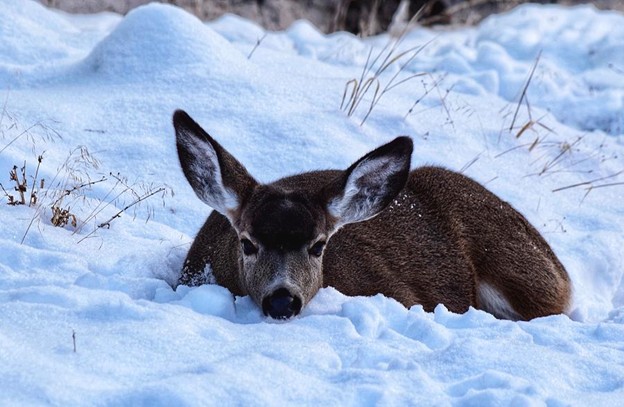
The forest teaches us many things; we just need to know where to look and how to listen. The winter season brings the lesson of life and allows us to see movement of animals in a way that no other season can. Most animals are elusive and not always seen while hiking. However, snow allows us to understand active, resident animal activity in our area through deer beds, middens, scat, and tracks.
Reading Deer Beds
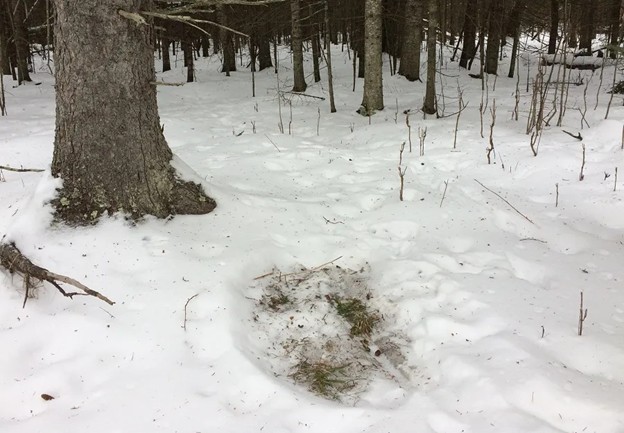
Deer beds are an easy indicator for tracking white-tailed deer in the snow. A deer bed looks exactly what it sounds like — the spot where they slept. When deer sleep on top of the snow, they leave an impression of their body when they leave their bed. When there’s not a lot of snow on the forest floor, a deer bed might melt down to the duff, allowing easy finding! If the snow is heavy and the imprints leave lasting impressions in the snow, limb locations and traces of the neck and head can be observed.
Keep a keen eye out for deer beds. Female deer tend to group together in the winter months. When you find one bed, the odds are pretty good that you’ll find more!
Exploring Red Squirrel Middens
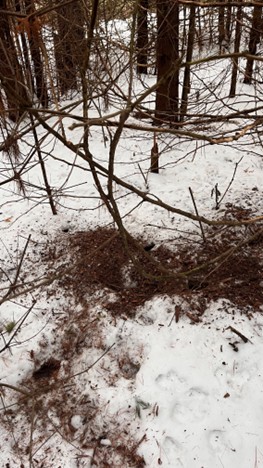
Another way of tracking animal behavior is looking for middens along the bases of trees, around logs, or along stumps. Middens are refuse piles of red squirrels – who have a different survival strategy from the gray squirrels. Gray squirrels scatter their cached food across many locations in their territory. Red squirrels create one location in the center of their territory for their winter food source. During the winter season, when food becomes scarce, red squirrels turn to an abundant food source in a conifer forest: the cones of pine, spruce, fir, and hemlock trees. However, most of the cone is inedible; the red squirrels are only after the seeds inside.
Red squirrels create middens by climbing a branch above the desired location, sift out and eat the seeds and throw out the discard – creating a midden. The accumulating pile of debris creates a storage area for their food, and they keep unopened cones buried under the discarded cone scales. Large middens can store up to 15,000 cones, which is why red squirrels are incredibly territorial. They need to defend their middens to survive the winter season.
See if you can notice any middens. They look like piles of reddish-brown debris, but hidden within are unopened cones of conifer trees in cold storage that hold the key to a red squirrel surviving the winter season.
Scat as a Storyteller
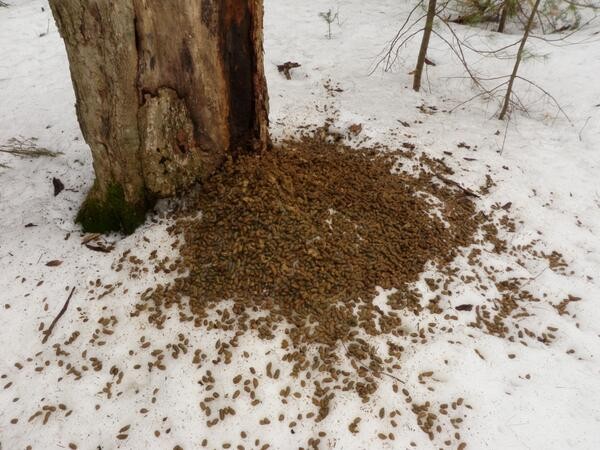
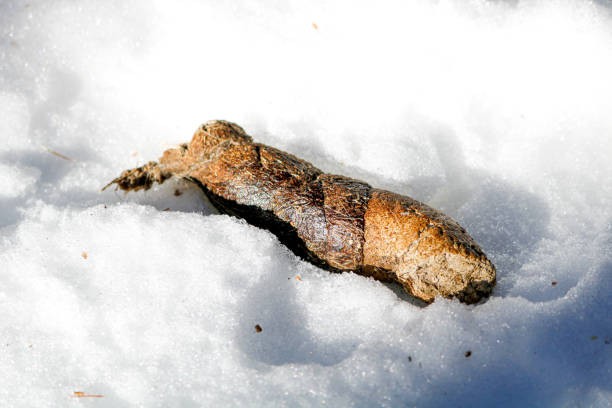
Another effective way to track which animals are active in the winter months is to identify scat. Scat (animal droppings) is relatively easy to observe on the high-contrast white backdrop of the snow. For anyone willing to look closely at animal feces in the forest, scat can tell the story of where the animal has been, what it’s been eating, and potentially which animal did the doo doo.
Scat contains remnants of what the animal ate, whether it is berries, fur, or plant fibers. If the excrement is mostly composed of berries or plant fibers, that is an indicator of an herbivore like white-tailed deer, eastern cottontail rabbit or snowshoe hare, North American porcupine, and squirrel species. Other scat contains compacted fur, bones, or feathers. This is most likely the scat of a predator from the weasel family, a North American river otter, or fisher. Finally, if the scat has a combination of plant and animal material, it could belong to an omnivorous animal. Examples include the coyote, red or gray fox, raccoon, or opossum.
Alongside the content of the scat, the shape and location of animal scat can help understand which animals are active in the winter. Due to the high fiber in the plants that herbivores consume, their specialized digestive systems absorb as much moisture as they can and create uniform pellets.
Territorial animals like fishers, coyotes, and foxes will often leave their scat on elevated surfaces to act as a scent post. Their scat is dense and full of material that they cannot digest like fur or hair, bones, or even porcupine quills! Coyote and fox species have similar looking scat; the end of has a long thin rope-like appearance. The tapered point of the scat aids in carrying the scent to communicate with other animals.
The Snow as a Record Keeper
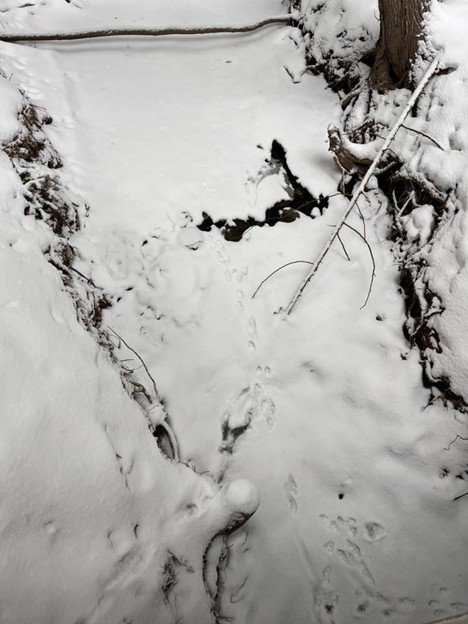
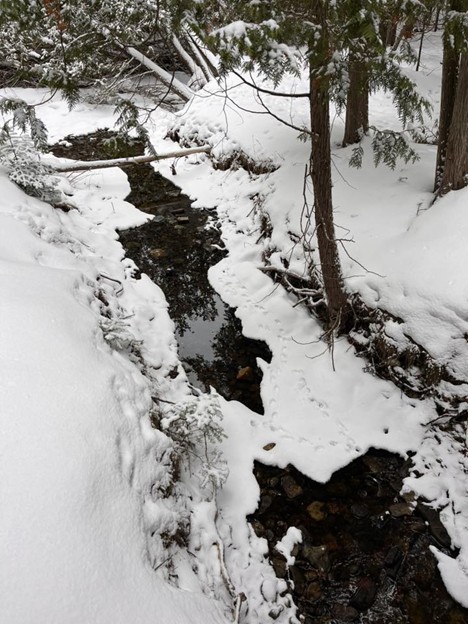
Otter tracks above Hidden Brook at the Sanctuary, 2/5/26, by Ana Hinkle
Animal tracks left in the snow are the most enchanting way to track animals in the winter season. While deer beds show observers where white-tailed deer are resting, middens signify the center of red squirrel territory and hide a large cache of food. Scat can help determine if an animal is an herbivore, omnivore, or predator based on contents, shape, and location. Animal tracks tell a story of where an animal was going and where it came from.
Wildlife tracks allow animal gait and movement to be observed, even without the presence of the animal. Deer and coyotes are diagonal walkers in the forest; their tracks are left in a straight line of alternating prints. Squirrels and rabbits are hoppers; they will leave a distinct pattern that is repeated throughout their path. Otter tracks show exploratory and play behavior in the snow, often leaving belly slides and bounding tracks. Raccoons, skunks, and porcupines are waddlers of the forest; their prints are left in a side-to-side, four-print gait.
It is difficult to find wild animals outside. The groundcover of snow allows us to find evidence of animals in our area through deer beds, middens, scat, and tracks. Through tracks and signs in the snow, the forest reveals its winter lessons.